
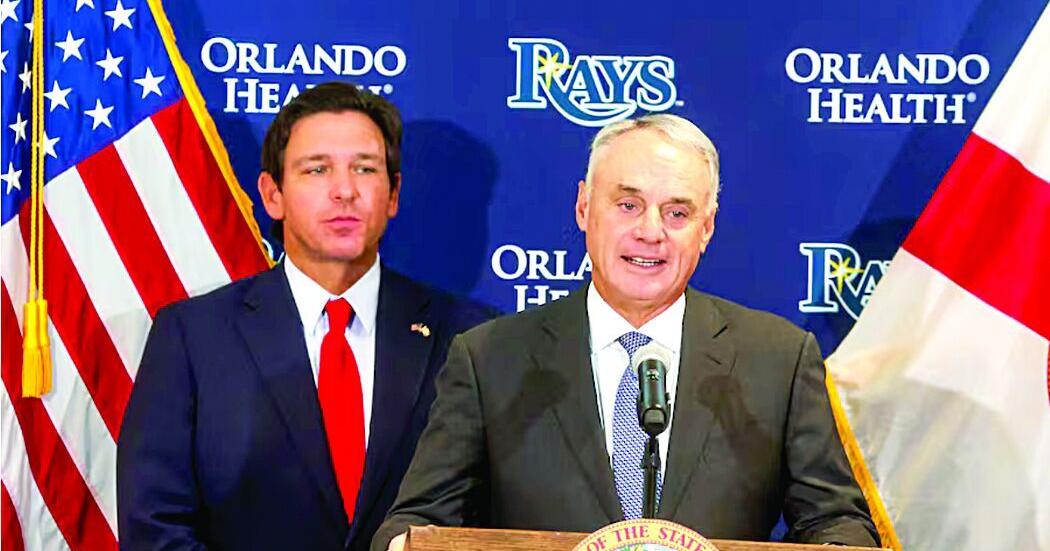
The Tampa Bay Rays made a splash this week in its quest to build a new stadium in Tampa. The governor came to town, as did the head of Major League Baseball, while Hillsborough County officials talked money and the Rays teased new drawings of the mixed-use stadium development.
It was a sandspur-free media blitz, fueled with a gust of urgency, and while we’ll see if the Rays can pull this off, the positive energy was great. But the events still reinforced three nagging questions that deserve more serious attention. Let’s break them down.
The governor’s influence. It was no small thing for Gov. Ron DeSantis to hold a news conference Feb. 3 to declare his support for the project. “Baseball belongs in Tampa Bay,” DeSantis said, leaning on the nostalgia of Tampa baseball greats to declare the game was “in the DNA of this area.”
Some quickly interpreted the governor’s endorsement as a sign he would deliver taxpayer subsidies to the project and political cover for Republican officeholders who may be called upon to approve subsidies for team owners. But despite supporting plans to rebuild Hillsborough College as it makes room for the Rays’ project, the governor arrived with no check, no plan and no promises to plug what could be a billion-dollar gap on stadium construction.
As for protecting down-ballot Republicans, DeSantis doesn’t have a history of farming other people’s fields. What influence a termed-out governor has in this year’s election cycle is also debatable, given how tax cuts and Florida’s affordability crisis have taken hold of the electorate. Voters worried about insurance and electricity costs don’t seem pliable to arguments about handouts to millionaires. There’s a real danger here in misreading the voters’ mood, because the deal hinges on several big public incentives falling into place.
Costs to taxpayers. Hillsborough commissioners unanimously approved a motion Wednesday to further explore a deal, which was the right step at this early stage of negotiations. But nearly a dozen funding sources are on the table, reflecting the depth of public assistance that may be needed to get this multibillion-dollar project off the ground.
That’s in addition, of course, to the handover of Hillsborough College’s Dale Mabry campus, currently valued at about $112 million. But that appraisal is pegged to the property’s use as an educational facility. Converted for commercial use, the same land could be valued at four times that amount. Add to that a $50 million request from state Sen. Danny Burgess, R-Zephyrhills, to rebuild the college, and you’re nearing the half-billion dollar mark already.
Commission Chair Ken Hagan, who has long supported a Rays stadium in Tampa, stressed Wednesday that Hillsborough had “a long way to go” in examining whether a deal was viable. Those financial questions will increasingly face political headwinds as the November elections near, especially as state lawmakers debate putting a statewide property tax cut on the 2026 ballot.
Hillsborough College site. Everyone involved reiterated this week that the stadium would be a catalyst for modernizing the college and for sparking a multibillion-dollar remake of Tampa’s Drew Park neighborhood.
Here’s where the marketing has gotten too far ahead. Nobody knows what a remade college would look like, how the project would affect students or enrollment, or what a smaller footprint would mean to Hillsborough College’s future. It also overlooks a simple point: Hillsborough College doesn’t need the Rays or a new stadium to redevelop its property. If the market for housing, retail and restaurants is so strong, let the college open the bidding and oversee the project itself.
Moreover, mixed-use developments don’t carry the novelty they once did. This isn’t the 1990s; Tampa is flooded with mixed-use developments, from new, tony neighborhoods along Tampa’s Riverwalk, on Water Street and in Ybor City to more modest developments in Midtown and North Hyde Park. Plunking an isolated project at an F-rated intersection along congested Dale Mabry Highway doesn’t sound so appealing. It also threatens to disrupt a commercial warehouse district that underpins Tampa’s economy. Kudos to the Tampa Sports Authority for combing through the numbers.
I have no opinion about this deal; there’s nothing on which to base an informed view. I’ve got no idea what Rays managing partner Patrick Zalupski has in his wallet, on his mind or up his sleeve. I’m also still wading through the reaction by Tampa’s political and business leaders to separate cheerleaders from those with skin in the game.
But you don’t need to occupy one side of the street. It’s early enough to hope the Rays and this community reach a mutually beneficial deal, while also acknowledging the government purse has limits and the county has other priorities.
John Hill is a columnist for the Tampa Bay Times.