
As the 2026 college baseball season approaches, Baseball America will examine the top pitchers to watch across each major conference. This series is not limited to draft-eligible players and includes standout upperclassmen and veterans alike.
Each list is informed by a combination of data, performance and scouting feedback to whittle down the top arms to know entering the season. Throughout the series, we’ll evaluate pitchers through the lens of physical build, release traits, pitch characteristics and on-field results at the collegiate level.
We begin with the SEC, college baseball’s top conference, which is littered with future professional prospects. Narrowing the field to just 10 pitchers was a challenge given the overwhelming volume of talented options. To finalize the list, we leaned heavily on our contacts with knowledge of the conference to identify the pitchers who have the most buzz heading into the opening weekend of the 2026 season.
1. Liam Peterson, RHP, Florida
Draft Class: 2026
HT: 6-5. WT: 220.
2025 stats: 8-4, 4.28, 69.1 IP (15 starts), 96 SO, 32 BB, 1.428 WHIP
One of the top prospects in the 2026 draft, Peterson is built like a big league starter at 6-foot-5, 220 pounds. A graduate of Florida prep powerhouse Cavalry Christian, he has spent two seasons in the Gators’ rotation and is expected to be their Friday night anchor in 2026. While his command was below-average in 2025, Peterson consistently missed bats against elite competition.
Despite his physicality, Peterson isn’t the best mover on the mound. The righthander struggles to get downhill and has below-average extension, working from a higher release at his size. Like many high-release pitchers, he generates lots of induced vertical break and that trait, paired with his power, drives his fastball’s effectiveness. Even without premium angle, Peterson’s four-seamer misses bats because of its velocity and ride, a combination that defines his approach and fuels much of his success.
Peterson primarily works off his four-seam fastball, slider and changeup, with an infrequent curveball. His plus 94-96 mph four-seamer touches 99 with nearly 21 inches of IVB on average. The slider, his primary secondary, sits 84-86 mph with high spin rates in the 2,700 rpm range and short, tight shape. His below-average changeup has little vertical separation from his fastball. While it lacks late movement, it missed bats in 2025. Peterson shows fringy command of both his slider and changeup, yet produced whiff rates north of 40%, so both were effective despite not looking outstanding on paper.
Peterson shows feel for spin, power and the ability to sell his changeup, giving him a nice starter’s foundation despite a lack of refined strike-throwing.
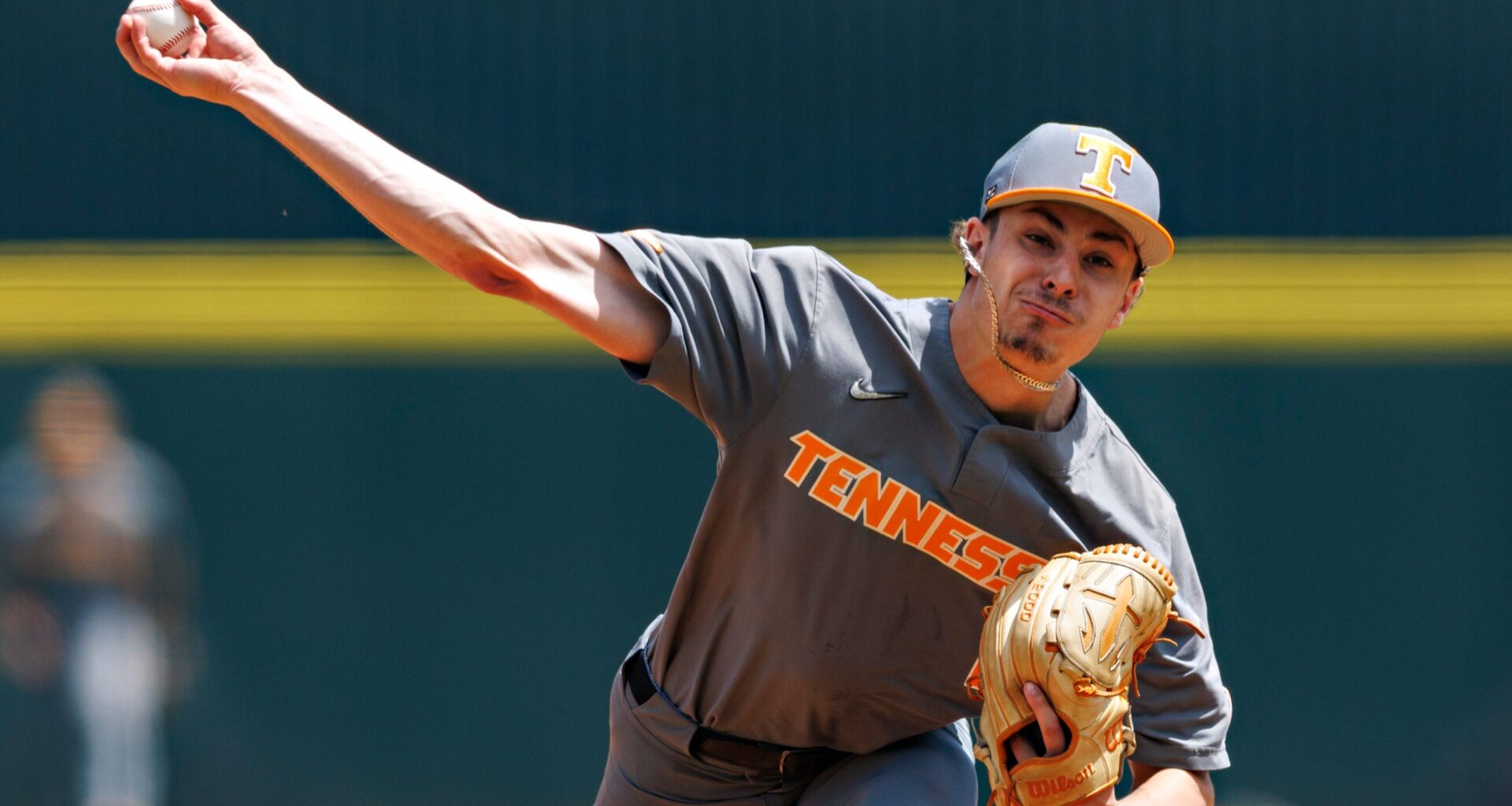
2. Tegan Kuhns, RHP, Tennessee
Draft Class: 2026
HT: 6-3. WT: 189.
2025 stats: 2-4, 5.40, 36.2 IP (10 starts), 40 SO, 16 BB, 1.609 WHIP
A Pennsylvania native and draft-eligible sophomore, Kuhns features a smooth, athletic delivery. As a freshman, he made 15 appearances for Tennessee but pitched into the fifth inning only twice. He was more impressive on the Cape Cod League with Brewster, striking out 20 batters against one walk over 13.1 innings.
Kuhns is expected to take on an expanded role in 2026 and pitching deeper into starts will be paramount for his draft stock. He throws five pitches in a four-seam fastball, cutter, slider, curveball and changeup. While his fastball command is quite good, he really struggles to land his secondaries in the zone, leading to easier takes for hitters, even on 50/50 balls. That’s one of the culprits for Kuhns’ inefficiency in starts. While he moves well and his mechanics are buttery smooth, athletic and explosive, he can spin off hard to the first-base side, which leads to poor, scattered locations.
Kuhns’ 94-95 mph fastball touches 98 with roughly 17 inches of IVB and 12 inches of armside run. His average extension and lower arm slot create a good angle on his fastball. Kuhns’ upper-70s, two-plane curveball has moderate depth and is his most-used secondary. He has better feel for his curveball than any other secondary, but it’s primarily still a chase pitch. Kuhns’ short low-80s slider has moderate horizontal break and he uses a third breaking ball, a low-90s cutter, sparingly. He also rarely finds the zone with his mid-80s changeup.
Kuhns has a lot of nice elements to his profile, including power, feel for spin and strong release traits. He’ll need to refine the command of his secondaries and usage. If he can’t make those improvements, Kuhns likely has good enough stuff for the bullpen.
3. Gabe Gaeckle, RHP, Arkansas
Draft Class: 2026
HT: 6-0. WT: 190.
2025 stats: 4-2, 4.42, 71.1 IP (9 starts), 92 SO, 31 BB, 1.318 WHIP
Drafted by the Reds in the 20th round in 2023, Gaeckle opted for Arkansas and spent his freshman year exclusively in the bullpen. In 2025, he bounced between the pen and the rotation, and he’s expected to open 2026 back in the Razorbacks’ rotation.
At 6 feet, 190 pounds, Gaeckle’s size leads to some questions about his viability as a starter, but his plus stuff and bat-missing ability provide multiple pathways to success in pro ball. In that sense, he’s not unlike former teammate and 2025 first-rounder Gage Wood. Gaeckle moves well, gets downhill and creates plus extension for his height, dropping his release height to 5-foot-4 on average. He starts his move to the plate with a semi-windup, followed by a leg lift that reaches his chest as he stands upright on his drive leg. He then explodes toward the plate, getting down the mound and creating difficult angles and tricky plane, particularly on his fastball.
Gaeckle’s fastball plane is arguably his most outlier trait. Sitting 94-96 mph and touching 99 mph, Gaeckle generates around 18 inches of IVB on average from his low release height which, combined with his higher spin efficiency, creates a flat vertical approach angle around -4.3 degrees. That’s a low enough approach angle to be effective at the top of the zone.
Gaeckle’s primary secondary is a mid-to-high-80s slider with baby-sweeper shape and six to seven inches of horizontal break. While his fastball command is fringy, he lands the slider for strikes consistently. The pitch spins at 2,600–2,700 rpm, highlighting his ability to generate both fastball efficiency and breaking-ball spin. He also mixes in a 78-80 mph curveball with heavy two-plane break that too often becomes an easy take when thrown outside the zone. His changeup misses bats but rarely finds the zone with only so-so vertical separation.
Purely on stuff, Gaeckle is arguably one of the top arms in college baseball. Whether the pitchability and strike-throwing develop remains a guessing game. While there’s a lot to like, his size and lack of refinement led many evaluators to project him as a future reliever.
4. Casan Evans, RHP, LSU
Draft Class: 2027
HT: 6-2. WT: 194.
2025 stats: 5-1, 2.05, 52.2 IP (3 starts), 71 SO, 19 BB, 1.196 WHIP
A Texas native, Evans impressed primarily out of LSU’s bullpen as a freshman and won’t be draft eligible until 2027. He could work in a hybrid role in 2026, but his long-term upside is significant after ranking among the SEC’s most impressive first-year arms. Feedback this fall and spring has been mixed, but his reputation keeps him among the league’s most intriguing follow targets.
Evans is a powerful, physical player with an average build and minimal remaining projection. He begins his operation with an aggressive rocker step, but closes his hips during that motion. Evans crouches down, drawing his knee to his chest in his leg lift and setting his hands out before break. It’s a longer arm swing that builds to a higher three-quarters release. There’s some effort in his delivery and his tempo occasionally gets sped up. At times, he finds better rhythm out of the stretch.
Evans deploys a standard three-pitch mix of four-seam fastball, slider and changeup. His 94-96 mph four-seam fastball touches 99 with 18 inches of IVB and above-average armside run. He shows traits of above-average fastball command but doesn’t generate as many whiffs as the velocity/break combination suggests, likely due to more stock release traits and plane.
While Evans’ changeup performs slightly better, he uses it nearly evenly alongside an 85-86 mph gyro slider. Evans commands the slider both in and out of the zone, driving strong strike, whiff and chase rates. The changeup has similar velocity, and he does a good job killing lift to create vertical separation, which is often a struggle for pitchers with similar release heights.
Evans may not seize a rotation spot in 2026, but he should log plenty of important innings. He could take a big step forward if he can improve his fastball command and find a bridge pitch between his heater and his secondaries.
5. Dylan Volantis, LHP, Texas
Draft Class: 2027
HT: 6-6. WT: 212.
2025 stats: 4-1, 1.94, 51 IP (1 start), 74 SO, 12 BB, 0.882 WHIP
A 6-foot-6 lefthander, Volantis creates consistently uncomfortable at-bats. He recorded 12 saves as Texas’ closer in 2025 and won’t be draft eligible until 2027, and he’s guaranteed to be one of the top players in the class because he’s unique and projectable.
Volantis uses his long levers to deliver the ball from a higher three-quarters slot, creating unusually steep angles across all of his pitches. He leans into those traits across an arsenal that includes a 90-91 mph sinker and three breaking ball shapes: a cutter, slider and curveball. Volantis’ steep angle creates the visual appearance of sink and drop that exceeds its actual movement, creating deception, and the 7.22 VAA on his sinker would be one of the steepest planes in the majors alongside Clay Holmes. Unsurprisingly, his 6-foot-8 release height would be one of the highest in baseball.
Volantis’ unusual release height benefits his trio of breaking balls. He uses a mid-to-upper-80s cutter that has similar movement to a gyro slider, a slurvy 83-86 mph slider with more depth than the average slider and a low-80s curveball with the most depth of any breaking ball in his arsenal. Volantis’ curveball is presently his best pitch, driving a 70% groundball rate in 2025 with a 49.3% whiff rate and a .126 wOBA against. It’s arguably already plus, and Volantis’ command of it only works in his favor.
Volantis also shows plus command traits—the final piece of the puzzle. He ran a 68.4% strike rate in the SEC as a freshman. While his zone rates are average, only his curveball’s strike rate is boosted by an exceptionally high chase rate. Overall, he floods the zone with a variety of pitches and suppresses flyball contact.
Even if he doesn’t open the year in the rotation, Volantis could make some starts this year. His velocity has also reportedly ticked up and could inch closer to 93-94 mph on average by the end of 2026.
6. Ryan McPherson, RHP, Mississippi State
Draft Class: 2027
HT: 6-3. WT: 205.
2025 stats: 4-1, 4.12, 39.1 IP (2 starts), 56 SO, 15 BB, 1.093 WHIP
A Florida prep product, McPherson put himself on the 2027 draft radar with a strong freshman year, working primarily out of Mississippi State’s bullpen. He paired average strike-throwing with plus stuff, holding opponents to a .190 average and a .278 wOBA. While he’s expected to return to a relief role in 2026, McPherson gives new coach Brian O’Connor a viable depth option if rotation needs arise.
At 6-foot-3 and 205 pounds, McPherson is already strong but his muscular frame hints that more projection could be coming. He works from a semi-windup with a higher leg lift and moderate-length arm stroke, delivering from a true three-quarters slot with average extension and a fairly stock 6-foot release height. McPherson’s operation gives him the look of a classic reliever with power and movement being his carrying traits over command, deception or outlier extension.
McPherson’s intrigue lies in the quality, power and movement across his arsenal. McPherson is fastball-centric but throws a deep mix of secondaries, including a cutter, slider, curveball and splitter. The 81-83 mph curveball leads his secondary usage, while the 82-85 mph slider plays more like a slurvy variation of it than a distinct offering. He has decent command of both, but the curveball drives more whiffs and overall better results on contact.
His upper-80s cutter acts as a bridge pitch, pairing with the splitter to give him another look in the mid-to-high-80s velocity band, though his cutter command was poor in 2025. McPherson’s splitter remains a work in progress that flashes above-average. He really kills spin on the pitch and it shows the ability to dive when McPherson snaps off his best ones.
McPherson has an exciting pitch mix with a collection of projectable secondary pitches. Refining his two true breaking ball shapes and finding consistency with his splitter could lead to a big step forward for the powerful righty.
7. Joey Volchko, RHP, Georgia
Draft Class: 2026
HT: 6-4. WT: 218.
2025 stats: 3-4, 6.01, 70.1 IP (15 starts), 56 SO, 34 BB, 1.607 WHIP
If stuff gets you paid, then Volchko will earn his pay in pro ball. Unfortunately, his stuff needs plenty of refinement. Over two seasons at Stanford, he struggled to keep runs off the board before transferring to Georgia ahead of 2026. Under coach Wes Johnson, one of college baseball’s most decorated pitching minds, Volchko is expected to take a step forward.
While command has been a bugaboo for Volchko, he has an outlier blend of power and feel for spin and generated some buzz after a string of strong outings this fall where his mechanics and command looked improved. Volchko mixes five pitches in a four-seam fastball, cutter, slider, curveball and changeup.
Volchko’s fastball and slider dominate his usage. The fastball underperforms its metrics and velocity, while Volchko’s slider is his one pitch that consistently performs. Mechanically, Volchko is fairly clean, he’s a tall-and-fall style thrower with a higher three-quarters arm slot. His issues likely aren’t based on how he moves, but there’s little command of the ball out of his hand.
Volchko’s four-seamer is really a cut fastball, sitting 94-97 mph and touching 99 mph at peak with only 7-8 inches of ride with heavy cut. The pitch produces underwhelming whiff and chase rates and shows well below-average command. His most-used secondary—and best pitch—is a short, 89–92 mph slider. It’s the only offering in his arsenal with average-or-better strike and zone rates, and it generated whiff and chase rates north of 30%. He also mixes a 93–95 mph cutter that blurs with the fastball. The changeup is a pure chase pitch with one of the lowest zone rates in his mix but still drives whiffs. A mid-80s curveball with two-plane break shows up sparingly and lacks command.
Volchko has the size, power and spin traits to develop into a good starting pitcher. His lack of feel for the strike zone and struggles to stay off barrels will need to be triaged in order for him to take the necessary steps to project as a professional starter.
8. Shane Sdao, LHP, Texas A&M
Draft Class: 2026
HT: 6-2. WT: 170.
2024 stats: 5-1, 2.96, 48.2 IP (5 starts), 55 SO, 9 BB, 1.048 WHIP (missed 2025 with injury)
Sdao broke out as a sophomore in 2024, but he had internal brace surgery that September and missed the 2025 season. He returned to live bullpens in June and went undrafted. He looks like a potential top-five-round pick entering 2026 now that he’s recovered and fully healthy.
Before the injury, Sdao worked primarily in relief with a four-seam fastball, slider and changeup. The fastball is his foundation, delivered from a three-quarters slot with a slightly more vertical hand position than is customary of this slot and style of fastball. At his best, Sdao sits 93-95 mph with above-average ride, but his velocity fluctuated in 2024 and often settled in the 91-93 mph range. While his fastball generated below-average whiff rates, it limited damage, holding opponents to a .273 wOBA and a strong 29.1% chase rate. The pitch doesn’t stand out from a power or plane perspective, but he generates an above-average amount of ride and total movement.
Sdao’s slider is his primary secondary and he uses it frequently against both lefties and righties. It’s a sweeper-style breaker with 10 inches of horizontal break on average with 5-6 inches of ride. While it lacks the foot of sweep synonymous with sweepers, it plays that way out of his hand because of how he drops his arm slot and orients his hand. The pitch performed well in 2024, generating a 42.3% whiff rate, a 39.8% chase rate and a .205 batting average against. His command of the pitch could stand to improve, but it is at its best when he drives chases off the plate to lefties.
Sdao throws his changeup almost exclusively to righthanded batters and it’s a clear third pitch. It shows interesting traits and he commanded it well enough in 2024 for it to be effective. He does a good job of killing lift and spin, but he extends more on the changeup than his fastball, leading to less separation than desired off his fastball plane.
Overall, Sdao is an interesting redshirt junior who should go fairly early in the 2026 draft. His performance this spring, coming off injury, will determine whether he pushes himself into top-two-round consideration.
9. Connor Fennell, RHP, Vanderbilt
Draft Class: 2026
HT: 6-1. WT: 183.
2025 stats: 6-0, 2.53, 53.1 IP (7 starts), 84 SO, 11 BB, 0.825 WHIP
A Londonderry, New Hampshire native, Fennell hopes to follow fellow Granite State native Liam Doyle in his quest to dominate the SEC in his platform season. After transferring from Dayton, he thrived at Vanderbilt in 2025 and is expected to make a full-time move into the rotation in 2026.
Fennell is slightly built with a thin, wiry frame with limited remaining strength projection. He’s a good mover with a smooth operation and an unusually low sidearm release. Fennell throws three pitches in his four-seam fastball, slider and changeup. His arsenal has well below-average power across the board, as he’s one of the softest-throwing starters in the SEC. Despite this, Fennell’s unique blend of pitchability and deception leads to impressive results.
Fennell’s primary pitch is a four-seamer that plays well above its 87-90 mph velocity for two reasons: command and release. Fennell ran plus zone and strike rates with the pitch in 2025, and his insane 4.5-foot release height paired with 6.5 feet of extension creates extreme angles, leading to uncomfortable at-bats for hitters even if his velocity is more comparable to a high school pitcher.
His primary secondary is his high-70s changeup that saw similar usage to his fastball in 2025. Fennell’s changeup generates nearly negative vertical movement with nearly 20 inches of armside run on average with significant vertical separation off his fastball. Fennell has very little feel for spin, reflected by a 72-73 mph slider with sub-2,000 rpm spin and moderate gloveside break.
Fennell projects more like a change-of-look professional reliever who will go as far as his deceptive release traits will take him.
10. Aidan King, RHP, Florida
Draft Class: 2027
HT: 6-2. WT: 205.
2025 stats: 7-2, 2.58, 73.1 IP (12 starts), 79 SO, 23 BB, 1.105 WHIP
A standout freshman in 2025, King looks like a surefire professional starter with two more seasons to build his SEC resume. He navigated a difficult conference schedule with poise and pitchability in 2025, showing a diversity of ways to generate outs. While he may not miss as many bats as other successful SEC arms, he racked up a 45.5% groundball rate in 2025 and held opponents to a .213 average.
King has an average build with moderate remaining projection. His mechanics are clean, with a semi-windup leading to a moderate leg kick and arm swing. King delivers the ball from a three-quarters arm slot and just average extension. It’s a very repeatable operation with little deception, making the ball easier to see out of his hand.
King mixes four pitches in a four-seam fastball, slider, splitter and changeup. The four-seamer is his primary pitch sitting 92-94 mph touching 97 mph. King generates above-average ride and plus armside run, but it’s a more stock fastball plane leading to just average whiff rates. Added velocity and more spin efficiency could result in a step forward in the coming years.
The slider is King’s go-to secondary, sitting 80-82 mph with around seven inches of sweep and a few inches of drop. It’s a slurvy offering and generated good results on contact, but had a less than desirable whiff rate in 2025. King’s changeup is a clear fourth pitch. The changeup was hit in 2025 to the tune of a .376 wOBA against. However, he didn’t allow nearly any barrels against it as it ran a 8% hard hit rate.
The splitter is arguably King’s best pitch, as he has the unusual characteristic of throwing two distinctly different offspeed pitches. The splitter has true dive and works well off the fastball. Scrapping the changeup for the splitter could be easy low-hanging fruit for King going forward.
King has good pitchability, but it’s hard to know if his stuff is good enough for him to find consistent success as a professional without added power or improved deception across his mix.