
The 2026 college baseball season begins Friday. And that means it’s time for The Athletic’s annual coaches forum.
In part one, we ask our panel about the best position players and pitchers they have ever seen in college baseball, which teams might surprise in 2026 and what stats are important to them when evaluating a prospect. In Part 2, publishing on Wednesday, the coaches share some recruiting memories. Who was the biggest recruiting find of their career? What about the one who got away? And in Part 3, on Thursday, the coaches discuss revenue sharing, the transfer portal and the postseason format.
Here are the coaches:
J.D. Arteaga, Miami
Mike Bianco, Ole Miss
Jordan Bischel, Cincinnati
Dan Fitzgerald, Kansas
Scott Forbes, North Carolina
Pat Hallmark, UTSA
Wes Johnson, Georgia
Skylar Meade, Troy
Eddie Smith, Washington
Who is the best position player you have ever seen in college baseball?
J.D. Arteaga (Miami): Pat Burrell, his freshman year (at Miami) in 1996, it was unbelievable. He led the country in batting average and hit .484 or something like that. And it just seemed like if he didn’t hit it at somebody, it was a hit. He hit the ball so hard. Buster Posey in ’08 was another — just watching him play and competing against him at Florida State was … a great season.
Mike Bianco (Ole Miss): I’m going to go with Todd Walker at LSU in the mid-90s. When you look at the numbers and what he did, from an offensive standpoint, it’s hard to duplicate that. Basically, hit .400 three years in a row at LSU, was a middle infielder and won a national championship.
Jordan Bischel (Cincinnati): We faced (Florida outfielder) Wyatt Langford in a Regional a handful of years ago. And what’s interesting is Jac Caglianone was on that same team, too, but he was so young and still doing a lot of the pitching. It feels like it would be Wyatt Langford, but I tell you, this is not a homer answer, but what Kerrington Cross did for us last year (at Cincinnati) … what that means at the pro level, I don’t know, but what he did for us last year was pretty hard to replicate and pretty amazing in terms of consistency. It might be Kerrington last year. If not, Wyatt Langford a few years ago, when we were in the Gainesville Regional.
Dan Fitzgerald (Kansas): Dylan Crews (LSU). Dylan did everything at such a high level — the power and the defense and the ability to run and all that. In my one year of coaching him at LSU (2022), he had the ability to really be present in the big moments. Like in the Regional at Southern Miss, we’re down late, he comes up, hits a home run and sparks a rally. And there were countless of those situations where he just always seemed to … the moment was never too big for him. And he had such a calm to him. And it’s really how he prepared, too. His preparation was so consistent. He’d sit and hammer the ball to right center all day long in BP. And in the last round, the guys would be trying to blast home runs, and he’d hit them over the video board. He just had such an ability to stay focused and then perform. He was just kind of a unicorn and I was very blessed to coach him for a year.
Scott Forbes (North Carolina): I’ve seen so many great ones. I’m going to go with Buster Posey. Just how he was able to start at shortstop his freshman year and then change to catcher. I’m sure he caught when he was growing up, but just how fast he got so good. I feel like he impacted the game. He closed at Florida State. He pitched. He could do it all. He was a kid that starts at shortstop, I think, as a freshman, and then he goes behind the plate and ends up being one of the best catchers in the country.
Pat Hallmark (UTSA): I’m biased, but I got to go with Anthony Rendon (Rice, 2009-11). He was just complete. We talk about being complete in our program, and the level of completeness with Anthony was off the charts. It’s everything you could possibly ask for. He could hit a home run regularly. He could make a fantastic defensive play to beat you like a diving highlight-type play. But at the same time, he made the mundane, boring plays. You can’t call him a boring defender because he made those plays. But when you wake up after half a season, and he’s got one error at third base or shortstop, he played third base for us mostly back in the day, but just a really boring defender, and I use boring as a positive. He didn’t do it often, but late in the game, if they walked him, which they tended to do later in his career, he could steal a base and get himself in position to beat you that way, too.
Wes Johnson (Georgia): Well, he played for me (at Georgia), Charlie Condon. The year Charlie Condon put up in ’24, man, I think that one’s going to be tough to break or match. Way back in the day, I was at the University of Central Arkansas when Paul Goldsmith was at Texas State (2007-09), and he was special. That was almost 20 years ago now, and I still remember how good that guy was. The SEC has been so good in my time through here. I think back to Jonathan India’s year offensively at Florida, I think that was ’18. That was special. Christian Moore at Tennessee (in 2024). Here’s one that I coached and then had to coach against, Jake Mangum (Mississippi State, 2016-19). Mangum’s the SEC all-time hit leader. There are so many.
Skylar Meade (Troy): I think the most, not the best, the most “wow” person I ever saw was Michael Bourn in 2003 (at Houston). Just the raw, unadulterated speed he had. That was pretty incredible. I thought Micah Owings (Georgia Tech, 2003-04, and Tulane, 2005) was pretty amazing. As a hitter, he was terrifying. As a pitcher, he was incredible. I thought Micah Owings was the best I’ve ever seen. He was 6-5, too. He looked like a dude. He would throw on Fridays at Tulane back then and obviously hit a zillion home runs. Those bats were pretty juicy back in the early 2000s. His teams were great. I know there are guys who had better big-league careers, but, for me, Micah Owings was just a real dude.
Eddie Smith (Washington): Dylan Crews. He was just a guy where, Day 1 on campus, I didn’t really believe my eyes, and then Day 2, he confirmed that, and he continued to do that for the entire year. He was 18 years old when he showed up, and what he could do just day to day with the bat and the way the ball came off that bat, but then the repeatability. It was just special.
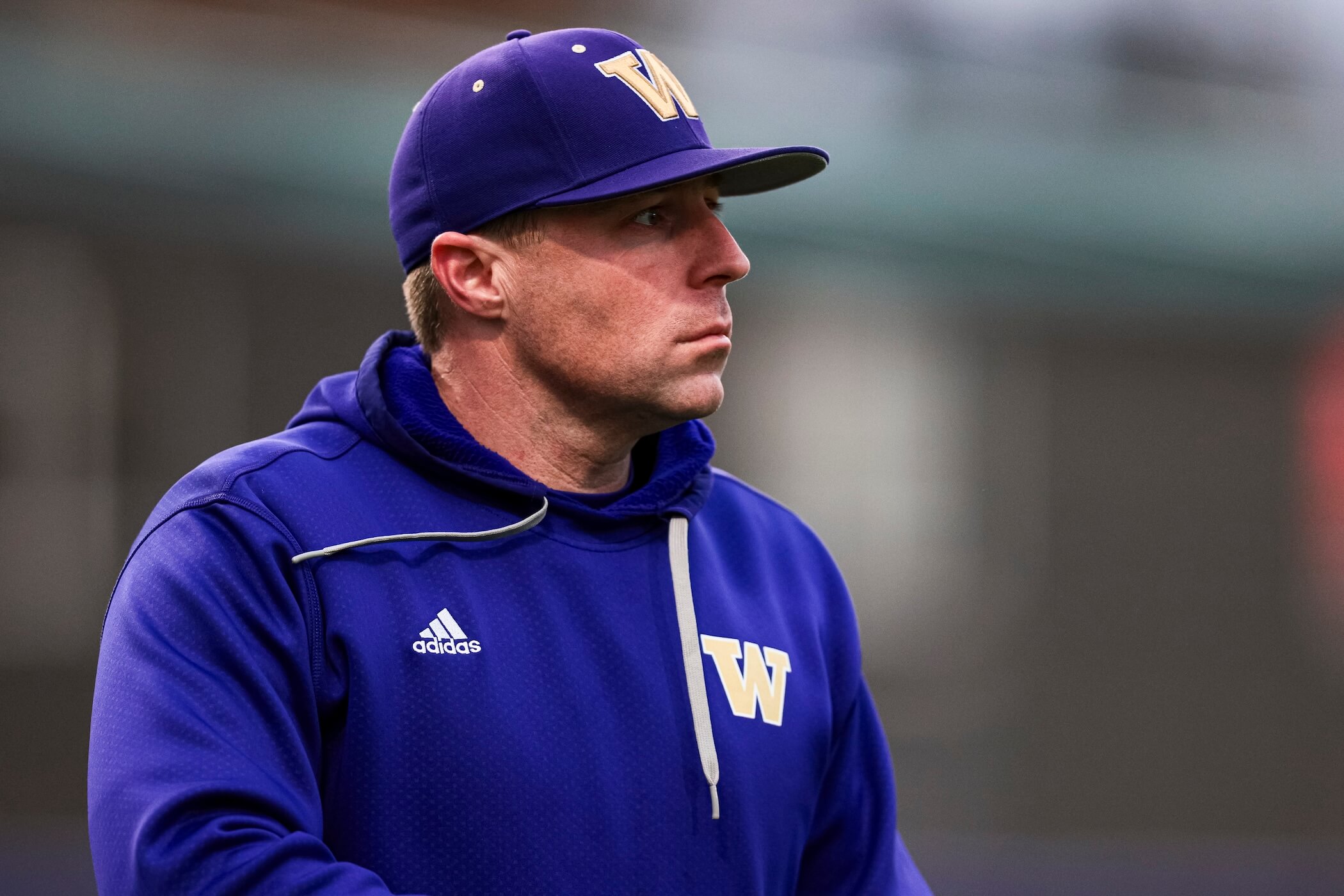
Eddie Smith is in his second season at Washington after serving as the head coach at Utah Valley for three years. (University of Washington Athletics)
Who is the best pitcher you have ever seen in college baseball?
J.D. Arteaga (Miami): I tend to go back to my playing days (at Miami). Kris Benson was pretty impressive. That whole rotation for Clemson that year, Kris Benson, Billy Koch and Ken Vining was very impressive. Obviously, the Friday (Benson) and Saturday (Koch) guys both had good big-league careers, but Kris Benson, it was a very impressive season he put together, in 1996.
Mike Bianco (Ole Miss): If I had to answer it four years ago, I would have said Ben McDonald. I caught him (at LSU, 1988-89) and watched him, and he was just so much better than everybody else. But if you fast forward 35 years, there was a guy named Paul Skenes. Very similar. … If people really saw Ben in Ben’s prime, nobody would argue that he could obviously be the greatest college pitcher of all time. But then, when you look at Paul Skenes, I don’t think you’re getting much argument against him either.
Jordan Bischel (Cincinnati): When Mississippi State had Ethan Small (2016-19). It was 90 (mph), but we couldn’t see the baseball. I don’t remember ever having (another) time where it was like, “My God, what do we do here?” It was incredible, the deception he had. He’s awfully high, and maybe (TCU’s) Payton Tolle two years ago. We actually beat him here two years ago, but it didn’t involve hard contact. His fastball was incredibly special that night.
Dan Fitzgerald (Kansas): The best pitcher I’ve coached in college baseball is Colin Poche, who was with us at DBU (2016). And he had blown out at Arkansas, and we picked him up, and he rehabbed with us for a year and then pitched and was our Friday night guy. And he went undefeated on Friday nights in the Missouri Valley Conference. Colin throws way harder now, and he’s had a great big-league career. But in college, you know, his velocity, he touched some low-90s. But by the end of the game, his velocity would be dropping into the mid-80s. But he could locate a fastball better than anyone I’ve ever coached. He pitched inside for an entire year, never hit any batters, was able to live on the inside black. He was the best college pitcher I’ve seen. If you have to win one game, he’s the guy I would want on the mound.
Scott Forbes (North Carolina): I felt my one year with Andrew Miller (North Carolina, 2006), he would be at the top of the list. But I will probably go with (Stephen) Strasburg (San Diego State, 2007-09) or Gerrit Cole (UCLA, 2009-11). Just domination.
Pat Hallmark (UTSA): Trey Yesavage (East Carolina, 2022-24) was really good. He’s an easy one, kind of a sexy one.
Wes Johnson (Georgia): I had one of them, Paul Skenes. One that I didn’t coach, Chase Burns (Tennessee, 2022-23, and Wake Forest, 2024). I thought he was always special. A lot of people forget about a young man I had at Arkansas in 2018, when we were the national runner-ups. I had a young man named Blaine Knight. He went 14-0 that year and started on Friday nights.
Skylar Meade (Troy): For a single day, Jack Leiter was the best I’ve ever seen. He struck us out 16 times, all 16 on fastballs in 2021, when (South Carolina) played at Vanderbilt; he threw a no-hitter after our leadoff guy got on. In a single moment, him, but man, I thought his teammate, I thought Kumar (Rocker) was the most polished performer, winner, I think I’ve ever seen. He was just incredible. So if you ask me to pick, I think Kumar was it for me.
Eddie Smith (Washington): Danny Hultzen. When I was at Virginia, from 2009 to 2011, he started every Friday night for us. He was a guy who took us to Omaha as a true freshman, and we were ranked No. 1 in the country his entire sophomore year and then lost in Game 3 of the Super Regional that year, and then we went back to Omaha in his junior year, his draft year. He was just a guy who set the tone every weekend on Friday night, and having a true Friday night guy like Danny, it was just an unbelievable thing to watch. We had velocity on our scoreboard there at Virginia before anybody else did, and it would be 93-95 before anybody else was throwing 93-95, and he was doing it from this left-handed, three-quarter slot with a plus changeup. Just incredible.
Who is a team that might surprise in 2026?
Mike Bianco (Ole Miss): They certainly have gotten a lot more publicity in the last maybe five years, but people probably nationally don’t talk enough about Southern Miss — just how consistently good they are. And it’s almost a backhanded compliment to say for a mid-major, but they don’t play like that. They host (Regionals), they do everything that everybody else does from a Power 4 standpoint. But they are probably the best team over maybe the last four or five years that hasn’t been in Omaha.
Jordan Bischel (Cincinnati): I don’t follow it closely enough, but I do think last year is going to look like an outlier year for UCF. I thought they had really good players, and I think Rich (Wallace) does a really good job there. And obviously, he had a great first year. That’s one that just pops to mind that I would not be at all surprised if they’re right back towards the top of the league this year.
Dan Fitzgerald (Kansas): UTRGV. They barely missed the NCAA Tournament last year, and they return everyone.
Scott Forbes (North Carolina): UNC Wilmington or Charlotte. I think they always are dangerous. I think they can give some teams some problems because coach (Randy) Hood and coach (Robert) Woodard do such a great job.
Pat Hallmark (UTSA): I’ll take South Florida. Because I think their coach (Mitch Hannahs) is terrific. This will be his second year. Usually, when you get a good coach, sometimes the first year, sometimes they do it, but it’s hard sometimes the first year. But I do think he’s a terrific coach. And Year 2 is when you’ll start to see some strides.
Wes Johnson (Georgia): Kentucky.
Skylar Meade (Troy): I think our opening opponent, Mercer, is gonna be really good. And they’re always good. I think they have some real pieces. I think the other one that I would say, and they made a bit of a dent last year, but I think they have a lot of returning. I think Marshall is going to be really good. You got a nice park, but also Marshall can be tough to get to. I think there’s an advantage to that if you have good players, which they have right now. I think they’re gonna be a really scary team with the rotation, some of the bullpen stuff that they have. And then, obviously, when you’re well-coached, I think it sticks out. They’re gonna know how to win close games.
Eddie Smith (Washington): I think Penn State’s a team that’s up and coming. I think that they’re a group that’s coached so well, and they’ve had so much investment poured into their program, and so I think they’re coming on quick, and it’s going to be as early as this year that you’re going to see a huge leap out of them.
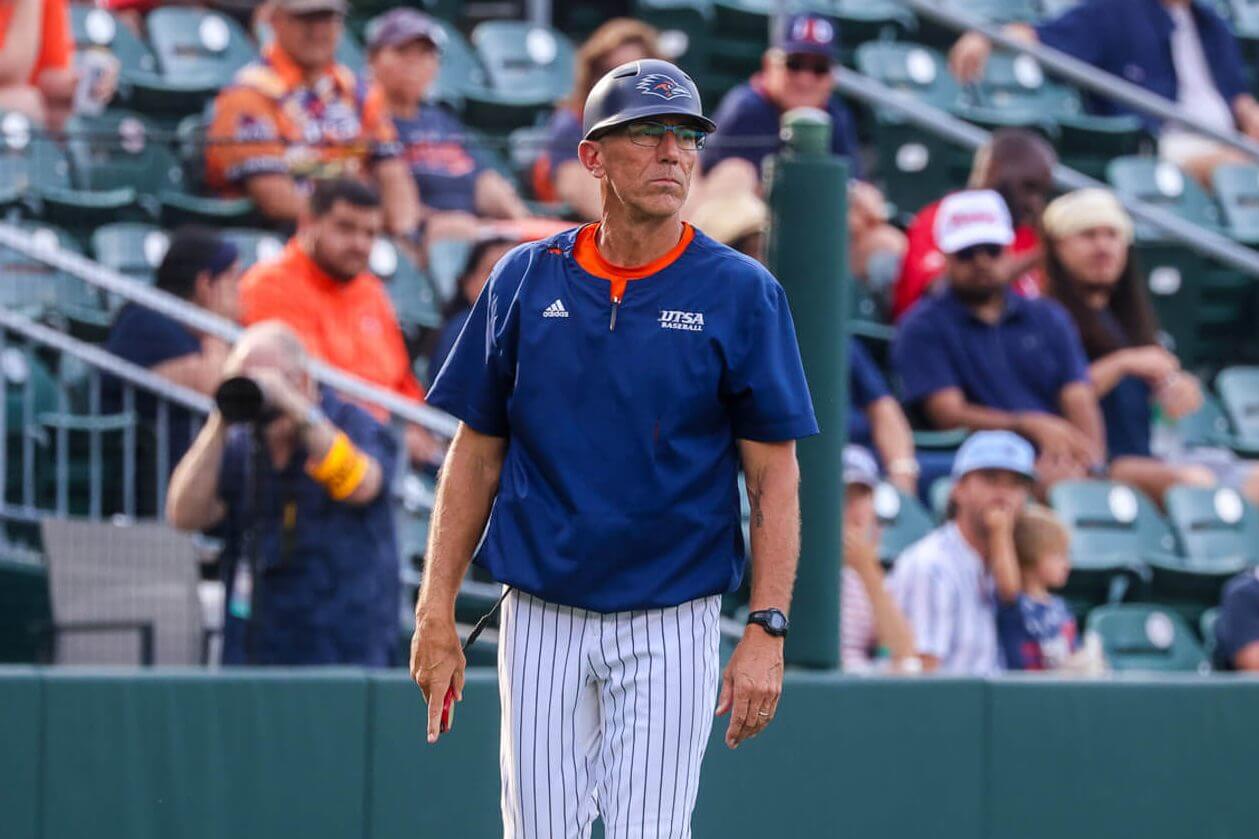
Pat Hallmark, who was a longtime assistant at Rice, is in his seventh season at UTSA. (UTSA Athletics)
What stat matters most when you are evaluating a hitter?
J.D. Arteaga (Miami): Strikeouts are something that’s a big turnoff for me. If you have a lot of swing and miss, that’s something we tend to shy away from. We want good bat-to-ball skills. Aluminum bats hide a lot of weaknesses in a hitter. But contact and no contact, you can’t hide that one.
Mike Bianco (Ole Miss): I’m still old school, and I still probably look at the batting average first. Then after that, probably go to home runs and those types of things. I still believe in the eye test more than any number. You watch guys hit, and the good hitters — it seems very simple — but they just hit more balls than everybody else. They just barrel up more balls.
I’ll rely on our recruiting coordinator, Carl Lafferty, and our hitting coach, Mike Clement, and they’re going to break it down more. They’re going to look at chase rate and those types of things. But at the end of the day, I think the best evaluation isn’t a stat, just watch guys in person. I think that’s why you miss a lot. I don’t know if there are numbers that — they’ll help push you over the edge on guys — but I still think the eye test is the most important thing with hitters. And I think that’s why so many guys are missed in the portal. So much of the portal is done on a computer, and it’s hard because of different leagues and different things. I think it’s hard to recruit hitters unless you see them.
Jordan Bischel (Cincinnati): Probably not at the high school level because there’s so much variation, but ultimately, if they get on base, I want them here. For a high school kid, that can be a little tough to track, but ultimately, do they get to first base safely a lot?
Dan Fitzgerald (Kansas): Strike zone discipline. Just trying to figure out, do they swing at strikes and do they take balls and do they do damage when the ball’s in the strike zone? I think that the one consistent thing in baseball over its entirety of the sport has been the 17-inch strike zone, and so I think the game’s always won and lost there.
Scott Forbes (North Carolina): Stats, I think you have to be careful, especially for a high school player because of the competition. Obviously, OPS, we’re going to focus on. But we want kids that, if you’re looking at a position player, a hitter, the bat is the hardest thing to evaluate. The bigger body of work and the better competition helps you evaluate that.
We like guys that control the strike zone, that are going to walk more than they strike out. They should be walking way more than striking out in lesser competition. … We don’t like a ton of swing and miss. You want some guys that can make things happen and do some damage. OPS is big because that takes all that into account. And guys that get on base and can make something happen when they get on base. It’s that combination of athleticism.
Pat Hallmark (UTSA): We hardly look at stats in high school. So if you ask me what stat, I guess the first thing I need to be clear is we’re talking about a little older hitter. So I’m talking about a portal player or a juco player. We look at stats in junior college and in the portal. And if you ask me to pick the one that matters the most, it would be OPS, on-base plus slugging.
Wes Johnson (Georgia): In-zone whiff rate.
Skylar Meade (Troy): Their strikeout-to-walk is huge. And do they hit the ball hard? But, inevitably, you can find a lot of really good hitters if they have positive strikeout-to-walk ratios. But if you have a guy that just so happens to maybe hit 20 home runs, but he’s got 85 (strikeouts) and five (walks), you’re sitting there going, man, that’s a dangerous slope. And maybe he’s upticking in competition, so how bad could those numbers get? The ability to swing at the right pitches, to get on base, to do all those things. It’s still paramount for us.
Eddie Smith (Washington): Walks to strikeouts. If you’re striking out all the time and can’t walk at a junior college or a high school, then you’re only going to do that more once you get here.
What stat matters when evaluating a pitcher?
J.D. Arteaga (Miami): Walks. You can’t defend walks. I don’t care what league you’re in. If you’re walking guys, that’s usually not going to play. And understanding that the better the competition is, those walks are probably going to go up because guys aren’t going to swing and chase as much.
Mike Bianco (Ole Miss): I probably worry more about command and balls in the zone, strike percentage, and less about swing and miss and swinging strikes and those types of things. I think that’s important, but I think it’s a lot harder to teach guys to throw strikes than it is to pick up another pitch and miss a bat.
And I think the era of baseball has flipped over the last five to 10 years, where there’s so many more guys that have swing and miss now, but less guys that throw the ball into the box. And I think the most important thing is strike throwing, and there are a lot of different stats to look at that. So strike percentage, the in-zone percentage, is probably the most important thing to look at.
Jordan Bischel (Cincinnati): For me, it’s still how many guys walk to first base. On-base percentage is the most important stat as a hitter, so who’s not allowing guys on base, for a pitcher. Free-pass percentage is huge to me. We’re not going to take an 80-mile-an-hour high school kid that throws it down the middle every time, but I want to know, do they get the ball in the strike zone? Do they attack? What’s their strike percentage or their free-pass percentage? I think it still carries a ton of weight for us.
Dan Fitzgerald (Kansas): In-zone swing and miss.
Scott Forbes (North Carolina): Command first. Well, for us, makeup is really, really high. We want the right guys. You have to see them over and over to see what is their true make-up, how they handle failure, that type of thing. But for pitchers, we put a premium on command with athleticism, knowing that there’s a ton of upside there. And not falling in love with velocity, especially with the young guys. We do feel like in our program, your velocity can get better with the right training. We have all the technology. We can tell you what you need to do to improve in certain areas to get stronger. But the velocity, really, you can throw it out the window if it’s not good command. And you can’t walk guys. Teams are too good. So that’s the top premium.
Pat Hallmark (UTSA): Walks, walks per nine innings.
Skylar Meade (Troy): In one sense, I would still probably argue that they need to have a good strikeout-to-walk ratio. But I do think if you can punch tickets and the delivery works — and I know delivery isn’t a stat — but if they strike dudes out, but they have a little higher walk, we feel like there’s a pathway to lessen that walk (ratio). If they have real stuff, that is certainly huge.
But if you’re not able to strike guys out at young levels, I think it means that you either show the ball early, you don’t have stuff, you don’t have a breaking ball. If you don’t strike out more than a guy an inning as you’re elevating your game, whether that be high school, summer high school stuff, junior college, maybe even potentially if you’re recruiting a D2 kid, like you got a D2 kid who’s 70 innings, but like 45 K’s — there’s a lot of luck involved in that. And so you got to be able to strike dudes out because it equates to stuff and potential value.
Eddie Smith (Washington): I’d say probably strike percentage. Particularly, swing-and-miss strike percentage.