
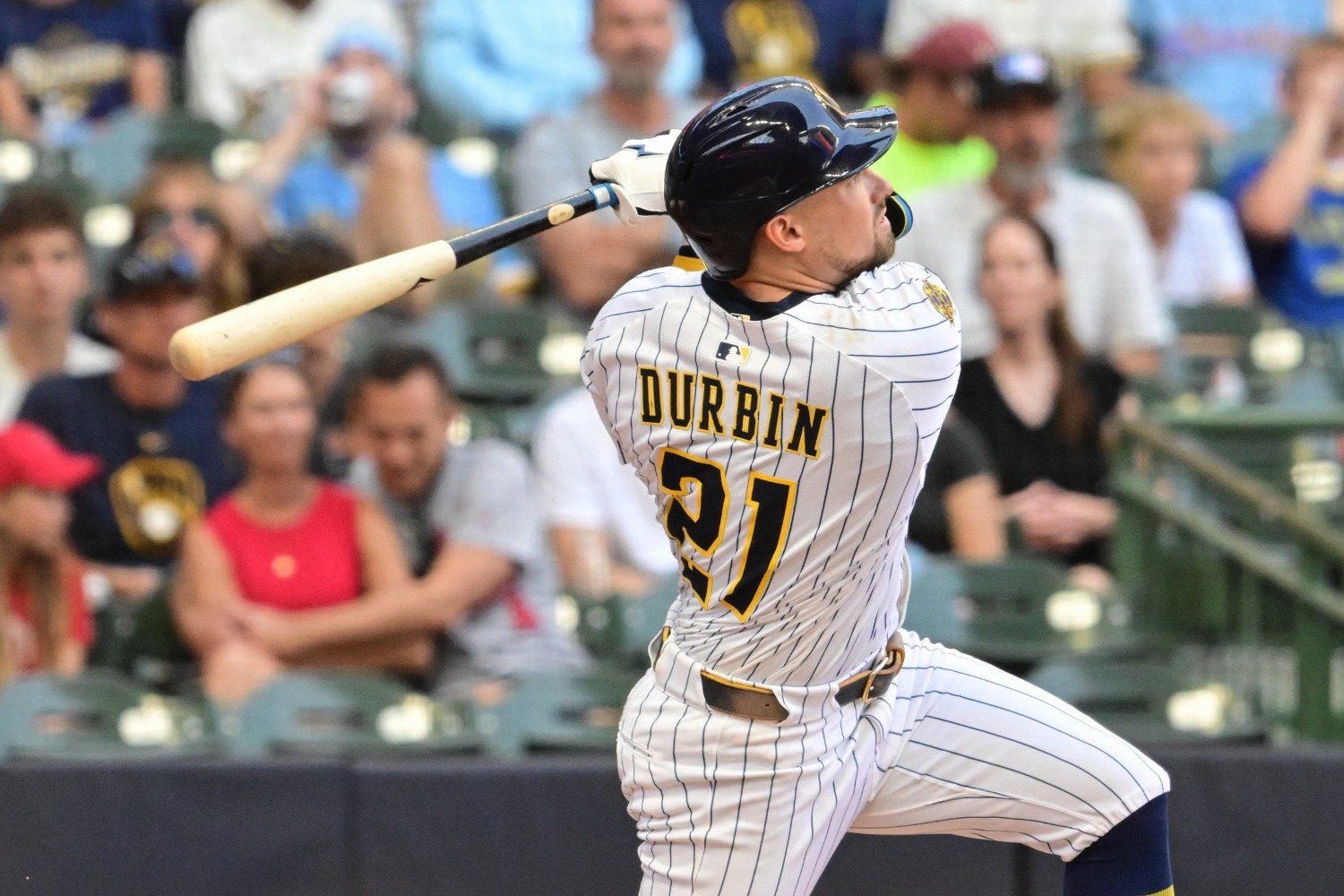
Caleb Durbin’s long-term future with the Brewers was likely to be a supporting role, rather than a multi-year residency as the starting third baseman. While his 105 wRC+ and 2.6 fWAR as a rookie demonstrated his high floor, Durbin was unlikely to improve upon that production. His hard-hit rate, barrel rate, and expected wOBA on contact were all in the bottom 4 percent of big-league hitters. As a short player without much power, he has already maxed out his abilities.
Given that low ceiling, Durbin was likely to become replaceable sooner, rather than later. Surprisingly, the Brewers feel they can replace him now. On Monday, they dealt him to the Boston Red Sox (with Andruw Monasterio, Anthony Seigler, and their competitive balance round B pick in the 2026 Draft) for left-handers Kyle Harrison and Shane Drohan and infielder David Hamilton.
With pitchers and catchers reporting to spring training this week, the deal leaves the roster in an odd place. The Brewers now have even more bodies in what was already a crowded rotation picture, and the three players who combined for 85% of last year’s innings at third base are gone. For that matter, Vinny Capra and Oliver Dunn are gone, too. They combined for just over 200 innings at the position last year.
The rotation additions might seem redundant, but the Brewers don’t view them that way. Acquiring even more controllable starters remained enticing to them after they traded away Freddy Peralta last month. While Peralta’s 65 ERA- last year was seventh among qualified starters, replacing his volume will be the greater challenge. He started at least 30 games in each of his last three seasons in Milwaukee, including 33 in 2025. That kind of durability has become increasingly rare in modern baseball, where frequent arm injuries limit availability and starters work fewer innings even when healthy. The Brewers will need a collection of arms to backfill Peralta’s innings.
“It’s no longer just the five-man rotation where every guy’s going to give you five innings anymore,” president of baseball operations Matt Arnold said on Monday morning. “It’s a combination of your entire staff.”
The Brewers have seen firsthand how quickly injuries can chew through a depth chart. A slew of spring training ailments contributed to a pair of season-opening blowouts in New York and left Elvin Rodríguez starting their home opener. Excluding openers, Milwaukee used 14 different starting pitchers last season and 13 the year before.
“We know we’re going to have injuries,” Arnold said. “You guys saw what we were dealing with at the start of last year, when not everybody’s 100%. That’s going to happen again, and we know that. But having a number of guys here, like Harrison and Drohan, really does raise the floor for us.”
While there’s no such thing as having too much pitching, the Brewers are testing how much pitching is the best use of a team’s resources—and how many starters they can realistically develop in that role at once.
Milwaukee’s 40-man roster currently contains as many as 15 potential starters, although Aaron Ashby, DL Hall, and Ángel Zerpa could remain relievers after the additions of Harrison, Drohan, and Brandon Sproat. With another crop of prospects (Tate Kuehner, Brett Wichrowski, and K.C. Hunt) progressing to the upper minors, finding consistent starts for nearly 20 pitchers between the majors and Triple-A Nashville could get tricky.
Meanwhile, the left side of the infield is unclear. After acquiring Jett Williams in the Peralta deal and Hamilton (Monasterio’s likely replacement) for Durbin, the Brewers have enough players to man the dirt, but only Joey Ortiz has experience at third base. Arnold also pointed toward infield prospects like Jesus Made, Cooper Pratt, and Andrew Fischer, each of whom is carving a rapid path toward the big leagues.
“There’s just a lot of these types of guys coming in our system that we feel can absolutely handle the left side of the infield and have really high upside,” Arnold said. “And so we feel like we have the ingredients now to weather the loss of somebody like Caleb Durbin.”
Still, as things currently stand, the Brewers will have to fill third base with an infielder who does not profile well at the position. They could use their rotation depth to trade for a more proven option, such as Houston Astros third baseman Isaac Paredes or Washington Nationals shortstop CJ Abrams. Ramón Urías, Enrique Hernández, and Jose Iglesias are among the lower-cost free agents still available.
They could decide against further additions, though. Paredes would supply the power the Brewers need, but he lacks the speed, defense, and versatility they usually prioritize. Those veteran free agents are not clearly better than their internal options. Furthermore, reporting from the Milwaukee Journal-Sentinel suggests that the Brewers’ stated confidence in their current infield is genuine, not just posturing for trade talks.
Arnold said the Brewers remain open to outside acquisitions, but if the current mix holds, they will use spring training to test different arrangements and determine the best one.
“We’re not really married to any one particular permutation of the infield here,” he said. “I think there are a number of different ways we could sort this out.”
One option is handing third base to Williams. At 5-foot-7 and with a suspect throwing arm, the 22-year-old profiles best at second base or in center field. Durbin is, notably, the same height and had the same defensive concerns as a prospect, but Matt Erickson successfully converted him to a capable third baseman last year.
Arnold confirmed that Williams will receive reps at third this spring, along with shortstop, second base, and outfield. The Brewers are also open to trying Ortiz (who could slide back to third) and Brice Turang (a former shortstop) at other positions, based on how Williams or other players look defensively.
“We want to put him in a position to succeed, because he hasn’t played third base yet,” Arnold said of Williams. “But he certainly has the ingredients to do so. So we’re going to give him some reps there, along with other guys as well.”
The Brewers either have another move in the hopper that will tie their infield together, or they’re taking a pair of calculated gambles. There’s a world in which injuries make nearly 20 starters the right number to fill innings, while some combination of Ortiz, Williams, and Pratt provides solid production at shortstop and third base. There’s another in which the Brewers don’t have enough innings for their myriad arms, as the left side of their infield struggles.