
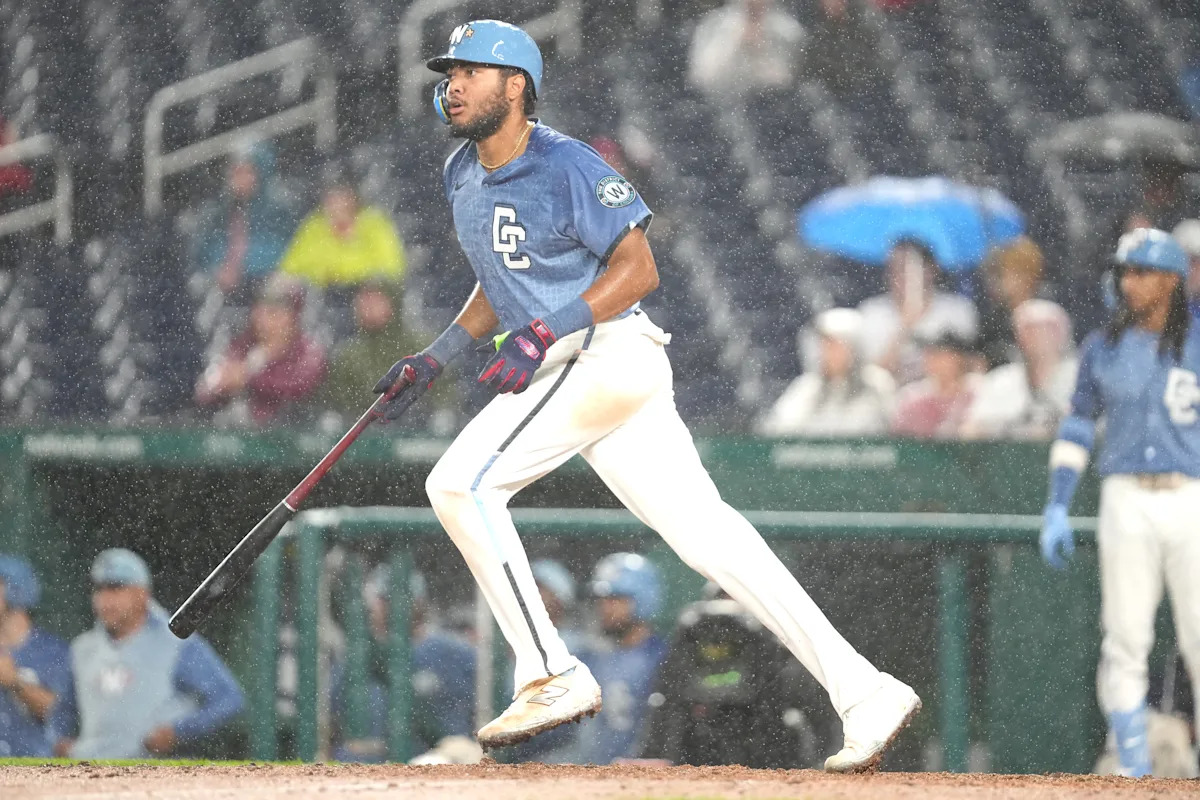
Following a disappointing 2025 season where the Nationals went 66-96, Fangraphs doesn’t expect the results to be much improved entering the 2026 season, with their ZiPS projection system placing them at an estimated 63-99 record this season. While this number won’t bring much joy to Nats fans about how this season is going to look, it’s important to look at this number in context and understand how accurate these projections really are.
First off, it’s important to understand what ZiPS is and why it’s worth looking at when evaluating a roster as a whole. ZiPS uses player aging curves, along with all sorts of Statcast data and injury history, to project how every player on a team will perform in an upcoming season.
Advertisement
Once that has been compiled, they project the playing time of all these players on a club, and then run roughly 10,000 simulations of the season to find the most likely scenario for a ballclub. While it shouldn’t be taken as gospel, as there are so many external factors that go into a team’s season, it can offer a useful guide for how clubs should be viewed entering a season.
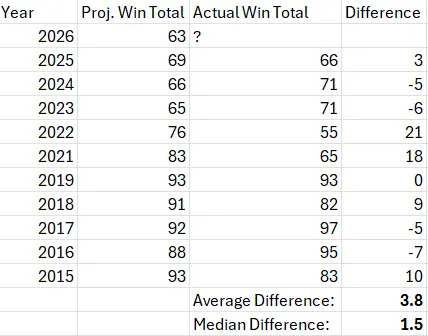
I’ve compared ZiPS projected record for the Nats from 2025 to 2015 (excluding 2020) to their actual records in those years, and a few things stand out. For starters, the only years I’d say the projection system was way, way off were in 2021 and 2022, years where the Nationals roster was changing vastly from beginning to end of the year.
ZiPS still had faith in the Nationals’ big three of Scherzer, Strasburg, and Corbin to hold down the rotation in 2021, and thought the big bats of Juan Soto and Trea Turner, with the addition of Josh Bell and Kyle Schwarber to the lineup, would be enough to keep the Nationals at least relevant that season. The 2021 Nats had a wide range of outcomes, and, unfortunately, they ultimately ended on the bad side of that outcome range, finishing 18 wins under their projection with 65.
Advertisement
In 2022, it’s hard to say quite why ZiPS thought the Nats would be at least a watchable group, but it also couldn’t have projected for the midseason loss of Juan Soto or the atrocious performance of Nelson Cruz after nothing but years of raking. ZiPS also anticipated a rebound in success from Patrick Corbin and Stephen Strasburg to pitch at least a portion of that year, 2 things that we now know did not happen at all. 2022 was ZiPS’ biggest miss in modern times when it comes to projecting the Nationals’ record, with the actual 2022 Nats finishing a whopping 21 wins under their projection.
Outside of those 2 years, ZiPS has been rather on the money with its Nationals record predictions, finishing within 10 games 7 of 8 years, and within 5 games in 4 of those 8. It’s done particularly on the money on the Nats club of the past 3 seasons, undershooting slightly on the 2023 and 2024 Nats win totals, before overshooting a little bit on the 2025 Nats.
So what does all of this mean for the 2026 Nationals? It means it could be another long season full of growing pains, but it’s also worth considering the external variable that could affect this projection. For starters, there is an entirely new front office and coaching staff in place from years past, meaning new voices for the players to hear from and potentially help find another gear of success in them.
There are also plenty of youngsters on the ballclub, such as Brady House and Harry Ford, who could break out at anytime, something the model struggles to account for as compared to veterans that it has lots of success to back up its projections.
Advertisement
Overall, while these models and projection systems can be fun to look at and attempt to decipher during the offseason, all bets are off once it’s time to playball, as the 2026 Nationals could come out swinging and make these numbers all look silly. Still, based on the historical trend of these projections, it would be unwise to dismiss them completely.