
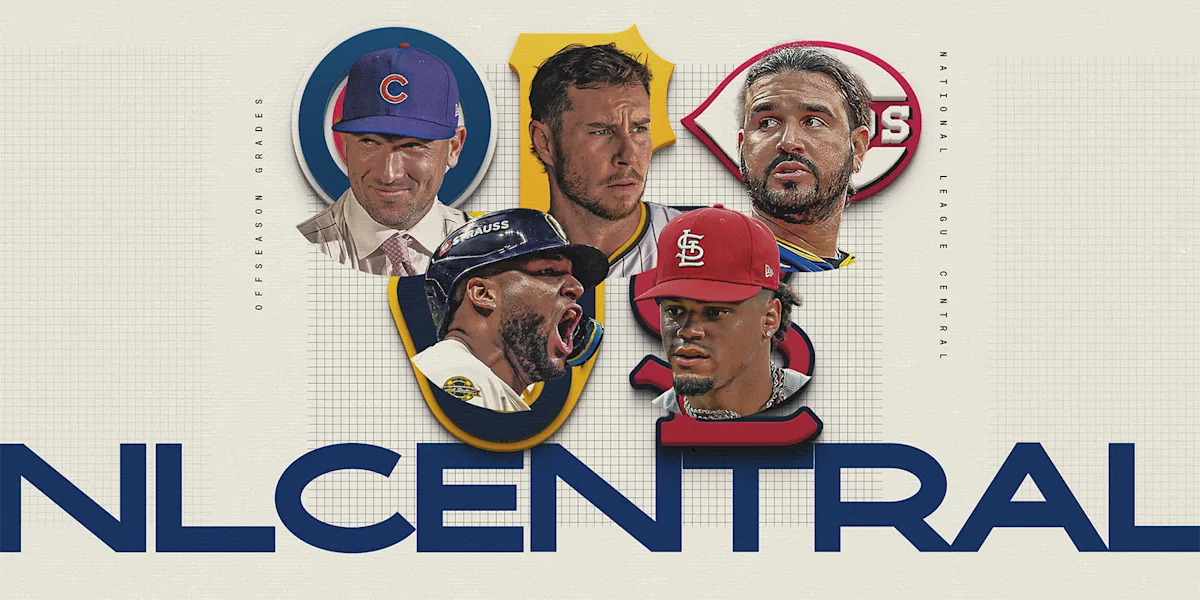
With pitchers and catchers reporting to spring training this week, our offseason grades roll on with the National League Central. All five teams in this division were active in different ways throughout the winter, with the Cubs, Reds and Pirates making meaningful upgrades to their rosters, the Cardinals embarking on a full-blown rebuild and the reigning champion Brewers executing a series of Brewers-like maneuvers.
This is also a division that has stayed active in the days leading up to camps opening in Arizona and Florida, and we might see a few more moves before Opening Day. But the bulk of the business appears to be behind us. So what did these NL Central clubs accomplish this winter?
Advertisement
Let’s grade ‘em.
Read more: National League East offseason gradesMilwaukee Brewers
Significant outgoing free agents: C Danny Jansen, 1B Rhys Hoskins, LHP Jose Quintana, RHP Erick Fedde, RHP Shelby Miller
Major moves:
Retained RHP Brandon Woodruff via qualifying offer
Acquired LHP Angel Zerpa from Royals for RHP Nick Mears, OF Isaac Collins
Acquired INF/OF Jett Williams, RHP Brandon Sproat from Mets for RHP Freddy Peralta
Acquired LHP Kyle Harrison, LHP Shane Drohan, INF David Hamilton from Red Sox for INF Caleb Durbin, INF Andruw Monasterio, C/INF Anthony Seigler, Competitive Balance Round B Pick
Signed OF Akil Baddoo to a 1-year deal
Offseason grade: C+
Doubting Milwaukee’s operation might be naive at this point. But for a franchise that’s still looking to break through for its first World Series appearance in decades, it is simply disappointing to see the roster in an objectively lesser state than it was when last season concluded.
That’s not to say the three fascinating swaps won’t yield any positive returns. Zerpa, Sproat, Harrison and even Drohan could all impact the major-league club in some form in 2026, and the Brewers often do well to get the most out of pitchers arriving from other orgs. It’s also reasonable to suggest the Brewers might have sold high on Collins and Durbin after their surprising contributions as rookies. But it’s also fair to say that no matter what president of baseball operations Matt Arnold says, third base is an enormous question in the short term, and replacing a legit ace in Peralta is no small task.
Advertisement
Regardless of Milwaukee’s strategy on the trade market, its complete disregard for free agency is discouraging. Excluding the retention of Woodruff via the qualifying offer, the Brewers have handed out zero guaranteed major-league deals this winter, and they are the only team with that designation (Baddoo received a split deal that does not guarantee him a 26-man roster spot). Splurging in free agency doesn’t always equate to getting better, but Milwaukee’s complete lack of spending stands out this winter, particularly when several other small-market teams spent real dollars.
Tagging Milwaukee with a less-than-stellar hot stove grade doesn’t mean I’m dooming them to a regular season of assured failure, nor will I rule out the possibility of another move or two to round out the roster before Opening Day. The Brewers are still quite good on paper, and there’s reason for optimism on both sides of the ball. But if we’re strictly grading offseason moves, it has been an underwhelming and perplexing winter for the Brew Crew.
Chicago Cubs
Significant outgoing free agents: OF Kyle Tucker, RHP Brad Keller, RHP Michael Soroka, LHP Drew Pomeranz, RHP Nate Pearson, UTL Willi Castro
Advertisement
Major moves:
Signed 3B Alex Bregman to a 5-year deal
Acquired RHP Edward Cabrera from Marlins for four prospects
Retained LHP Shota Imanaga via qualifying offer
Signed RHP Phil Maton to a 2-year deal
Signed LHP Hoby Milner to a 1-year deal
Signed LHP Caleb Thielbar to a 1-year deal
Signed RHP Jacob Webb to a 1-year deal
Signed RHP Hunter Harvey to a 1-year deal
Signed 1B Tyler Austin to a 1-year deal
Offseason grade: A-
In signing Alex Bregman to a heavily deferred, five-year, $175 million deal, the Cubs finally flexed the financial might typically associated with a big-market club of their ilk. It’s the kind of addition that carries more weight than just the projected WAR the player brings, as Bregman’s unrivaled baseball IQ and leadership qualities can positively impact the entire roster. Plus, the Cubs finally landing Bregman after a failed pursuit a year ago is a massive organizational victory — and a crucial one in the wake of Kyle Tucker’s departure.
Chicago’s moves on the mound this winter were less straightforward. The offseason started with Chicago retaining left-hander Shota Imanaga via the qualifying offer after declining the three years and $57.75 million remaining on his previous deal, ensuring some short-term rotation stability albeit for a hefty 2026 salary. Rather than spend further in free agency on another starter, the Cubs spent prospect capital to acquire right-hander Edward Cabrera from the Marlins.
Advertisement
Cabrera arrives with an array of promising pros (three years of team control, huge stuff) and troubling cons (lengthy injury history, limited track record of throwing strikes), and the cost to acquire him notably included outfielder Owen Caissie, who appeared to be in line to replace Tucker in right field as soon as this year. That — in tandem with Bregman taking over third base – has led to a lack of clarity regarding the positional plans for sophomore infielder Matt Shaw and Seiya Suzuki, whom the Cubs seemed to prefer in a DH role last year rather than as an every-day outfielder.
However the position player group shakes out — Austin is another intriguing addition after a prolific half-decade in Japan — manager Craig Counsell should be able to roll out one of the best lineups in baseball. The question is whether adding Cabrera and redesigning the bullpen with a new crop of solid if unspectacular veterans is enough of an upgrade on the mound to vault Chicago into a higher tier of contention in the National League.
With Alex Bregman now leading the offense, the Cubs earned the best offseason grade in the NL Central.
(Grant Thomas/Yahoo Sports)Cincinnati Reds
Significant outgoing free agents: RHP Nick Martinez, RHP Zack Littell, RHP Scott Barlow, OF Austin Hays, OF Miguel Andujar, INF Santiago Espinal
Advertisement
Major moves:
Signed 3B/DH Eugenio Suarez to a 1-year deal
Signed JJ Bleday to a 1-year deal
Acquired OF Dane Myers from Marlins
Re-signed RHP Emilio Pagan to a 2-year deal
Signed LHP Caleb Ferguson to a 1-year deal
Signed RHP Pierce Johnson to a 1-year deal
Acquired LHP Brock Burke from Angels in three-way trade that sent 2B/LF Gavin Lux to Rays
Offseason grade: B
The Reds gradually improved their lineup, defense and bullpen over the course of the offseason — no small feat for a team coming off a postseason berth, but also a reminder that Cincinnati’s roster was notably worse than the rest of last year’s playoff field. After unsurprisingly coming up short in its long-shot, free-agent pursuit of local native Kyle Schwarber, Cincinnati pivoted to a collection of smaller transactions to improve its roster in the aggregate, rather than making one humongous splash.
Adding power was paramount for a club that finished 21st in home runs last season — a particularly paltry output when playing half their games at MLB’s second-most homer-friendly ballpark. Credit to Cincinnati for pouncing when the market didn’t materialize for old friend Eugenio Suarez, who rejoins the Reds coming off a 49-homer season, strengthening a lineup that sorely needed more over-the-fence pop. Concerns about Suarez’s defense will be less relevant for the Reds with Ke’Bryan Hayes entrenched at third base; Suarez can focus on mashing, primarily at DH with the occasional infield cameo.
Advertisement
Hayes’ acquisition at last year’s deadline is still a bit of a head-scratcher. His contract (guaranteed $30 million over next four seasons) in tandem with his meek offensive output (63 wRC+ the past two seasons) could be cumbersome for a team on a limited budget, but at the very least, he provides elite defense at the hot corner. New outfielder Dane Myers also brings a plus glove with a weak bat, though his defensive impact will be felt less frequently in a part-time role. Exactly how much playing time Myers and fellow new outfielder JJ Bleday will get remains to be seen, but each should help if deployed selectively.
On the mound, Cincinnati had a ton of innings depart in free agency (Martinez, Littell, Suter, Barlow) and decided to focus its rebuilding of the pitching staff on bolstering the bullpen. That began with retaining Pagan as the closer, and adding Johnson, Burke and Ferguson provided manager Terry Francona with a trio of veteran options to call on late in games. Trading Brady Singer, scheduled to make $12.75 million in his final season before free agency, was rumored as a possibility to ease payroll, but the Reds opted to hold on to the right-hander (their 2025 innings leader), ensuring some stability in a rotation that will be counting on several young arms to step up.
On the whole, the Reds achieved modest upgrades across the roster, even if some major questions remain about how the position-player group will fit together. Solid work.
St. Louis Cardinals
Significant outgoing free agents: RHP Miles Mikolas
Advertisement
Major moves:
Acquired BHP Jurrangelo Cijntje, OF Tai Peete, OF Colton Ledbetter, two Competitive Balance Round B picks in three-way trade with Mariners, Rays that sent INF/OF Brendan Donovan to Mariners
Acquired RHP Richard Fitts, LHP Brandon Clarke from Red Sox for RHP Sonny Gray
Acquired RHP Hunter Dobbins, RHP Yhoiker Fajardo, RHP Blake Aita from Red Sox for 1B Willson Contreras
Acquired RHP Jack Martinez from D-backs for 3B Nolan Arenado
Signed RHP Dustin May to a 1-year deal
Signed RHP Ryne Stanek to a 1-year deal
Selected RHP Matt Pushard in Rule 5 Draft
Offseason grade: B
The rebuild is on. New president of baseball operations Chaim Bloom did not take any half-measures in his efforts to dramatically turn the page on an era of Cardinals baseball that flamed out into unsustainable mediocrity. The quality of the returns netted in St. Louis’ four major trades ranged wildly in terms of the players and contracts involved, but St. Louis broadly accomplished its goal of flipping its accomplished (and expensive) veterans for future assets.
Considering how far behind the Cardinals have fallen on the mound in recent years, it’s no surprise the four deals focused on adding arms; seven of the nine acquired players are pitchers. The two picks acquired in the Donovan deal should also enhance St. Louis’ ability to reel in a major haul in this summer’s draft, which should add further to a farm system that rates as one of the strongest in baseball.
Advertisement
Grading offseasons for rebuilding clubs is a tricky task, and it feels fair to judge them based on only how well they achieved their organizational goals; evaluating a team in the Cardinals’ position based on how much they improved their major-league roster doesn’t make much sense. As such, this grade is awarded to St. Louis based on its successful unloading of its most glaring trade candidates in exchange for an intriguing assortment of upside and depth. Rather than slow-playing the painful part of the rebuilding process, executing all of these deals in one winter makes the organizational direction clear. Competing in 2026 might be off the table for the Cards, but there’s enough exciting, young talent in the upper levels that a leap back into relevance in 2027 is not out of the question.
Pittsburgh Pirates
Significant outgoing free agents: OF Andrew McCutchen, OF Tommy Pham, RP Colin Holderman
Advertisement
Major moves:
Hired Don Kelly as full-time manager
Signed 1B/OF Ryan O’Hearn to a 2-year deal
Acquired 2B Brandon Lowe, OF Jake Mangum, LHP Mason Montgomery from Rays in three-way trade that sent RHP Mike Burrows to Astros
Signed DH Marcell Ozuna to a 1-year deal
Acquired OF Jhostynxon Garcia from Red Sox for RHP Johan Oviedo
Signed LHP Gregory Soto to a 1-year deal
Signed RHP Jose Urquidy to a 1-year deal
Offseason grade: B-
The Pirates unquestionably got better, dealing from their wealth of pitching depth to upgrade the lineup while pushing their payroll above $100 million via multiple free-agent additions. Pittsburgh finished 30th in home runs by a mile last year — its 117 homers were the second-lowest team total of the past decade (excluding 2020) — and responded by adding a trio of former All-Stars with track records of power production: second-base slugger Brandon Lowe, the late-blooming Ryan O’Hearn and veteran designated hitter Marcell Ozuna. Add an outfield prospect with real pop in Jhostynxon Garcia and a switch-hitting speedster in Jake Mangum, and it’s not hard to envision this group of new personnel driving a meaningful step forward offensively. And while the Pirates subtracted from their rotation depth via trade, they added two of the hardest-throwing lefty relievers on the planet in Soto and Montgomery to enhance the bullpen’s ultimate potential.
The “minus” component of Pittsburgh’s offseason grade is rooted in concerns about how all the new pieces fit together, particularly defensively. Lowe’s glove rated as the worst among every-day second basemen last season. O’Hearn is solid at first base, but incumbent Spencer Horwitz is a better fit there, and the addition of Ozuna — who hasn’t played in the outfield since 2023, when he did it just twice — removes the DH spot as a regular option for him. That would seem to push O’Hearn to a less-favorable role as a regular in the corner outfield, where he would join another poor defender in Bryan Reynolds and a wild card in Oneil Cruz, who became a full-time center fielder just last year. The current depth chart also features Nick Gonzales as the starting shortstop, despite the bulk of his reps as a pro coming at second; presumably he’s a placeholder until top prospect Konnor Griffin is ready.
Advertisement
If all the new guys rake in support of what should be a terrific pitching staff led by Paul Skenes, perhaps the defensive deficiencies go unnoticed. But a lot is riding on the new bats to produce in a big way, particularly in the pitcher-friendly confines of PNC Park. And if this ill-fitting collection of hitters is how the Pirates want to unceremoniously move on from Andrew McCutchen — perhaps another reunion is in store, but it’s tough to see after the Ozuna addition — that’s fine, but it better work.