
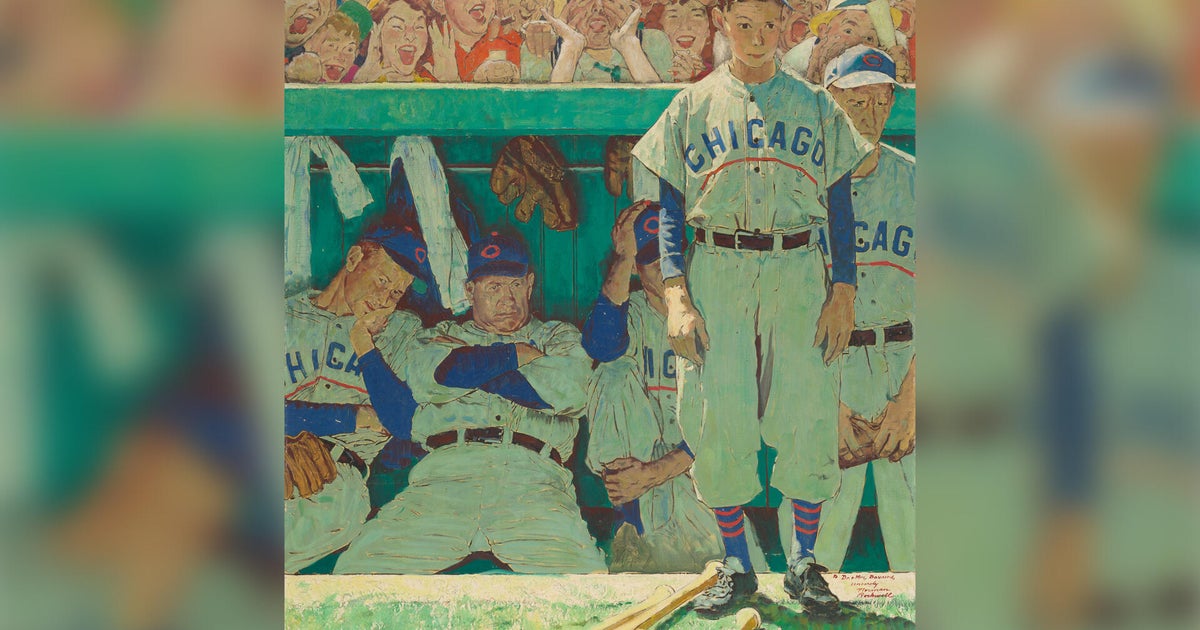
The Norman Rockwell painting “The Dugout,” now hanging at the Art Institute of Chicago, is a longstanding symbol of the Chicago Cubs’ reputation as lovable losers — which for some fans had its own appeal.
The Cubs finally broke that hex in 2016. If you can believe it, the 10th anniversary of that magical night when the Cubs won the World Series is coming up later this year. But it’s nothing compared to the 108 years that passed before that without a World Series victory, and 71 without even a World Series appearance.
When Rockwell painted “The Dugout” for the Sept. 4, 1948, cover of the Saturday Evening Post, it had been a mere three years since the Cubs had last appeared in the World Series. The painting depicts the Cubs after they lost a doubleheader to the Boston Braves — now the Atlanta Braves — with dejected players standing in the dugout as the fans mock and jeer at them.
Rockwell painted using photographs of the scene for reference, but he did not capture the expressions spontaneously. He staged the scene himself and took photos for reference with pitcher Bob Rush, manager Charlie Grimm, catcher Al “Rube” Walker, and pitcher Johnny Schmitz in the dugout, and Braves batboy Frank McNulty posing as a Cubs batboy for $5, the Art Institute noted.
That Cubs team also included future Cubs manager Phil Cavarretta, five-time All-Star Andy Pafko, and Peanuts Lowrey — who three years earlier had scored a run in the World Series and was the last Cubs player to do so until 2016. But the 1948 Cubs team was terrible, finishing last in the National League with a record of 64-90.
The Art Institute noted that Rockwell’s painting helped cement the Cubs’ image as lovable losers, and as the years — the decades — went on, the Cubs couldn’t seem to shake that image. It was always something. In 1969, a red-hot Cubs team featuring Ernie Banks, Ron Santo, Billy Williams, Fergie Jenkins, and Randy Hundley suffered a late-season collapse.
In 1984, the Cubs won the National League Eastern Division championship, making their first postseason appearance since 1945, but lost the NL Championship Series to the San Diego Padres.
The Cubs won the division and lost the championship series again in 1989. They made the playoffs in 1998, 2003, 2007, 2008, and 2015, but fell short in either the National League Division or Championship Series every time.
Curses became part of the Cubs’ lore, and kept piling up.
In 1945, the Cubs hosted Game 4 of the World Series at Wrigley Field and were poised to take a 3-1 lead over the Detroit Tigers when legend says Billy Goat Tavern owner Billy Sianis came to the ballpark with his pet goat. Legend has it that Sianis said the Cubs “ain’t gonna win no more” when the animal was denied entry. The Cubs went on to lose that World Series in seven games.
In 1969, a black cat walked between Santo and the dugout during a Cubs-Mets game at Shea Stadium. The Cubs lost that game, and the Mets went on to knock them out of first place and win the NL pennant.
During the NCLS in 1984, a hit by the Padres’ Tim Flannery went through first baseman Leon Durham’s legs, and legend has it that a cooler full of Gatorade was spilled on Durham’s glove before the game and was to blame for his failure to catch the ground ball. It was Game 5, and the Cubs lost and were eliminated.
In 2003, fan Steve Bartman became a pariah for trying to catch a fly ball that outfielder Moises Alou was trying to catch too. It was Game 6 and the Cubs were up 3-0 in the game and were five outs away from the World Series, but they went on to lose that game to the Florida Marlins, and Game 7 too.
Some fans saw appeal in lovable losers
On Sept. 24, 1984, Cubs fans were in a frenzy when the team won the division, which itself was an achievement not seen in decades up to that point. But referencing Rockwell’s painting, the late CBS Chicago reporter Mike Parker noted that some Cubs fans actually preferred the plucky, but always fruitless teams they’d known for so many years. As the ever-eloquent Parker put it, those depicted by Rockwell as “fans and fate, and a batboy betrayed.”
Studs Terkel, the revered writer, historian, and radio host, was one of those fans who saw an appeal in futility.
“I like losing teams,” Terkel told Parker in 1984, “because you sit in the bleachers, and there are not too many people there, because most go along with winners and they’re not there, and you’re with your friends who follow the game, and know the nuance, and the team is inept, and they come undone then — and it’s kind of good.”
In late September of ’84, Parker noted, the Wrigley Field being spruced up for the playoffs was “the Wrigley Field of champions, not of inept vagabonds.” But again, the Cubs didn’t get too far in that series, and there were plenty of years between then and 2016 when “inept vagabonds” might have been an apt description once more.
Terkel told Parker that he found those inept vagabonds more interesting.
“When you’re in a poker game, who are the most interesting players? The losers!” Terkel said. “The winners are bookkeepers — and I have nothing against bookkeepers — but the winners are accountants.”
Losers, more interesting? A lot of Cubs fans probably thought that was ridiculous — the baseball fan equivalent of the fox of Aesop’s Fables fame who can’t jump high enough to catch some grapes on a high vine, and rationalizes that the grapes must be sour anyway.
But Terkel was not the only one who found a charm in the Cubs of perpetual futility.
Three days before the Cubs won the 2016 World Series, Bob Sirott — formerly CBS Chicago’s entertainment and lifestyle editor — extolled the distinctiveness of the lovable-loser Cubs in a guest commentary on CBS Sunday Morning:
“Without all that losing history, the Cubs wouldn’t be unique. By winning the World Series, they’ll become just like any other team.
“If they didn’t hold the record for the longest championship drought in the history of any sport, would they have their enormous national fan base? Would George Will have written so many eloquent columns about the romance of sticking with a team of losers to gain life lessons?
“Would longtime broadcaster Jack Brickhouse have ever come up with the slogan he’s famous for around here: ‘Everyone’s entitled to a bad century?'”
But Sirott said even with the allure of the losing Cubs’ lore, “Of course, as a true fan I’m rooting for them to win the World Series.” And of course, the Cubs did win the World Series, taking four of seven games against the team now known as the Cleveland Guardians, ending with a nailbiter of a Game 7 that involved extra innings and a 17-minute rain delay.
An update of Rockwell’s painting that never made print
“The Dugout” was never forgotten as a symbol of the Cubs’ seasons in vain. During the 2016 World Series, the New York Times was all ready to publish an updated version of the painting — placing Javy Báez in place of the slump-shouldered batboy; sticking Kyle Schwarber, manager Joe Maddon, Jake Arrieta, and Kris Bryant in the dugout; and adding Cleveland fans Tom Hanks and LeBron James to jeer at them in the stands.
“We of little faith who work in The Times’s sports department wish to confess: We thought the Cleveland Indians were going to win the 2016 World Series,” the Times’ Wayne Kamidoi wrote two days after the Cubs won. “History was certainly on our side. The last time the Cubs were World Series champions? 1908.”
Cleveland had not, and has not, won a World Series since 1948, and until the Cavaliers won the 2016 NBA Championship, no Cleveland team had been a champion at all since 1964. But the Times was all ready to prioritize mocking the Cubs over celebrating Cleveland.
Kamidoi wrote that obits reporter Sam Roberts reminded the newspaper’s art department about Rockwell’s “The Dugout,” and staff designer Andrea Zagata commissioned freelance illustrator Robert Carter “to create an image that would lead the Sports section front when the Indians won the World Series.”
Carter delivered the final artwork, and it was ready to go. But it never appeared on the front page of the New York Times sports section. The morning after Game 7, a photo showing the triumphant champion Cubs in a moment of joy on the field appeared instead.
Had the Cubs lost the 2016 Fall Classic, and had that image appeared, that day’s New York Times sports section would likely have gone down as the most popular tinder choice for Chicagoans wishing to enjoy a fire that night.
Now it’s coming up on 10 years since that glorious November night when the Cubs became champions for the first time in the lifetimes of nearly everyone living at the time. The Cubs are well-positioned for 2026, having won 92 games and made the playoffs last year. And we don’t hear about lovable losers and curses too much anymore.
But Rockwell’s painting remains iconic, and the Art Institute is proud to have it. Former Illinois Gov. Bruce Rauner and his wife, Dana, gifted the painting, which will now be on public view.
“Twenty years ago, when I bought this painting, it was an opportunity to both celebrate the Cubs but also Norman Rockwell,” Rauner said. “He was one of, I think, the greatest, most American of American painters.”
But “The Dugout” doesn’t have to be a symbol of futility anymore.