
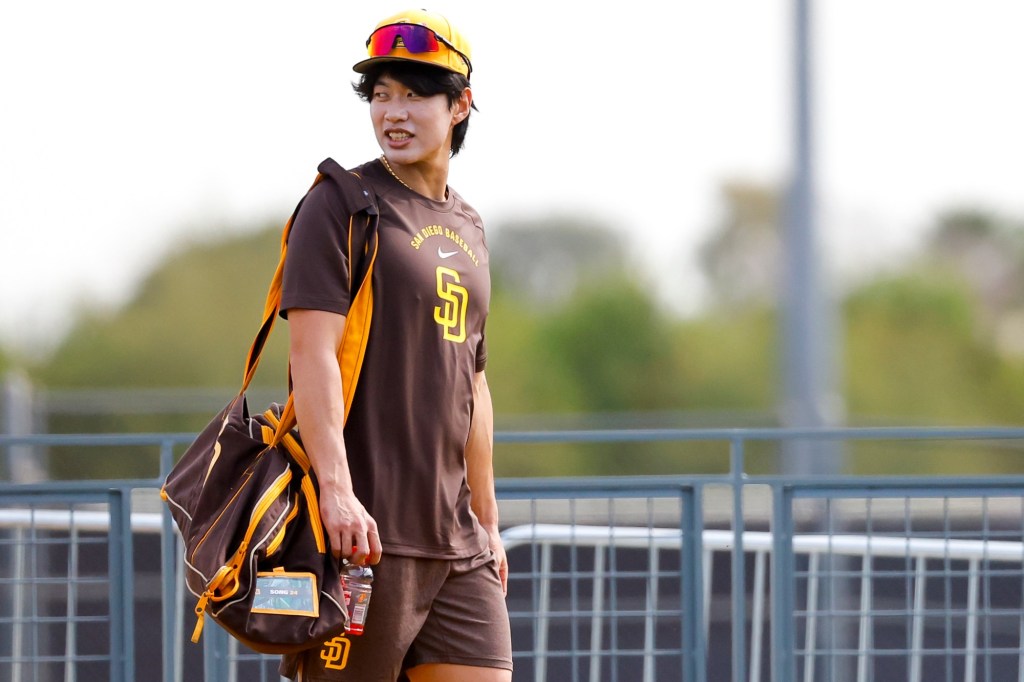
PEORIA, Ariz. — Sung-Mun Song will not start spring late.
That is good for both him and the Padres, because history and the scouting report says he has some catching up to do.
Song, signed in December after nine seasons in the Korean Baseball Organization, appears to be pretty much full-go after suffering an oblique injury while taking batting practice in January.
“Sung-Mun has shown up in actually pretty good health, probably better than we expected,” manager Craig Stammen said.
“Obviously, when you have a little oblique injury, those can go sideways if you try to come back too soon. But I think the medical staff did a really good job trying to communicate with his people back in Korea and (Song took) it easy until he got to the States. And I think him having a baby in that time period also slowed him down a little bit too, which was good. But he’s been out here on the field for a couple days, done some work. He looks really good. We’re all kind of excited about what he looks like, fielding ground balls, the swings he has been taking in the cage.”
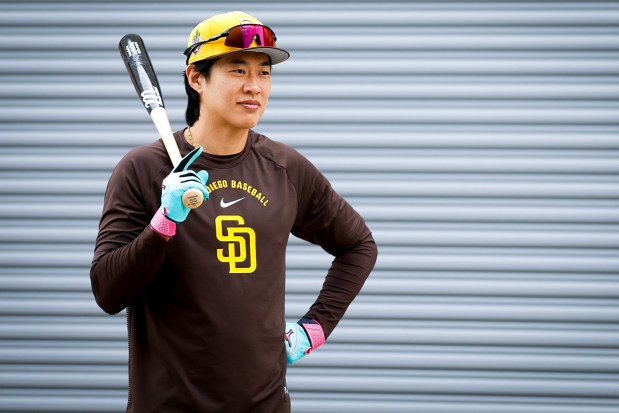 Sung-Mun Song #24 of the San Diego Padres looks on during the first day of spring training workouts at the Peoria Sports Complex on Wednesday, Feb. 11, 2026 in Peoria, Ariz.(Meg McLaughlin / The San Diego Union-Tribune)
Now comes the work of Song acclimating to Major League Baseball, which has proved to be an evolutionary process for even the best KBO players.
“I definitely heard a lot from my former teammates … and they’ve all told me pretty much the same thing,” Song said Wednesday through interpreter Sam Jeong. “It’s trying to get used to living in a different country. Within the field and just playing baseball is the same. But also I still have that language barrier, so getting used to that as well, and just being able to adapt and playing a higher level of baseball.”
How those former Kiwoom Heroes teammates — Ha-Seong Kim, Jung Hoo Lee and Hyeseong Kim — transitioned to playing against the world’s best pitchers might provide a glimpse into what is ahead for Song.
The Padres acquired Song, a left-handed hitter, at a cost of $15 million for four years. And the possibilities over the course of their relationship are practically limitless.
The strong-armed Song is primarily a third baseman, meaning he could eventually take over for Manny Machado at that spot if/when the superstar transitions across the diamond or to designated hitter. Song can also play second base, where the left-handed-hitting Jake Cronenworth currently plays. Song is going to start adding outfield to his list of positions this spring, and the Padres figure to need a left fielder after 2026 when Ramón Laureano’s contract is up.
For now, Song is expected to fill in all over the infield when regulars need a day off and a right-hander starts against the Padres.
And it is roundly anticipated that he will need some time to level up to where the Padres believe he can eventually get.
Song arrives as somewhat comparable offensively to the aforementioned trio that made the jump from KBO to MLB over the past five seasons.
At 29, he is four years older than Ha-Seong Kim and Lee and three years older than Hyeseong Kim when they debuted in the United States.
All three took time to adapt to the new culture, new food and the much higher level of play, significantly longer season and far bigger country to traverse.
The three players who preceded Song to MLB all produced at a higher level for longer than Song, who took a huge jump in 2024 and maintained that level in ‘25.
His production in those seasons was similar to the final two KBO seasons put forth by the other three.
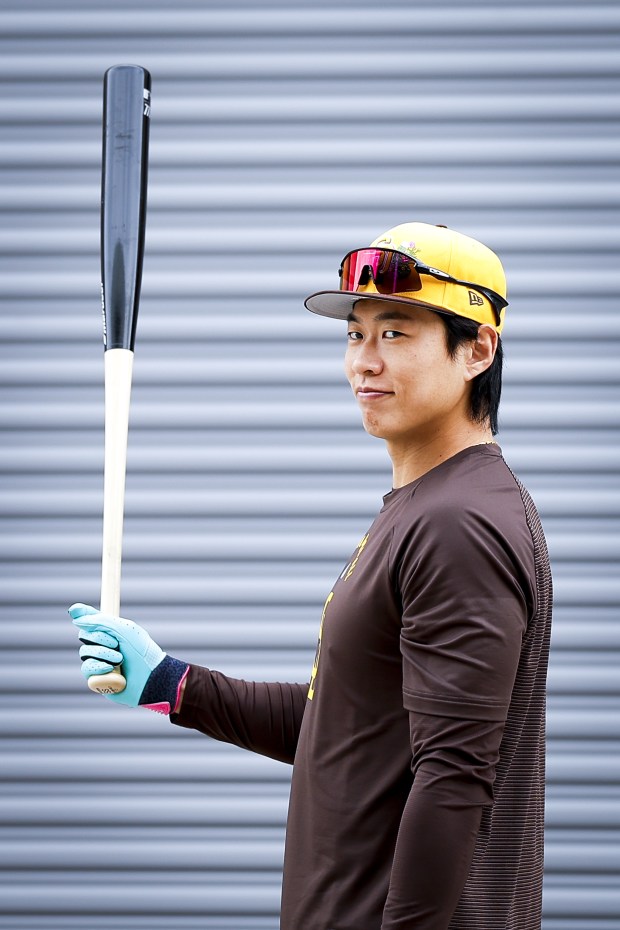 Sung-Mun Song #24 of the San Diego Padres looks on during the first day of spring training workouts at the Peoria Sports Complex on Wednesday, Feb. 11, 2026 in Peoria, Ariz.(Meg McLaughlin / The San Diego Union-Tribune)
Song’s on-base and slugging numbers were slightly better than both Kims’ and slightly lower than Lee’s.
But Song’s lower contact rate and higher strikeout rate are at least causes to wonder.
Lee was limited to 37 games for the Giants in his first MLB season in 2024, then batted .266/.327/.407 over a full 2025. Hyeseong Kim spent the first month of ‘25, his rookie season, in Triple-A and another month there later, ultimately playing in 71 MLB games and hitting .280/.314/.385 for the Dodgers.
The easiest comparison to visualize for Padres fans is Ha-Seong Kim, who spent his first four MLB seasons in San Diego.
After hitting .202 with a .622 OPS in limited playing time his rookie season in 2021, Kim became the Padres’ primary shortstop in ‘22 and raised his batting average by 49 points and his OPS by 86 points. He also cut down on his strikeouts and started to catch up to more velocity, though through five seasons he is still just a .180 hitter on at-bats ending on pitches 96 mph or greater. The MLB average over that same span is .225.
Among the changes Song made that contributed to his improvement in Korea were an altered diet and workout regimen and, moreover, a new approach at the plate.
He is a hard swinger now, with a big leg kick, and is big on pulling the ball. How that translates when he is facing pitchers consistently throwing 5 or 6 mph faster than he routinely saw in KBO will be a focal point early.
Earlier this offseason, Song said Ha-Seong Kim “gave me a lot of encouragement that I had the ability to challenge myself out here.”
Kim was immediately embraced by fans in San Diego for his relentless style of play and how clear it was that his teammates enjoyed him. By 2024, he had established a penchant for dramatic home runs and had become one of the team’s most popular players.
Someone visiting Petco Park for the first time and hearing the “Ha-Seong Kim” chants might have thought he was the most beloved of Padres players.
The goodwill Kim built with teammates and fans could conceivably serve to make Song’s transition smoother.
“The Padres were definitely a familiar team for me, just because I’ve definitely seen Ha-Seong Kim play out here,” Song said Wednesday. “Also, Kim having a successful career out here and just being a good teammate overall while he was here, that also played a factor. The players really have been welcoming me with that influence. I think that played a big factor (with) me getting welcomed into the team.”