
Baseball Prospectus posted their PECOTA projections for 2026 on Tuesday, including projected standings and playoff odds. For Brewers fans, the news is not good. The Cubs are not only favorites to win the division, but project for 90.5 wins—a full 10 games clear of the 80.5 victories for which the system pegs the Brewers. The system gives the Crew just a 10.5% chance to win their fourth straight NL Central crown, and only a 31.2% shot to make the playoffs at all. This feeling is familiar, but not fun, even though the story tends to end with Milwaukee far outstripping their projected win total.
Last week, FanGraphs posted their own projections and playoff odds, which are (technically) more optimistic about the Brewers. It gives them an 82-win projection. However, in that version of the projected standings, the Cubs are still first (albeit at a more reachable win total) and the Pirates sneak in just ahead of Milwaukee, for second place. That’s a jarring snapshot of where things stand as Brewers personnel gather in Maryvale. They’re not only not the favorites, but very much the underdogs in the fight to sustain their regional dynasty.
For PECOTA, at least, the problems the Brewers face lie in run production, rather than run prevention. The model expects Milwaukee pitchers to be better than average, and for them to be about 11 runs better than average when combining fielding and baserunning. However, the team’s projected DRC+ is just 96, where 100 is average and higher is better. It’s a dreary outlook, even for a team that prides itself more on good pitching and defense than on slugging.
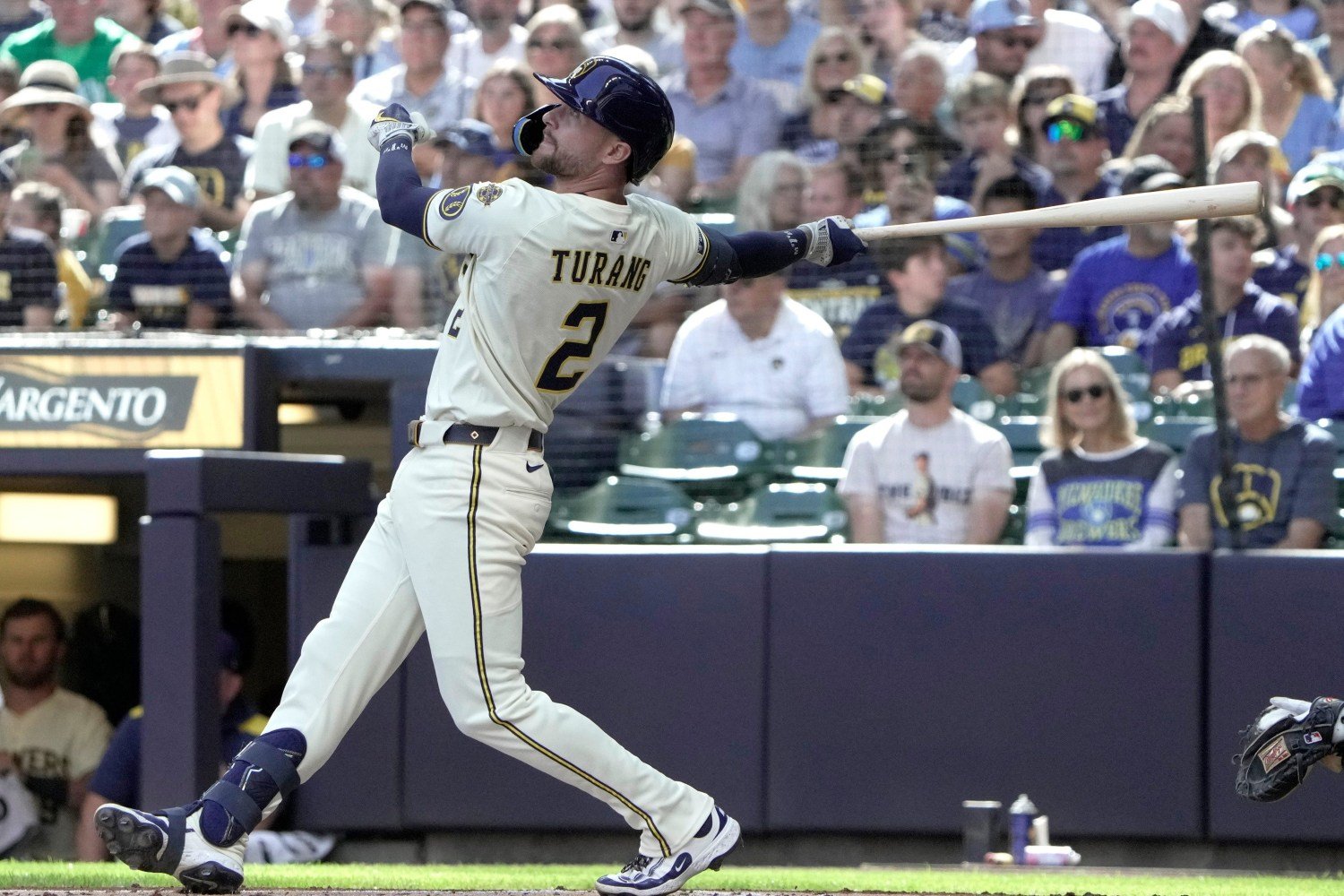
Two things about the projection stand out especially starkly. Firstly, PECOTA hates Brice Turang. I mean, it hates him. The model projects an 87 DRC+ and a .238/.311/.360 batting line for Turang. It sees him hitting 13 homers in 630 plate appearances, which would represent a small step backward after 2025, but the extent of the setback that overall line would be is much greater. Turang batted .288/.359/.435 in 2025. Admittedly, he hit just .254/.316/.349 in 2024, but even that line is essentially equal in value to the one he’s forecasted to produce this season—and it ignores his breakout year altogether, despite that being the most recent and relevant data about what he’ll do next.
Systems can be designed for varying levels of sensitivity to sub-surface adjustments, like the way Turang increased his bat speed in 2025 and traded some contact for better power, but they can’t be tweaked in specific cases; the risk of compromising the methodological integrity of the model is too great. Thus, PECOTA’s wariness about Turang is understandable, and perhaps even a necessary evil. Nonetheless, to best predict what the Brewers will do in 2026, one should mentally adjust Turang’s expected offensive output upward by about 10 runs.
Secondly, the Brewers set themselves back Monday by trading Caleb Durbin, as far as PECOTA is concerned. Durbin, now with the Red Sox, is projected for a 104 DRC+, with a .254/.332/.377 line. If the system is to be believed, Milwaukee will sorely miss those on-base skills.
David Hamilton will bring more speed and better up-the-middle defense off the bench than did Andruw Monasterio, but Monasterio is projected to be the better hitter. Meanwhile, neither Joey Ortiz nor Jett Williams is expected to replace what Durbin (with his elite contact rate and knack for getting hit by pitches) brought to the Milwaukee lineup. Barring a move for an external solution at third base, the Brewers downgraded somewhat significantly by trading Durbin and Monasterio to Boston. It’s nice to have better pitching depth than ever, but it might not be enough to justify having moved on so quickly from a player with long-term team control and such a high baseline for performance.
Sharp-eyed readers will notice that both Ortiz and Williams are projected to outhit Turang, according to PECOTA. That just reinforces the jarring nature of Turang’s projection. It feels indefensibly wrong, but it does highlight an important truth: using more than one year of data (where it’s available) makes projections better. What happened last is not always what should be expected to happen next. Turang’s projection probably is too low, but that doesn’t mean that Ortiz’s is unduly optimistic. The best-case scenario, then, is that the Brewers make some other addition to shore up the infield mix, but also get this version of Ortiz (one very much akin to the player he was in 2024) and the improved version of Turang. That still won’t get them to 90 wins, but it’ll start them on the journey there. The team will have to find other players who outdo their projections, too, but that’s rarely a problem for the unassuming superpower of the NL Central. At least Pat Murphy won’t be hurting for bulletin board material this spring, should he want some.