
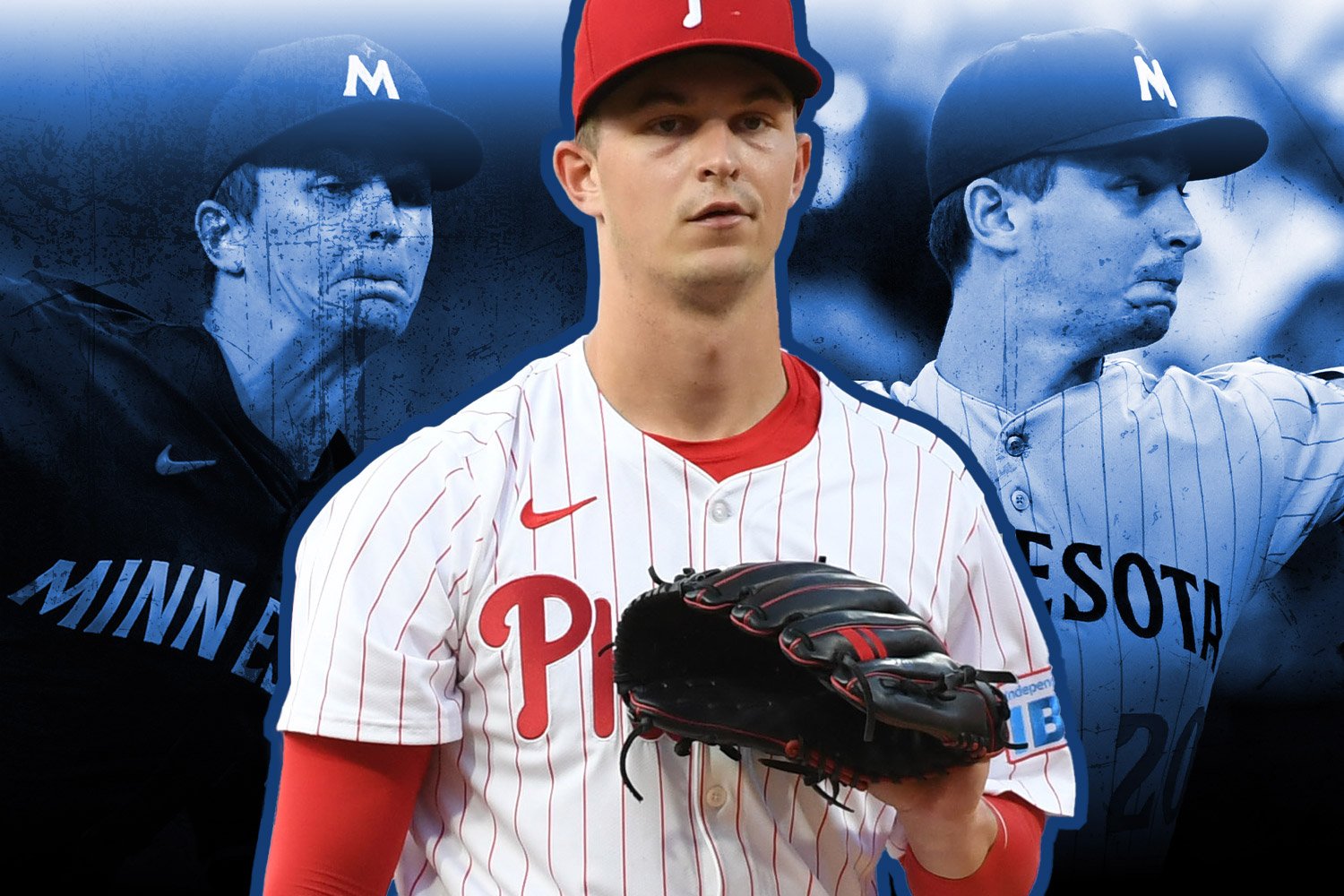
Acquired alongside top-100 prospect Eduardo Tait in the 2025 trade deadline deal that sent closer Jhoan Duran to the Philadelphia Phillies, Mick Abel made four appearances for the Minnesota Twins last season, generating an 8.36 ERA, 2.99 FIP, and an 18-to-7 strikeout to walk ratio over 14 innings. Abel’s struggles weren’t unique to his tenure in Minnesota, as he posted similarly disappointing numbers (5.04 ERA, 6.30 FIP, and 21-to-9 strikeout-to-walk ratio) over 25 innings with Philadelphia. Despite struggling during his first cup of coffee in the majors, the 24-year-old still projects to be a serviceable major-league starting pitcher in the near future, given his plus stuff and sustained success in the high minors. What should his role with the 2026 Twins be? Let’s take a look.
This article is part of a series about the Twins pitchers with the most fluid set of possible roles, as spring training begins. Read previous entries:
Mick Abel’s Stuff
Abel relies on his four-seam fastball; he threw it 42% of the time last season. Hovering around 96 MPH, the righty’s four-seamer possesses above-average velocity but an average movement profile. With a high spin rate, the heater ate up minor-league hitters over the past four seasons. Unfortunately, he was unable to replicate those results with the pitch at the major-league level in 2025, surrendering a .610 slugging average on it.
Somehow, attacking with a fastball this firm at the top of the zone should work. Philadelphia and Minnesota’s pitching coaches agree, evidently, as the young righty threw his four-seamer up in the zone 33.5% of the time last season, which would have been the highest rate in baseball if Abel pitched enough to qualify for that leaderboard.
Again, Abel’s fastball shape and spin rate grade out better than average, especially once one adjusts for his low three-quarter arm slot. That pitch isn’t disappearing from his arsenal any time soon. However, he’ll need to locate it more efficiently and become less predictable if he wants to mirror the success he had with the pitch in the high minors.
Mick Abel’s Arsenal
Abel’s best pitch is his curve, which he threw at a 21% rate in 2025. He reserces the offering almost exclusively for left-handed batters. As is true with a good changeup, right-handed pitchers are often able to get left-handed hitters to swing over curves low in or below the zone, generating whiffs or inducing weak choppers to the right side of the infield. The pitch was a darling of advanced metrics, with left-handed hitters generating a .296 expected slugging average (xSLG) and a .212 expected weighted on-base average (xwOBA) against the pitch last season. Though it pops out of his hand a bit, lefties have a hard time adjusting to the depth of the pitch’s movement. The blue tracer below shows the average trajectory of Abel’s curve. Hitters read that either hump, but struggle to bend their swing enough to respond to its two-plane break.

His slider (thrown 12% of the time) was less impressive, generating a .449 xSLG while being thrown only 83 times. Abel throws his slider far more often to righties, hoping to pinpoint the pitch low and outside of the zone. Unfortunately, his slider control is spotty, with his heat map looking like a no-correlation scatter plot. Still, you can see how it’s more deceptive to a righty than that curve. Horizontally, the slider and four-seamer stay in the same tunnel longer, before the slider breaks away and the fastball tails back toward the batter.

The righty also throws a sinker and changeup, which combine for a 22% usage rate. Unsurprisingly, he utilizes his change (alongside his curve) to attack left-handed hitters. The pitch was hammered last season, though, with hitters turning into Ted Williams and posting a .417 batting average against it. Abel was slightly more effective throwing his sinker, with hitters instead turning into Tony Gwynn and running a .375 batting average against the pitch. Abel will need to continue refining his pitches with Minnesota’s pitching development. Luckily, being 24 years old and having thrown only 39 innings in the majors, Abel should still be treated with the grace of an unproven pitching prospect.
Year
Pitch Type
#
# RHB
# LHB
%
MPH
PA
AB
H
1B
2B
3B
HR
SO
BBE
BA
XBA
SLG
XSLG
WOBA
XWOBA
EV
LA
Spin
Ext.
Whiff%
PutAway%
2025
Four Seamer
303
92
211
42.1
96.4
73
59
17
10
1
0
6
15
44
.288
.273
.610
.570
.439
.418
90.7
25
2544
6.8
25.9
18.3
2025
Curveball
154
31
123
21.4
82.7
35
35
6
2
1
1
2
16
19
.171
.198
.429
.296
.248
.212
89.4
12
2672
6.8
37.5
23.5
2025
Sinker
95
80
15
13.2
95.4
26
24
9
8
0
1
0
1
23
.375
.339
.458
.398
.386
.351
91.5
7
2469
6.7
12.2
6.3
2025
Slider
83
65
18
11.5
87.3
23
22
5
5
0
0
0
3
19
.227
.271
.227
.449
.222
.320
95.5
14
2419
6.7
16.3
9.4
2025
Changeup
63
4
59
8.8
89.1
12
12
5
5
0
0
0
2
10
.417
.333
.417
.538
.368
.375
90.2
1
1704
6.8
25.0
13.3
2025
Sweeper
22
22
0
3.1
84.5
5
5
1
1
0
0
0
2
3
.200
.228
.200
.313
.176
.237
87.4
34
2781
7.0
41.7
15.4
What Should Be Mick Abel’s Role In 2026?
While technically competing with Taj Bradley, Zebby Matthews, and David Festa for the fifth rotation spot, Abel has the fewest innings in the majors of that group and the most refinement needed to his arsenal. That being the case, Abel would be best suited to start his 2026 campaign in Triple-A, functioning as a still-developing starting pitching prospect. He still has two minor-league option years, so Minnesota has the luxury of being patient with Abel. He should figure into the rotation at some point in 2026. Yet, given that Pablo López, Joe Ryan, and/or Bailey Ober could no longer be part of the club’s rotation come next season, the team would be wise to continue developing Abel as a starting pitcher in Triple-A, with an eye toward him becoming a rotation stalwart in 2027 and beyond.