
Getty
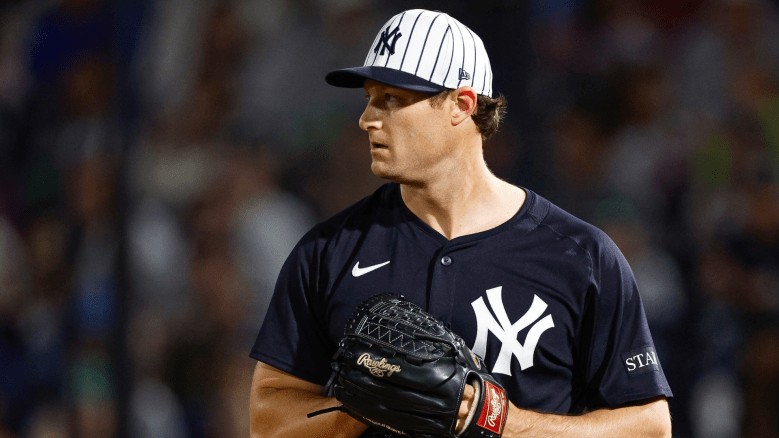
The New York Yankees did not open spring training with chaos. They opened it with cautious optimism—and one interesting wrinkle. Manager Aaron Boone acknowledged that while Gerrit Cole is still targeting a May or June return from Tommy John surgery, there is a scenario in which the ace could appear in a Grapefruit League game before camp breaks.
On the surface, it sounds encouraging. But analytically, it’s worth examining whether it’s realistic—and whether it serves any meaningful purpose.
The Timeline vs. the Temptation
Cole is approximately 11 months removed from Tommy John surgery. Historically, pitchers return to major league game action between 12 and 14 months post-procedure. The Yankees have consistently framed early summer as the realistic target window.
From a medical and performance standpoint, that timeline is conservative and logical. Cole has already cleared key checkpoints: offseason mound work, multiple bullpen sessions, and a progression toward live batting practice. The next step—facing hitters—is scheduled within the next few weeks.
Technically, nothing prevents him from appearing in a controlled spring training outing if his arm responds well.
But here’s the analytical question: What does that appearance accomplish?
Spring training innings would not accelerate his regular-season debut. Whether Cole throws 15 pitches in late March or none at all, he still needs a structured buildup of volume. Rehab assignments, pitch-count increases, recovery monitoring—those elements matter far more than symbolic Grapefruit League participation.
The Yankees’ real objective isn’t to be ready for Opening Day. It’s sustainable through September and October.
Introducing competitive adrenaline too early adds variability. Even low-stakes exhibition environments create different stress patterns than bullpen sessions. From a risk-management standpoint, the marginal upside appears minimal.
Rotation Context Changes the Equation
The Yankees’ broader rotation depth matters here. Carlos Rodón is reportedly ahead of Cole in his rehab timeline following his elbow procedure. Max Fried provides frontline stability from the left side. Internal options and depth arms offer insulation for April and May.
This context reduces urgency.
If the Yankees were entering camp thin and desperate for innings, perhaps the calculus changes. But they are not operating from scarcity. They are operating from strategic patience.
There is, however, a psychological component. For elite competitors like Cole, crossing the threshold from rehab to game action can represent a mental checkpoint. Proving the elbow responds in a competitive setting has value. The organization may want that data—velocity consistency, recovery response, command under sequencing pressure.
If Cole were to pitch in a spring game, it would likely be highly controlled: one inning, strict pitch limit, immediate evaluation.
From an analytical lens, that suggests the appearance would function more as information gathering than competitive ramp-up.
So, is it realistic?
Yes—medically and structurally, it’s plausible.
Does it materially change the Yankees’ 2026 outlook? Unlikely.
The smarter projection is that the Yankees prioritize controlled progression over optics. The temptation to showcase positive rehab momentum is understandable. But championship windows are rarely influenced by March appearances.
For the Yankees, the real milestone isn’t stepping onto a Grapefruit League mound.
It’s stepping onto a regular-season mound—healthy, durable, and built to last.
Alvin Garcia Born in Puerto Rico, Alvin Garcia is a sports writer for Heavy.com who focuses on MLB. His work has appeared on FanSided, LWOS, NewsBreak, Athlon Sports, and Yardbarker, covering mostly baseball. More about Alvin Garcia
More Heavy on Yankees
Loading more stories