
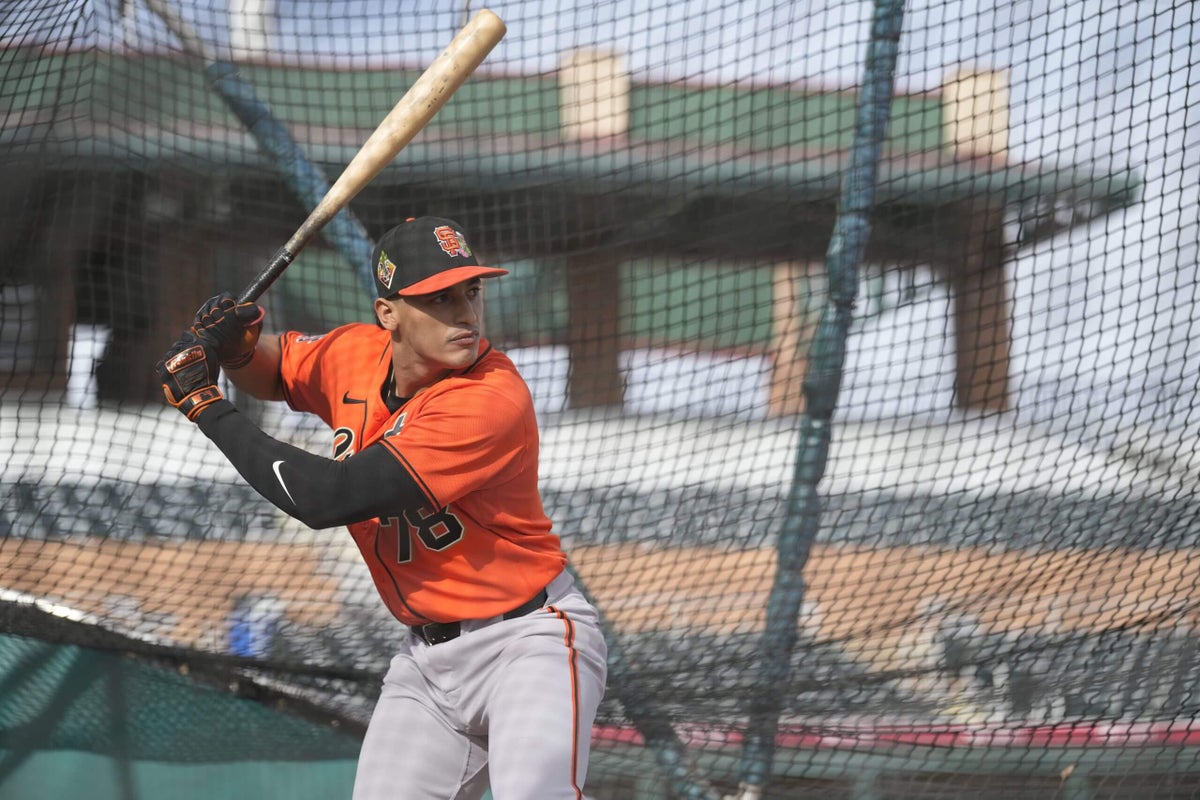
It wasn’t so long ago that catcher Diego Cartaya was the toast of the Los Angeles Dodgers’ celebrated farm system: a teenage phenom with breathtaking power, a high baseball IQ and every attribute to become a defensive asset behind the plate.
While he was tearing up the lower levels of the Dodgers’ system and becoming one of the top-ranked prospects in the game, Cartaya learned a lesson that gets drilled into every Dodgers prospect — a healthy animosity toward their NL West rivals, especially the San Francisco Giants.
Cartaya never reached Dodger Stadium. He is a 24-year-old non-roster invitee in Giants camp this spring. So, what does he think of the Dodgers now?
“Now I hate them!” Cartaya said, laughing. “It’s the same mentality, but things get switched around a bit. I hate every single team that’s not the Giants now.”
It might be the only negative emotion that he allows himself to feel. Cartaya has had enough bad and unproductive thoughts rumble through his head over the past few years as his lower back forced one swing change after another, his numbers stalled in the upper minors and his prospect shine dulled. He went from being the 18th-ranked prospect in the game by Baseball America in 2023 to being absent from the list the following year.
The Dodgers had added Cartaya to their 40-man roster to protect him from the Rule 5 draft. But prior to last season, when they faced a roster crunch after signing infielder Hyeseong Kim, they designated him for assignment, then traded him to the Minnesota Twins for an unranked prospect. He looked totally lost at the plate, hitting .085 with 40 strikeouts in 61 plate appearances over 20 games for Triple-A St. Paul, before the Twins released him.
Not long after that, Cartaya started learning to love the Giants. The team signed him to a minor-league contract at the end of July, and with no 40-man roster obligations, it could afford to let him start from scratch.
“He’s shown special ability in the past, and youth is still on his side,” said Giants director of player development Kyle Haines, who remembered seeing Cartaya perform well in the Low-A Cal League while competing as a 20-year-old against older players. “He’s a phenomenal young man, and he’s probably not too much older than some guys catching in their senior year of college. Catchers are hard to find, and usually catchers mature a little bit later than everyone else. It was a calculated risk: Let’s get this guy for two years and work with him.
“The poor kid has been through so many quick-fix solutions hitting-wise that he was still trying to find himself. When we talked to him, you could tell he just needed runway for development and not quick fixes.”
There’s activity in the bullpen❗️ pic.twitter.com/J1FZOM8oHt
— SFGiants (@SFGiants) February 11, 2026
Cartaya was considered a bat-first catcher with a strong arm and plenty of aptitude when the Dodgers awarded him a $2.5 million signing bonus in 2018, when he was considered the best prospect in his class from Venezuela. It didn’t take long for him to shoot up prospect lists. In 2022 and ’23, Baseball America ranked him as the top prospect in a stacked Dodgers system.
Then the lower-back issues started. Cartaya hit .189 with a 29 percent strikeout rate at Double-A Tulsa as a 21-year-old in 2023. The snowball turned into an avalanche.
“I feel like I was chasing being perfect and not enjoying the game like I used to,” Cartaya said. “I let the bad moments affect me a lot. I was just thinking about the future and not living in the present. I let one bad day take me to another, and then it becomes a week, and then a season. So the big thing is being present and loving what I’m doing right now.”
That was the mindset Cartaya adopted last July after signing with the Giants. He took a square-one approach with his swing at the Papago Park complex, then didn’t hesitate when the Giants asked him to join the San Jose club in Low A — a level from which he graduated three years earlier — for the Cal League playoffs. In four games, he hit a home run and a double and drove in five runs.
“I was happy to be healthy and with a team,” said Cartaya, who was impressed with several of his new teammates and had the most praise for left-hander Jacob Bresnahan. “It was exciting to be in playoff games, and I was just enjoying my time.”
The Giants did not sign Cartaya as a bat-first catcher. They were more attracted to his intelligence and maturity behind the plate, which has already paid dividends.
“Yes, the bat needs a lot of help, but his leadership ability is so far beyond his years,” Haines said. “It was really clutch to have that type of leader at our A-ball level with those pitchers. He’s not Crash Davis, by any means, but to have someone with his experience and knowledge around our younger pitchers at San Jose, and catching them in the playoffs, was a huge added development bonus for our pitching staff and our team in general.
“He’s really helped raise the floor of our catching depth and increase the quality of our pitcher-to-catcher conversations. But also, we know there’s more offense in there somehow. I’m sure the lower-back issues changed his swing a little bit. It’s a calculated risk, I guess, but really good people who are hardworking and intelligent, as catchers, they tend to stay around a little longer.”
In all likelihood, Cartaya won’t survive the first wave or two of cuts this spring. He’s ticketed for Double A or Triple A to start the season. If he positions himself for a 40-man roster spot and his first major-league promotion, he’d be out of options and couldn’t be sent back. The Giants want to give Rule 5 pick Daniel Susac every opportunity to make the team, and they have former Detroit Tigers catcher Eric Haase in camp as well. Catcher Jesus Rodriguez, who was acquired last July in the trade that sent Camilo Doval to the New York Yankees, is considered close enough to the big leagues that he spent the last homestand of last season on the taxi squad so he could be around big leaguers and coaches.
What does Cartaya hope to show the Giants for however long he has a locker in the major-league clubhouse?
“Being honest, I just want to be consistent with one thing and be present and enjoy the time,” Cartaya said. “I know I’m ready to do a lot of good stuff.”
What’s making this spring especially enjoyable is that Cartaya and his locker mate have a hometown connection. He and Rodriguez are from the state of Aragua and grew up in the neighboring towns of Maracay and La Victoria. Their academy teams played against each other often from the time they were 8-year-olds until they were 12 or 13. Cartaya was the star attraction for Liga INCE, called the Incitos, and Rodriguez played for Liga Las Mercedes.
“He was the guy,” Rodriguez said. “He was a really good power hitter. He was throwing flames from the mound, too. We’d say hi to each other, but it wasn’t a friendship or anything until last year.”
They connected when Cartaya was playing for Triple-A St. Paul and Rodriguez was with the Yankees’ Triple-A team. They promised each other that they’d keep in touch. They had no way of knowing it’d be so easy to follow through on that promise the next spring.
“Coming from the same town, it’s something you take pride in,” Rodriguez said. “It’s really good to have a friend here.”
Rodriguez fits the archetype of a bat-first catcher. His right-handed contact skills stood out to the Giants when they asked the Yankees about including him in the three-prospect deal for Doval. He performed as advertised after joining Triple-A Sacramento, hitting .322 while drawing more walks (18) than strikeouts (17) in 173 plate appearances. If Rodriguez develops into a big-league contributor, the Giants could have a third hyper-contact hitter in their lineup, along with Luis Arraez and Jung Hoo Lee.
Coming 🔜 to San Francisco: three-time batting champion and two-time Silver Slugger, Luis Arráez pic.twitter.com/QDoe6A4Haq
— SFGiants (@SFGiants) February 10, 2026
The defensive skills remain a work in progress, though. After a one-week clinic last September with Giants catching coach Alex Burg, Rodriguez spent his offseason working on improving ball security: receiving pitches more cleanly and addressing his blocking deficiencies.
“Those six days I spent (with the Giants), I really learned a lot about how to get a routine down,” Rodriguez said. “It was a really good offseason. I’m feeling grateful to be here. I want to show them how I improved. And I feel like being on base is always my game. That’s what I’ll try to do here — be on base and try to get some stolen bases, too.”
Perhaps Rodriguez can pick up a defensive tip from Cartaya while passing along his own insights about hitting. Development might be the buzzword in camp under new manager Tony Vitello, but it doesn’t have to be linear.
The Giants ideally would back up Gold Glove catcher Patrick Bailey with a right-handed hitter whose bat could be an asset off the bench. Ask Vitello for his criteria, though, and he provides a different answer.
“In a perfect world, all that stuff makes sense, but if we’re playing ‘Family Feud,’ No. 1 for me is having that rapport,” Vitello said. “You’ve got to like going into battle with a guy. … I’ve coached guys before where you’re sizing them up, and he’s not your favorite behind closed doors or on the dry-erase board, but you start talking to the players, and that’s who they trust. They value leadership and kind of that stuff that you can’t put analytics on. So that, that for me, is No. 1.”
And if your backup catcher hates the Dodgers, so much the better.