
As the 2026 college baseball season approaches, Baseball America is examining top pitchers to watch. This series is not limited to draft-eligible players and includes standout upperclassmen and veterans alike.
Each list is informed by a combination of data, performance and scouting feedback to whittle down the top arms to know entering the season. Throughout the series, we’ll evaluate pitchers through the lens of physical build, release traits, pitch characteristics and on-field results at the collegiate level.
After breaking down the SEC and ACC, we’re highlighting 10 more top arms to know heading into the 2026 season. To finalize the list, we leaned heavily on our contacts with knowledge of the conference to identify the pitchers who have the most buzz heading into the opening weekend of the 2026 season.
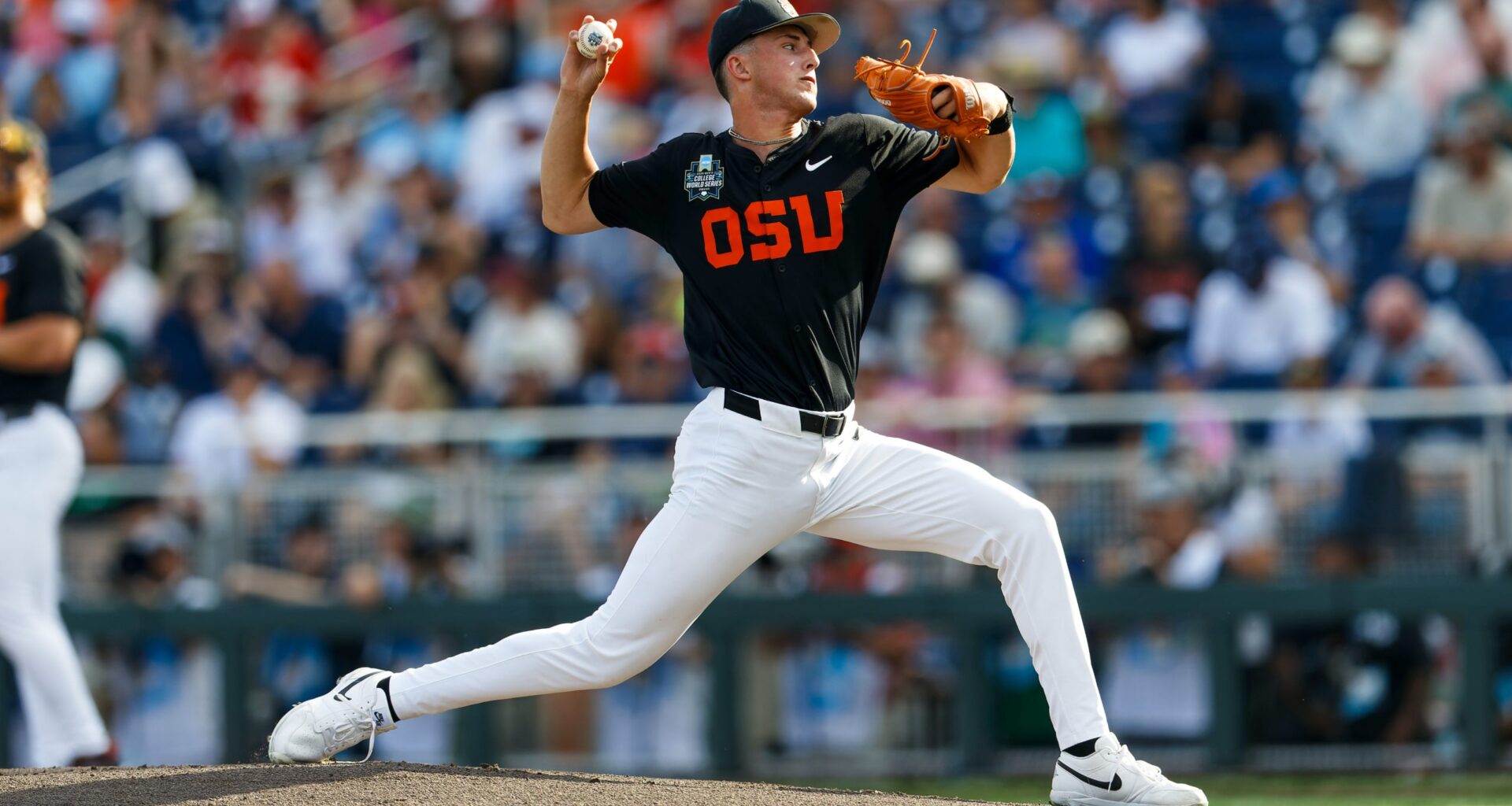
Dax Whitney, RHP, Oregon State
Class: 2027
HT: 6-5. WT: 204.
2025 Stats: 6-3, 3.40, 76.2 IP (17 Starts), 120 SO, 37 BB, 1.28 WHIP
Whitney is the top pitcher in BA’s 2027 college draft prospect rankings, and after a stellar freshman season for Oregon State, he’s one of the top pitchers in all of college baseball. Whitney has size, athleticism, power and feel for spin. It’s a collection of traits that will make him a top-tier starting pitching prospect the moment he enters pro ball.
Being unique is a large part of finding success as a professional starter, and Whitney has several unique traits. He’s able to create a flatter plane on his fastball with a higher release height and above-average extension—three traits that typically aren’t synonymous. To add in another dash of the unusual, he creates plus ride with heavy cut. It’s a unique pitch with the closest comparison being Chase Burns’ fastball, though it’s not an exact one-for-one. These traits are likely a product of his good extension, short arm action and over-the-top slot.
“Fastball dominant” is the best way to describe Whitney’s pitch usage. He threw his fastball 66% of the time in 2025, while mixing in his curveball and sweeper regularly. Whitney’s fastball sits 93-95 mph, touching 98 with 19 inches of ride and heavy cut. His primary secondary usage is split fairly evenly between his two breaking balls. He threw his mid-70s curveball with heavy spin and over a foot of drop and sweep. His sweeper sits 81-84 mph with 17 inches of horizontal break on average. He drove lots of swings and misses against both breaking ball types. The curveball generated an 18.3% swinging-strike rate in 2025, while the sweeper ran a 14% swinging-strike rate. His changeup was thrown around 7% of the time in 2025 and saw good results, with a 20.9% swinging-strike rate and an average number of strikes.
Whitney has four above-average to plus pitches. His ability to generate velocity, good angles and spin put him in a rare class of pitching prospects. He should be in consideration for the top-overall pick in 2027.
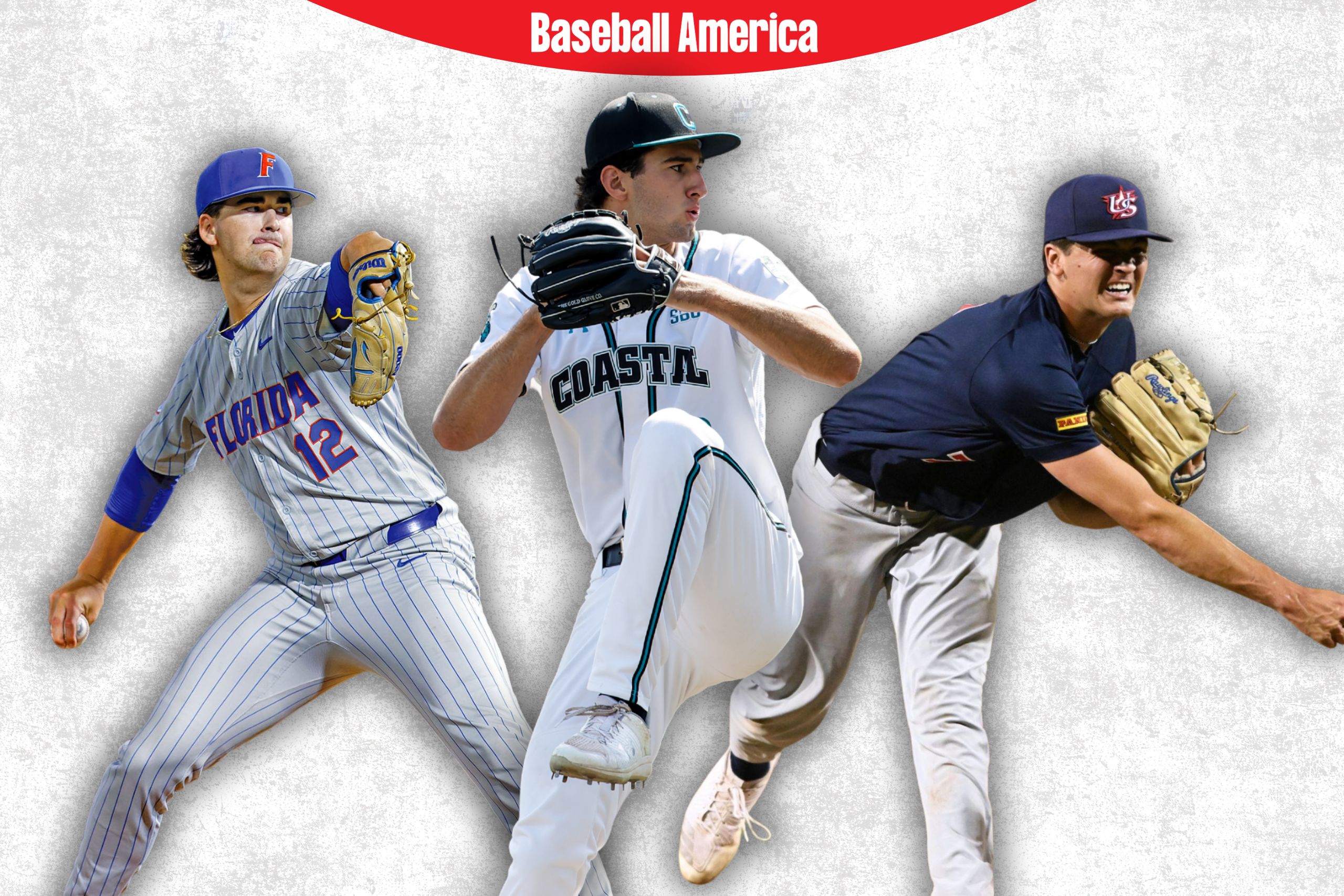
Cameron Flukey, RHP, Coastal Carolina
Class: 2026
HT: 6-6. WT: 210.
2025 Stats: 8-2, 3.19, 101.2 IP (17 starts), 118 SO, 24 BB, 1.00 WHIP
The top college pitcher in our most recent 2026 draft rankings update, Flukey helped pitch Coastal Carolina to the College World Series in 2025. He took a giant leap forward in his sophomore season earning first-team all-Sun Belt honors. Flukey has a deceptive operation, plus stuff and strike-throwing, a 6-foot-6 frame and a track record of starting. He’s a top-of-the-draft starting pitching prospect.
Flukey is a hyper-mobile mover with great balance and elasticity. He’s able to get into position few pitchers can, creating good power and angles. He starts in a semi-windup before moving into a high-tempo delivery with a high leg lift, longer arm swing and three-quarters arm slot. It’s an athletic motion but one that does come with a good deal of effort.
Flukey’s five-pitch mix features a four-seam fastball, slider, curveball, cutter and a changeup. The fastball sits 95-96 mph and reaches up to 98 with 20 inches of induced vertical break from a six-foot release height. His primary breaking ball is his mid-to-high-70s curveball with downer break. Flukey’s slider sits in the low 80s with slurvy shape and is effective expanding the zone. The cutter sits mid 80s with gyro cut shape, but it was barreled up in 2025 with a 50% hard-hit rate against.
Flukey shows above-average command across his pitch mix, helping to play up a more average mix of secondary pitches. It’s a deep mix with good velocity and a variety of shapes. Flukey looks like a potential midrotation starter in the making.
Jackson Flora, RHP, UC Santa Barbara
Class: 2026
HT: 6-5. WT: 205.
2025 Stats: 6-3, 3.60, 75 IP (11 starts), 86 SO, 17 BB, 1.00 WHIP
Flora is considered to be one of the top pitching prospects in the upcoming draft after an impressive sophomore campaign with UC Santa Barbara put him on the map. With size, stuff, athleticism and strikes, Flora checks a lot of the boxes synonymous with the prototype starting pitcher. A strong season for UC Santa Barbara could push Flora into the 1.1 conversation by this summer.
An outstanding athlete on the mound, Flora moves well, creates good angles and gets to the power in his frame. Flora is tall and high-waisted with a projectable frame that should add some muscle and good weight in the coming years. He starts his move to the plate with a semi-windup that leads into a leg kick, balancing over his back leg before pushing off from his drive leg. He gets down the mound to create average extension, delivering the ball from a low three-quarters arm slot. Flora’s mechanics are easy, free and smooth, and he repeats his motion well.
Flora has a three-pitch mix and is heavy on his fastball and slider usage, mixing in his changeup infrequently. Flora’s fastball sits 96-97 mph with above-average ride and moderate cut. He averaged around six and a half feet of extension, lowering his release height and creating a good angle on the fastball when paired with his lower three-quarters slot. Flora misses bats with the fastball and shows average command. His mid-80s sweeper is his primary secondary, seeing nearly all of his non-fastball usage. The slider has a plus combination of velocity, spin and movement. He gets some ride and around 13 inches of gloveside break. Flora also threw a firm upper-80s changeup with fringe vertical separation from his fastball.
Flora has a projectable frame, velocity, feel for spin and strikes. There’s a lot to buy into when it comes to the athlete and pitcher.
Tommy LaPour, RHP, TCU
Class: 2026
HT: 6-4. WT: 230.
2025 Stats: 8-3, 3.09, 90.1 IP (16 starts), 88 SO, 27 BB, 1.16 WHIP
After a strong freshman campaign with Wichita State, LaPour transferred to TCU before his sophomore season. In his one year with the Horned Frogs, he pitched to a 3.09 ERA and made an easy transition to the Big 12. Heading into 2026, LaPour is one of the top pitching prospects in the Big 12 and has a realistic shot of being drafted inside the first two rounds.
LaPour is a big, physical thrower who gets to his velocity easily thanks to a mature build and strength. He gets below-average extension, however, and there’s nothing particularly unique about his angles. He does drop down a bit in his drive toward the plate, lowering his release height below six feet. It’s a simple but explosive operation, as his motion is short on moving parts or quirks. Despite his bigger frame, LaPour performs as a plus athlete in testing systems teams use to determine athletic output.
Led by a four-seam fastball that sits 95-98 mph and touches triple digits, LaPour mixes three pitches. His secondaries consist of an upper-80s changeup and a low-to-mid-80s slider. LaPour’s fastball sees around 50% usage, and he manages to hold his velocity, reaching back for 98 or higher when needed. The fastball generates a below-average amount of whiffs despite plus velocity, but it did generate good results, holding opposing batters to a .305 wOBA. The fastball has just average ride and armside run, but he shows good command to avoid trouble spots in the zone.
LaPour generated good results against both of his secondaries in 2025, showing the ability to generate whiffs against his slider and changeup. The changeup sits 88-90 mph with minimal vertical separation off of his fastball, but it performs due to his ability to command it and sell it off his fastball. LaPour’s slider sits 83-84 mph with short slider shape and lower spin rates. Hitters did very little damage against the pitch, resulting in a 17% hard-hit rate in 2025. It’s his best swing-and-miss pitch and delivered his best results overall with a 39.8% whiff rate.
LaPour has top-end power for a starter and three defined pitch shapes but is without a pitch that plays as plus. Due to his power, there’s a wide range of outcomes but also a wide range of ways to deliver value as a professional.
Owen Kramkowski, RHP, Arizona
Class: 2026
HT: 6-3. WT: 172.
2025 Stats: 9-6, 5.48, 92 IP (18 starts), 90 SO, 18 BB, 1.46 WHIP
Kramkowski spent his freshman year pitching sparingly out of the Arizona bullpen, and in his sophomore season, he made the jump to the rotation. He struggled during his debut season as a starter but showed flashes of upside and an ability to handle a larger workload. Kramkowski shows above-average command, velocity and the ability to miss bats with his slider.
Kramkowski is a loose and fluid mover at 6-foot-3 with a thin frame that may or may not add weight in the future. He has the look of a projectable starter who should find more velocity as he ages, but it is a narrower frame. Kramkowski gets down the mound to create above-average extension and good angles on his pitches. His operation is low effort and repeatable, and he delivers the ball from a lower three-quarters arm slot. His 5-foot-2 release height creates a good plane on his two fastball shapes.
Kramkowski has four pitches: two fastball variations in a four-seam and two-seam, a cutter and a sweeper. The two fastball shapes sit 93-95 mph, touching 98 with good plane and angles. The four-seam fastball has a flat plane of approach, while the two-seamer has less ride and heavier armside run. Both of his fastballs generate groundball rates north of 50%, though neither is a good bat-missing pitch.
The secondary usage is split between two breaking ball shapes. The sweeper sees slightly more usage, sitting 81-83 mph with around 10 inches of sweep on average and spin rates in the 2,600 rpm range. It’s Kramkowski’s best bat-missing pitch, and it generates above-average whiff rates and a high chase rate. Like all of Kramkowski’s pitches in 2025, batters did damage against the sweeper, but it had the lowest batting average and hard-hit rate in his arsenal. Kramkowski’s cutter is a high-strike pitch with the ability to drive whiffs outside the zone and bridge between his fastballs and sweeper. The pitch sits in the high 80s with ride and true cut.
Kramkowski has an easy, clean operation and a build that projects for more velocity. There are unique release traits, some feel for spin and lots of strikes. The results haven’t quite matched the abilities yet, but 2026 could be a breakout season for Kramkowski.
Smith Bailey, RHP, Arizona
Class: 2027
HT: 6-4. WT: 196.
2025 Stats: 3-3, 3.94, 89 IP (18 starts), 80 SO, 32 BB, 1.39 WHIP
Bailey made an immediate impact in the Wildcats’ rotation as a freshman making 18 starts and producing strong numbers while showing the ability to handle a starter’s workload. Bailey is still two years away from draft eligibility but will be arguably the top 2027 pitcher in the conference. Bailey made the all-Big 12 freshman team in 2025 and is likely to be a major part of a talented weekend rotation for the Wildcats.
Bailey is a smooth and easy mover on the mound with repeatable mechanics. He doesn’t generate much extension, but he does move well, creating steeper plane on the fastball from a three-quarters slot and higher release point. He will lose his release point on his fastball at times, and his command suffers because of it.
It’s a four-pitch mix for Bailey, led by the four-seam fastball, two breaking ball shapes in a slider and curveball and a changeup. The four-seam fastball sits 91-93 mph, getting up to 96 and showing below-average ride and heavy armside run. Bailey will need to add a sinker with velocity to pair with the four-seam fastball for this to work as a professional.
The slider is Bailey’s most-thrown secondary, sitting 81-83 mph with gyro-like shape. He shows plus command for the pitch and has the ability to land it for a strike or expand the zone when needed. The slider has the highest whiff rate of any pitch in Bailey’s arsenal. The curveball is a change-of-pace pitch in the mid 70s with two-plane break and moderate vertical depth. It drove good results last year, including a .244 wOBA by opposing batters. The changeup is thrown almost exclusively to lefthanded batters, and while it doesn’t drive many whiffs, Bailey shows the ability to steal strikes and generate ground balls with the pitch.
Bailey is a projectable righthander with a deep pitch mix and the ability to throw strikes at an average rate. Added velocity and improved fastball command could help him find another gear in coming years.
Cole Carlon, LHP, Arizona State
Class: 2026
HT: 6-5. WT: 230.
2025 Stats: 3-1, 3.33, 54 IP (0 starts), 86 SO, 25 BB, 1.06 WHIP
Carlon was a power lefthanded reliever over his first two seasons with Arizona State, and after struggling with command as a freshman, he made big strides as a sophomore. He earned all-Big 12 first-team honors last year and is slated to head the Arizona State rotation to begin the season. Strike-throwing is a lingering question for Carlon, as is how well his stuff will hold up over longer starts.
Carlon is a tall, strong lefthander with a large frame that is close to physical max. He is a short strider who creates little extension, with a large leg lift move and coil that loads deeply into his back leg. He has a longer arm action, and he fires the ball from a high three-quarters slot. It does create some odd angles, particularly from a lefthander with above-average velocity and movement on his pitches.
Carlon throws three pitches, but his usage is dominated by his slider and fastball. He occasionally mixes in a curveball, too. The slider is Carlon’s bread-and-butter pitch, getting the most use and sitting 84-86 mph with gyro cut shape. The pitch generated a 28.1% swinging-strike rate in 2025—an elite marker for swings and misses. It’s an unusual look and shape for a lefty slider, and that’s part of the reason it drives great results. Carlon will mix in a curveball at 79-81 mph with two-plane break. It’s thrown infrequently and is his only example of a third pitch.
Carlon will make the jump to the rotation in 2026, and he faces questions around how he’ll hold up against a more rigorous schedule. He looks a lot like a reliever long term, but his performance in 2026 could determine his opportunity.
Chase Meyer, RHP, West Virginia
Class: 2026
HT: 6-2. WT: 175.
2025 Stats: 9-2, 3.94, 48 IP (3 starts), 63 SO, 38 BB, 1.46 WHIP
Over the last two seasons, Meyer has shown plus stuff while pitching primarily as a reliever. After a difficult freshman season, he took a big step forward in 2025, earning an all-Big 12 honorable mention. Meyer showed serious swing-and-miss ability, but his command leads to real questions about his ability to make the jump to the rotation. Meyer will be on the sidelines to start the 2026 season, as he’s a few weeks behind schedule after breaking a finger in his throwing hand in November.
Meyer has an average build with the ability to add some good weight in the coming years. He pitches out of the windup from a modified stretch with a higher leg kick, minimal extension and a three-quarters arm slot. Out of the stretch, Meyer’s command backs up significantly, as he seems to have issues repeating his operation.
Meyer’s pitch mix is rich on power, spin and movement. It’s the type of arsenal guaranteed to blow up Stuff+ models. He throws three pitches in his four-seam fastball, curveball and an infrequently-used changeup. The four-seamer sits 93-96 mph, touching 98 at peak with moderate ride and plane but heavy spin rates in the 2,500-2,600 rpm range. He generates an average amount of whiffs against the pitch, but its lack of plane and movement mean it plays down some.
Among Meyer’s three secondaries, the curveball is his go-to pitch. While it runs a low swing rate, when batters do try to hit it, they wind up missing around 50% of the time. It’s an absolute banger of a breaking ball, sitting 84-87 mph with over a foot of drop and gloveside break. The command on the pitch is very inconsistent, however, leading to more takes than are ideal.
Meyer also mixes in a changeup, but it was only thrown around 5% of the time last season. It’s firm at 90 mph with average vertical separation, but it generated good swinging-strike numbers. There’s perhaps some projection in Meyer’s offspeed if he begins to use it with greater regularity.
Meyer seems like a reliever long term. He’ll need to improve his strike-throwing and show more confidence in a third pitch for him to have any shot of starting.
Ben Blair, RHP, Liberty
Class: 2026
HT: 6-3. WT: 200.
2025 Stats: 6-4, 3.67, 83.1 IP (15 Starts), 94 SO, 30 BB, 1.27 WHIP
After spending his freshman season in the Liberty bullpen, Blair made the jump to the starting rotation in 2025. He earned first-team all-Conference USA honors last year and looks poised to lead a talented Liberty pitching corps again in 2026. Blair won’t blow away Stuff+ models, but he does have four defined pitch shapes with good angles.
Blair has a tall, lean build with some remaining projection left in his frame. He has an unusual up-tempo operation that starts with a shortened windup and gets into a moderate leg lift before dropping down as he drives to sling the ball from a sidearm slot. Blair’s slot and ability to get low in his drive drops his release height to 4-foot-5. This creates a flatter angle than is typical of a sinker like Blair’s. It’s these angles that play up his pitch mix despite just so-so power.
Blair mixes four pitches: a two-seam fastball, cutter, slider and changeup. His fastball sits 92-94 mph, and it gets up to 98 with sink and nearly 18 inches of armside run on average. He generates ground balls against his fastball at a rate north of 55%, allowing him to limit damage against his primary pitch. His most-thrown secondary is his cutter, which hovers around 85-87 mph with true cutter shape. The cutter is his best bat-misser, running an 18.8% swinging-strike rate last season. His low-to-mid-80s slider also generates a high number of swinging strikes (17.3% last season). The slider generates ride and sweep, though not quite enough sweep to be classified as a sweeper. He also threw a mid-80s changeup infrequently that has splitter-like traits.
Blair has two swing-and-miss breaking ball shapes, a groundball-driving fastball with unique angles and a history of average strike-throwing. Added power to his arsenal could see him take yet another step forward in 2026.
Ethan Kleinschmit, LHP, Oregon State
Class: 2026
HT: 6-3. WT: 206.
2025 Stats: 8-5, 3.56, 91 IP (17 Starts), 113 SO, 36 BB, 1.09 WHIP
Kleinschmit began his college career at Linn-Benton (Ore.) JC, which is the same junior college that produced former Oregon State star Jacob Melton. In Kleinschmit’s debut season in Corvallis, he pitched extremely well, finishing in the top 20 in the nation in strikeouts and innings pitched. He’ll once again be a part of the talented Oregon State rotation.
While Kleinschmit doesn’t work with significant power, he does create deception and weird angles from the left side. He uses a semi-windup before a high leg lift gives way to a longer arm action and a higher three-quarters arm slot. It’s not the most athletic operation, and at times he will get out of sync, leading to fringe command for stretches.
Kleinschmit mixes three pitches in a four-seam fastball, slider and changeup. His four-seamer sits 90-93 mph, touching 95 with 19 inches of ride and about a foot of run. Despite its lack of velocity, he generated an 11.4% swinging-strike rate against the pitch in 2025. His upper-70s sweeper features spin rates in the 2,600-2,700 rpm range with 17 inches of sweep on average. Kleinschmit showed the ability to land the pitch in the zone while generating swinging strikes at a rate of 13%. His changeup was used far less than his fastball and sweeper and doesn’t miss many bats. The changeup is, however, a good groundball-generating pitch, which Kleinschmit did 52.6% of the time with it last year.
Kleinschmit is a sum-of-his-parts lefthander with average strike-throwing, three defined pitch shapes and some room to add velocity. It’s likely more of a low-end starter outcome, but he knows how to pitch and generate outs.