
SCOTTSDALE — Arizona Diamondbacks players, and those around the league, will have the opportunity to challenge balls and strikes in spring training for the second straight year, only this time, they will do so preparing for what’s to come once Opening Day arrives.
The Automated Ball-Strike Challenge System will be implemented in Major League Baseball this season after years of trials in the minors.
It gives clubs two challenges per game on balls and strikes. If a player gets the challenge correct, then the team keeps it.
Diamondbacks leadership, among many others around baseball, will prepare this spring for how to best strategize.
“You want to have one late in the game, just in case,” D-backs manager Torey Lovullo said. “From what I’ve been told, and I’m asking the group for player development because they’ve had the most experience using it, the top of the first inning on an 0-0 fastball, I don’t want somebody to challenge and lose. … I want to be able to have one when I can when it’s a very critical part of the game.”
Only the pitcher, catcher and batter can challenge and it has to come within two seconds of the call.
Lovullo said catchers will probably be trusted more so than pitchers, who can be more “emotional,” as Lovullo describes. Based on spring training 2025, Lovullo said Diamondbacks catchers had a much higher success rate in challenging calls than pitchers.
“They got the best view possible, and I think they see the edges as good as anybody,” Lovullo said.
General manager Mike Hazen called it a learning process for the league, saying the faster his team learns to execute it, the better.
Will some hitters be more empowered to use it than others? Are some innings off limits? How will it impact catcher framing and the role of a backstop defensively?
The ABS system represents another major amendment for the sport in a period of change, one that is not expected to alter the game flow as noticeably as the pitch clock.
ABS Challenge System basics
In a presentation given in Scottsdale to media members by MLB on Thursday, the listed objective of the challenge system was to “provide players with an opportunity to correct missed calls in high leverage moments in a manner than fans like.”
In a survey displayed in ballparks last spring training, the league found that 72% of fans felt very positive or slightly positive about it. Fans were more open to the challenge system than robot umpires calling every pitch.
It was clear that defining the strike zone was a challenge for the league. The ABS strike zone has the width of home plate, so 17 inches. The height is 53.5% of a player’s height at the top and 27% of a player’s height at the bottom. Every player will be measured standing straight to determine their individual strike zone.
The ABS strike zone will be a bit tighter than what is typically called, particularly high and low. Only a seam of the baseball has to touch the zone to be a strike.

MLB presentation screenshot for ABS
Per MLB, there were 4.1 challenges per game in spring training last year and 4.2 per game in Triple-A.
In Triple-A, that added one minute and eight seconds to every game. Each challenge added 16.1 seconds to the game’s run time.
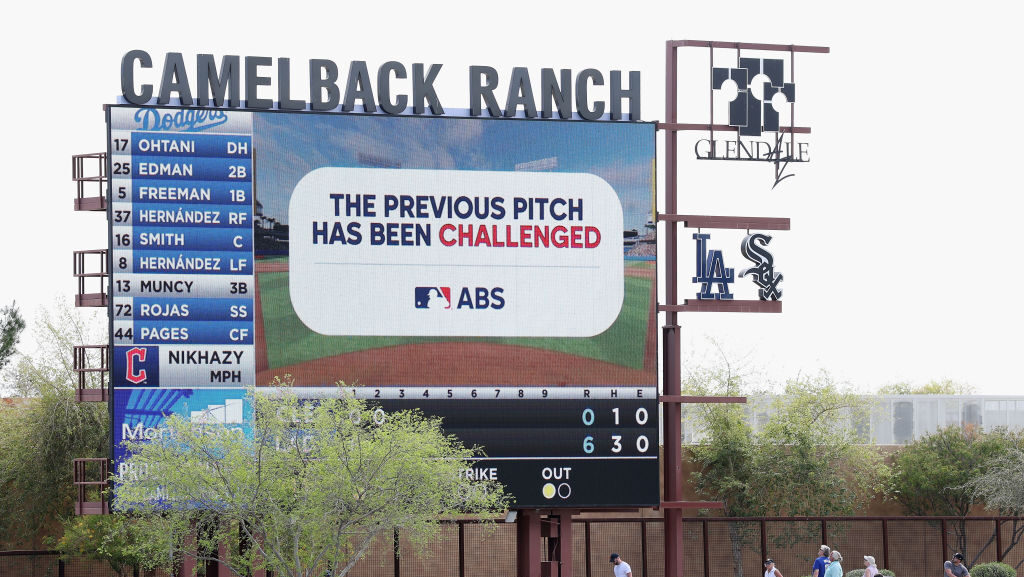
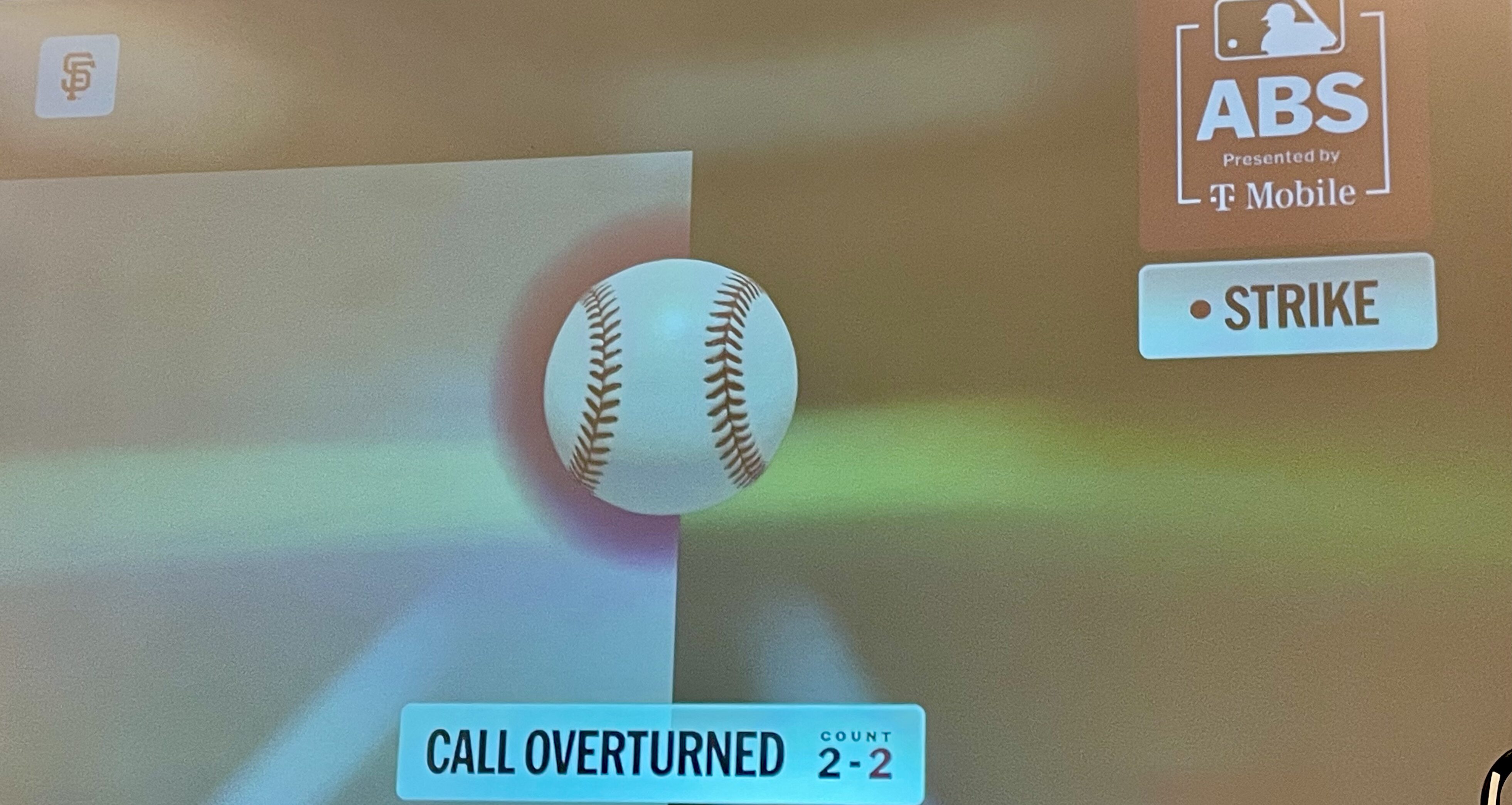
A player challenges by tapping on his head, and a graphic with the pitch location and call determination will appear on the stadium’s big screen. This applies to all Cactus League ballparks, as well, with the exception of Tempe Diablo Stadium, which does not have a big screen. The umpire will verbally give the call in that location.
MLB presentation screenshot for ABS
ABS changes
One change from the challenge system’s previous iteration will be extra innings. Instead of getting two challenges to last however many frames a game goes for, teams will enter each extra inning with at least one challenge.
How this works goes as follows:
If a team has no challenges entering extra innings, it will be given one to start the 10th
If a team has one or two challenges left going into extra innings, it doesn’t get an extra one
If a team loses its last challenge in the 10th, it gets another in the 11th
If a team has a challenge left after the 10th, it doesn’t get another for the 11th
Teams will always enter an extra inning with a challenge but cannot accumulate them.
Another change is that players cannot challenge when there is a position player pitching, which happens in a blowout. That just wastes time.
A third change pertains to the base runners.
What happens if a base runner steals second, but the ball four call at home is overturned to strike two? What happens to the runner? That will be up to the umpire’s discretion. Before, the base runner simply had to return to the previous bag. Instead, if an umpire assesses that the base runner would have stolen the bag anyway, he can give him the base.
Additionally, ballparks will display challenges remaining where mound visits remaining used to be present.
What about the TV strike zone versus the ABS strike zone?
In the past, the strike zone box on television has not always been perfectly accurate to the umpire’s strike zone. The strike zone on TV even slightly differed from the one fans could see on the MLB Gameday app.
The league is aiming to standardize the strike zone fans sees on all of these mediums using the ABS zone. It plans to work with broadcasts, many of which MLB now produces, along with its Baseball Savant staff to make sure the zone is the same anywhere fans see it.
How do other MLB clubs view this change?
Padres GM A.J. Preller: “It’s something we’ve had experience with at the minor league level, so we have some organizational knowledge and belief that we’re gonna share with the big league coaching staff. Then a little bit of that is player specific, game specific, leverage situations. I think we’ll be talking about it a lot because if it gives us a little bit of a competitive advantage and we want to use that, we wanna make sure that our players are aware of it.”
Cubs manager Craig Counsell: ”I mean, at this point we just gotta learn about it. I don’t think there’s as much strategy around this as maybe you guys want there to be. These are about did you miss the call? Did you get it right? If you missed the call, we want to challenge it and obviously you gotta pick spots in the game that matter.”
Reds GM Nick Krall: ”We’re gonna work from spring training, continue to talk about it, see how we use it, figure out who’s good and not very good at it, and then go from there.”
Guardians manager Stephen Vogt was a longtime catcher in MLB, including for the Diamondbacks. That said, he believes it’s best to let his catchers tinker with it this spring as opposed to setting hard rules this early.
“I want (the players) to play with it, they’re gonna be the ones in charge,” Vogt said. “I’ve never caught with ABS, so who am I to tell them what to do? We’re gonna play with it during spring training and see, see what we come up with. We’re still gathering information.”
