
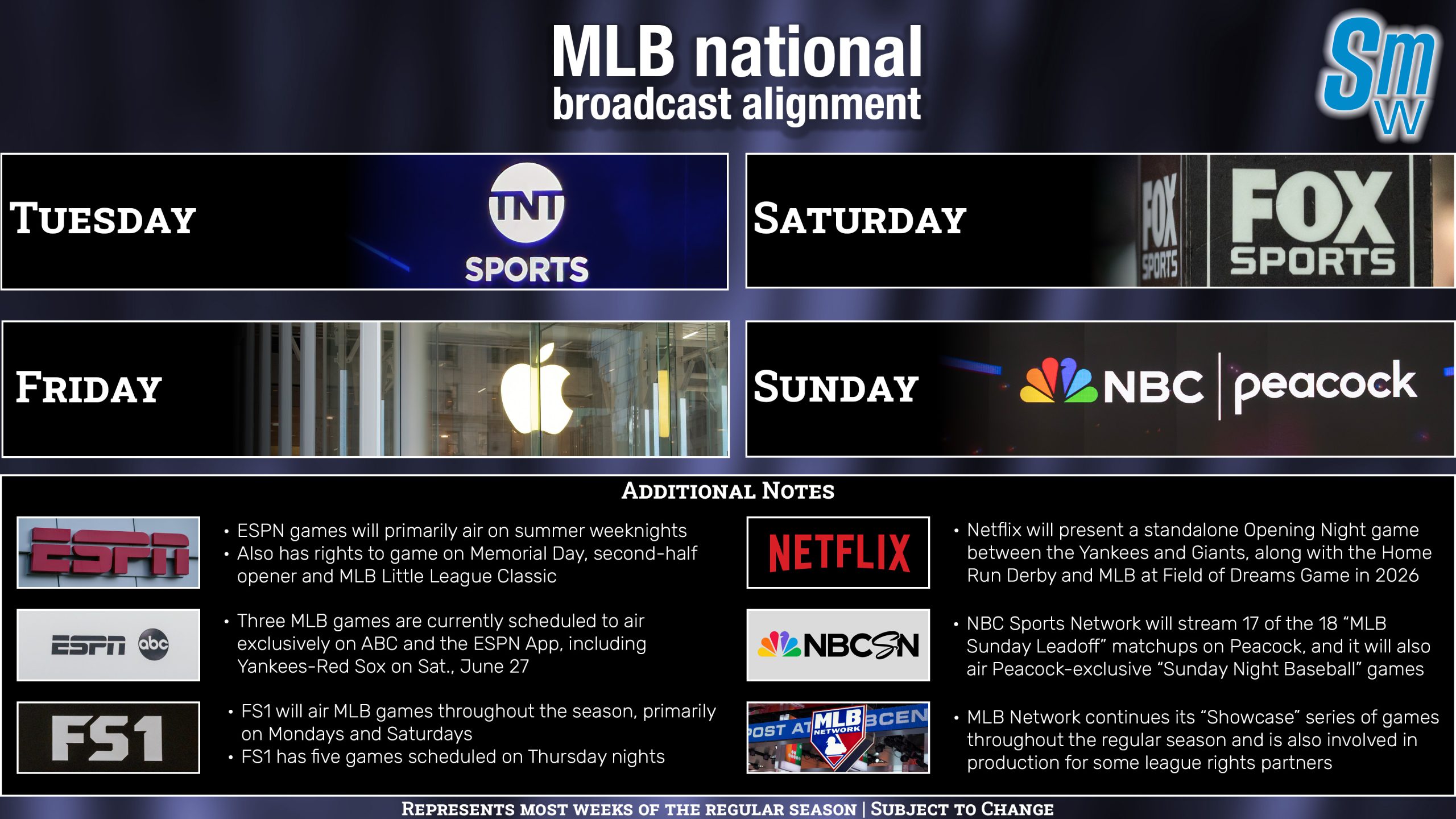
ESPN and Major League Baseball reached a new media rights agreement last fall that covers the next three seasons for a reported total of $550 million. As part of the new deal, ESPN gained rights to the MLB.TV out-of-market package, along with in-market streaming rights to teams whose games are produced and distributed by the league. While the network is no longer going to be televising “Sunday Night Baseball” or the Wild Card Series, it will still present 30 games throughout the regular season.
So what exactly is changing between MLB and ESPN heading into the 2026 campaign? And how will fans be impacted? We seek to answer these questions and more in this installment of the “SMW FAQ.”
Why is ESPN no longer airing “Sunday Night Baseball” this season?
ESPN opted out of its MLB rights deal last season, with its package — highlighted by “Sunday Night Baseball,” Wild Card playoff games and the Home Run Derby — eventually going to NBCUniversal and Netflix. But despite some harsh words by MLB commissioner Rob Manfred, the network struck an entirely new deal with the league. The three-year pact, reportedly at the same $550 million/year rights fee, grants ESPN 30 regular-season games, in-market streaming rights to teams whose games are produced and distributed by MLB, and sales/distribution rights to the MLB.TV out-of-market service.
 (Illustration) | Netflix Logo – Courtesy: Netflix | NBCSN Logo – Courtesy: NBC Sports | Other Photos – Courtesy: Derek Futterman
How do I subscribe to MLB.TV without an ESPN Unlimited account?
If you are a new subscriber looking to purchase MLB.TV on a monthly or seasonal basis, you will need to use ESPN rather than going through the league’s platform. For those who are not subscribed to ESPN Unlimited, a one-month free trial of the service is automatically included with new MLB.TV purchases. It is not necessary, however, to keep ESPN Unlimited in order to access the MLB.TV platform through ESPN or the league’s hub. Consumers can decide on their own if they would like to cancel ESPN Unlimited or continue for $30/month.
How do I subscribe to MLB.TV with an ESPN Unlimited account?
Users who already subscribe to ESPN Unlimited and wish to add MLB.TV will receive a $15 discount on the seasonal package, bringing the price to $135 for the year. The discount does not apply to the MLB.TV $30/month plan. Following the 2026 campaign, the seasonal plan will renew at full price. The free month of ESPN Unlimited service is not included with purchases of MLB.TV in this category. As previously noted, it is not necessary to retain ESPN Unlimited in order to maintain the MLB.TV subscription.
ESPN Unlimited is available as a standalone subscription for $30/month or $300/year and provides access to the company’s linear networks, on-demand programming and exclusive content. This includes the package of premium live events from WWE, out-of-market NHL games and, expected later this year, access to NFL Network. The National Football League recently acquired a 10% equity stake in ESPN with an “estimated fair value” equivalent to “approximately $3 billion.”
Watching MLB.TV through the ESPN App will provide users access to features such as multiview, key plays and being able to catch up to the live action. There are also integrations surrounding fantasy sports and betting, along with being able to toggle between home and away broadcast feeds. Included with a standard ESPN Unlimited subscription is access to over 150 out-of-market MLB games throughout the season branded as a “Game of the Day,” which does not require MLB.TV
A variety of pay television services — including DirecTV, Hulu + Live TV and Spectrum TV — provide ESPN Unlimited to customers included with some subscription packages. Some services will also ingest ESPN Unlimited content into their platforms, such as YouTube TV and Fubo, although it remains unknown if that would include any integrations with MLB.TV.
What if I am an existing MLB.TV subscriber?
Existing MLB.TV subscribers will be auto renewed as usual with no action required with ESPN platforms. The subscription comes with access to the out-of-market games in addition to MLB Network, the “MLB Big Inning” program, Minor League Baseball contests and an archive of previous games. Fans can watch MLB.TV using the league’s outlet or the new ESPN platform with authentication. Seasonal subscribers can view MLB Network both in season and in the offseason, while monthly subscribers have access to MLB Network through the World Series.
MLB.TV does not include access to exclusive national broadcasts throughout the regular season and postseason. Unlike the NFL where streaming games are made available on broadcast television locally, users need to subscribe to the relevant streaming service to access those exclusives. The exception to that rule is with NBC Sports Network, which is providing a simultaneous stream of MLB games on Peacock that are not also on NBC broadcast television.
What if I choose to cancel ESPN Unlimited but still want to watch MLB.TV through the ESPN App?
Fans can still access MLB.TV through the ESPN App even if they choose to cancel their ESPN Unlimited subscription. MLB.TV users can watch games on the league’s platform or through ESPN no matter how they purchased their subscription.
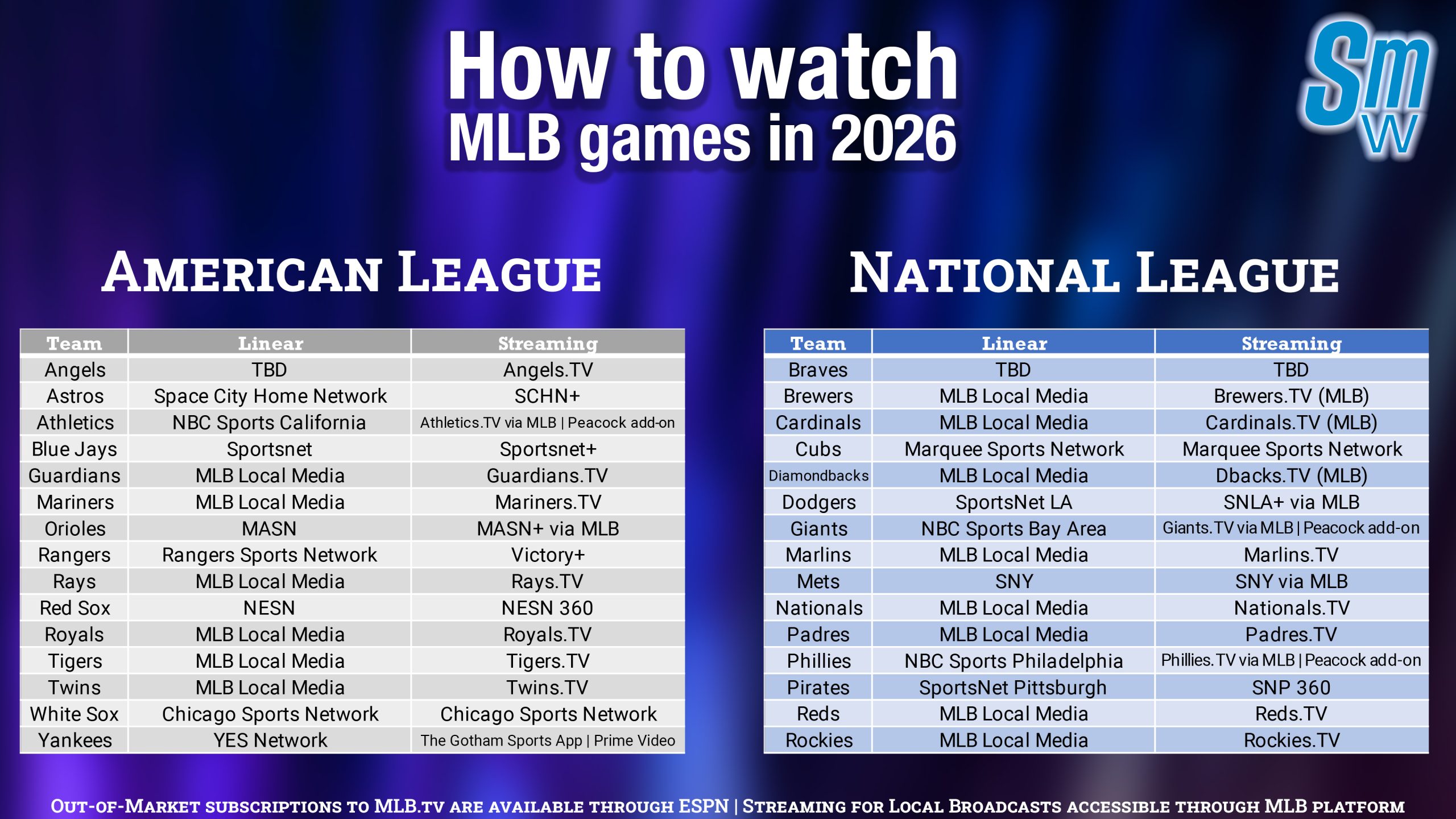
My local team is produced/distributed by MLB. Can I watch in market with MLB.TV or another subscription?
Local games that are produced and distributed by the league and the MLB.TV out-of-market package are, by definition, separate services; however, there is an opportunity to purchase a bundle for $40/month or $200/year. Users can also purchase subscriptions to access local game broadcasts in market for MLB-produced and distributed teams for $20/month or $100/season. The pricing structure varies for teams whose RSNs have partnered with the league for distribution of game broadcasts and/or other programming.
Every MLB team has a designated broadcast territory in which users can access local broadcasts through a variety of means. For consumers looking to gain access to local games outside of the domain, they will need to purchase an out-of-market subscription. While there are no blackouts with a league-produced television package, it is still necessary to purchase since MLB.TV only covers games that are out of market. MLB has a tool that allows users to check for MLB.TV blackouts by using their zip code.
For in-market fans who want to stream a team that is not produced and/or distributed by the league, they will need to go through the applicable service. As an example, a Pittsburgh Pirates fan who lives in the broadcast territory would need to purchase an SNP 360 direct-to-consumer plan. If a Pirates fan was living in Phoenix, Ariz. and wanted to watch local broadcasts, they would either have to subscribe to MLB.TV or purchase an MLB.TV single-team package.
What could this look like on a long-term basis?
Main Street Sports Group, which emerged from Chapter 11 bankruptcy proceedings after 20 months in January 2025, now reportedly faces potential liquidation. Although the company is continuing to broadcast NBA and NHL games at the moment, Tom Friend of Sports Business Journal cited industry insiders who “expect a wind down of their business by spring” sans last-minute financing. MLB started taking over local broadcast production and distribution for some teams when Main Street, then-Diamond Sports Group, started selectively rejecting contracts in the 2023 season while it was going through Chapter 11 bankruptcy proceedings.
Even before the collapse of Main Street, other companies were exiting the RSN business due to cord cutting and carriage disputes. As just one example, Warner Bros. Discovery shuttered its AT&T SportsNet brand of RSNs a few years ago that affected three MLB teams. Manfred has expressed a desire to centralize national and local rights, something that could presumably facilitate more lucrative deals following the 2028 season.
Manfred has stated on numerous occasions that he wants to have local rights when the league’s national deals expire following the 2028 season. At that time, the league could look to create new packages that could potentially generate more value. While it is unknown if the league would be able to procure local rights for all 30 teams by that time, all of them will be included in negotiations in some form or another through the national packages.
Per Mike Mazzeo of Sports Business Journal, Manfred said that going to the national market does not require the league “to have necessarily everybody wall-to-wall.” Manfred had previously set an expectation that rights for all clubs would be available as the league works to centralize national and local broadcast rights.
The challenge would seem to be convincing teams with large regional deals to be part of any league-wide solution. There has been speculation that MLB could endure a work stoppage after this season with the expiration of its collective bargaining agreement with the MLBPA.
The league currently brings in a reported total of approximately $2 billion per year from its national media rights spread across Fox Corporation, The Walt Disney Company, Warner Bros. Discovery, Comcast, Netflix and Apple. All of these deals expire after the 2028 MLB season.