
When the New York Yankees beat the Milwaukee Braves in the 1958 World Series, one of the team’s relievers was 27-year-old rookie Zack Monroe. Though his career was short, he earned his World Series ring with some quality appearances for the Yankees over the second half of the season. Monroe died on January 18 in Proctor Hospital in Peoria, IL, at the age of 94. He was one of three surviving Yankees who played in the Series, along with Bobby Richardson and Tony Kubek. (Bobby Shantz was also on the New York roster but did not make an appearance.) Monroe pitched for the New York Yankees in 1958 and 1959.
Zachary Charles Monroe was born in Peoria, IL, on July 8, 1931. He is listed as “Zach” on Baseball Reference and elsewhere, but he spent most of his life as “Zack,” like his father. Zack Monroe Sr. was a barber who later founded Peoria Barber College. He became a beloved civic leader in Peoria, serving on the city council and acting as supervisor of general assistance. Through his decades of service, he helped countless Peoria residents who needed aid or $1 haircuts at his college. The younger Monroe went to Woodruff High School in Peoria, where he was also a quarterback on the football team and an All-State guard on the basketball team. He was the subject of a recruitment war as a senior in 1949, as both Bradley University and the University of Illinois wanted an athlete of his caliber. Monroe ultimately chose to attend Bradley, and his work as a pitcher began to outshine his skills in the other sports. By the time he was a junior in 1952, he was the ace of the Bradley pitching staff and pursued by several pro teams. He spent part of that summer on his honeymoon, but once he returned, he signed a $40,000 contract with the New York Yankees and scout Lou Magoula. Monroe immediately reported to the Quincy Gems of the Three-I League, where he turned in a record of 7-6 over the rest of the 1952 season. His ERA was 5.04, and he walked about 8 batters per 9 innings. The U.S. Army intervened and inducted him into the military, so Monroe had to wait until 1955 before he could return to his pro career. Some newspaper reports show him as a pretty effective pitcher for military teams in Grand Junction, CO, and McCook, NE. One of his McCook teammates was future Yankee Billy Martin.
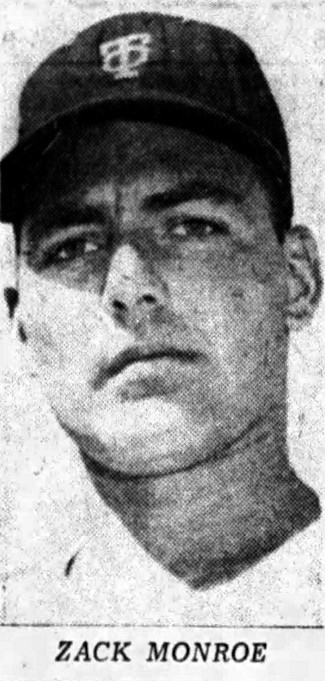 Source: The Sunday Press, August 11, 1956.
Monroe was discharged in 1955 and resumed his pro baseball career with the Binghamton Triplets of the Eastern League. It took a year for him to return to form, as he won 12 games but posted a 5.46 ERA with 121 walks in 178 innings. He actually had a better season as a batter, with a .258 average and 3 home runs. Monroe improved dramatically in 1956. Not only did he improve his record to 16-7, but he also lowered his ERA to 2.67. He also upped his strikeout count to 172 and walked 86, or 4 per 9 innings. He also threw Binghamton’s first no-hitter since 1943. It was a 6-0, 7-inning no-no on September 1, 1956, against Syracuse. He didn’t have his best stuff, as evidenced by 5 walks against just 3 strikeouts, but Binghamton scored 3 runs in the first 2 innings, and the righthander took over from there.
The Yankees promoted Monroe to Triple-A Denver in 1957, and he again won 16 games. He started 29 of his 36 appearances and had 14 complete games and a career-best 224 innings pitched to show for it. He had developed a very effective palmball, which he used as a substitute for a changeup. The 1957 Denver Bears were an outstanding team with Monroe and Ryne Duren as the team’s aces and Marv Throneberry, Norm Siebern and Johnny Blanchard contributing to the team’s 175 home runs. The Bears won 90 games and the American Association championship. Monroe returned to the Bears in 1958 and won 10 of his 13 starts, with a 3.33 ERA. He had been unable to make the Yankees’ jam-packed pitching staff to start the season, but New York found room for him in June.
Monroe made his major-league debut on June 27, 1958, nine days short of his 27th birthday. He took over for Duke Maas in the third inning after the starter had allowed 3 runs on 5 hits. He retired the first 7 batters he faced, with the first 6 coming via the ground ball or strikeout. Hector Lopez was his first major-league strikeout victim. Monroe pitched into the sixth inning and didn’t allow a hit in 3-1/3 innings, but he had to be bailed out by Art Ditmar after walking the bases loaded. Monroe made a start on July 2 against the Baltimore Orioles and worked a solid 7 innings, allowing 5 hits and 5 walks while striking out a pair of batters. The only run he allowed came on a Dick Williams solo home run. Duren pitched the final 2 innings, and Monroe was the winning pitcher in the 4-1 victory. In his first 4 appearances, Monroe allowed 1 run over 15 innings, with 2 starts and 2 relief appearances — the Red Sox scored twice off him in an eleventh-inning appearance on July 5, but the inning dragged past the 11:59PM curfew, and those runs were erased as the game was declared a 3-3 10-inning tie. Monroe was roughed up in his next two starts, with 1 loss and a win where he allowed 5 runs in 5 innings against the A’s. Given the strength of the Yankees’ rotation, with Bob Turley, Whitey Ford and Don Larsen, Monroe was shunted to the bullpen. He worked as a mop-up reliever in August, appearing in 10 Yankee losses. He pitched 15-1/3 innings in those games and had a 2.35 ERA. When September rolled around, injuries to Ford, Larsen and Tom Sturdivant forced manager Casey Stengel to start Monroe once more. He faced the Boston Red Sox on September 2 and threw a 5-hit, 6-1 complete game win. “He did it at just the right time,” said Stengel. “He didn’t look so good after we brought him up from Denver, June 15, but he sure showed ’em last night.” New York had more than a 10-game lead over the second-place Chicago White Sox by then, but Monroe’s work meant that the injured starters were able to rest a little while longer. Monroe won his next start as well, pitching into the eighth inning against Cleveland on September 10 without allowing an earned run. He finished the season in the bullpen and made his final appearance against Baltimore on the 28th. He gave up a ninth-inning leadoff home run to Leo Burke and put two more runners on base, but he got out of the inning and was given a save for his work in the 6-3 win. Monroe pitched in 21 games for New York, including 6 starts, and he had a 4-2 record and 3.26 ERA. He pitched 58 innings and walked 27, with 18 strikeouts.
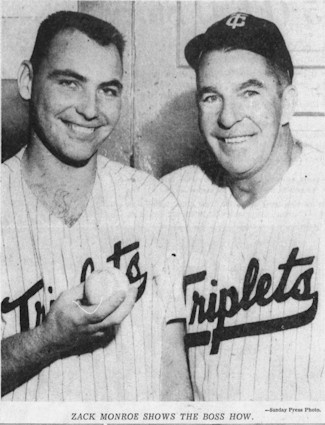 Zack Monroe and his Binghamton manager, Freddie Fitzsimmons. Source: The Sunday Press, September 2, 1956.
The Yankees and Braves had fought in the 1957 World Series, with the Braves coming out ahead, so the ’58 Series was a rematch. Milwaukee won the first two games before the Yankees came back to take the Series in 7 games. Monroe’s lone postseason appearance came in Game Two, when the Braves routed the Yankees 13-5. He struck out Lew Burdette to open the bottom of the eighth before allowing a walk to Bill Bruton, a ground-rule double to Red Schoendienst, a 2-run single to Eddie Mathews, a single to Henry Aaron, and a sacrifice fly to Andy Pafko. Frank Torre ended the inning with a grounder to second, and Monroe was charged with 3 runs in an inning of work. He returned to the Yankees in 1959, but he was the odd man out in the pitching staff. He threw a scoreless inning against Boston on April 17, but then he didn’t pitch again until May 1. In that game, he came into the bottom of the tenth against Cleveland after Shantz had allowed 2 baserunners. Monroe retired Billy Martin on a grounder, but Tito Francona belted a pitch into the right field seats for a walk-off 3-run homer. Monroe next pitched on May 3 and allowed a home run to Detroit’s Charlie Maxwell in 2 innings of work. That home run was the third of the game for Maxwell, and, counting a homer in the first game of a doubleheader, his fourth homer in 4 consecutive at-bats. Monroe was left with 2 runs allowed in 3-1/3 innings, and when the rosters contracted in May, he was sent to Triple-A Richmond. The Richmond News Leader later reported that other big-league clubs were interested in Monroe, but the Yankees were under no obligation to move him. He remained in the Yankees’ organization until July 22, 1960, when the team sent him on option to the Jersey City Jerseys, an International League affiliate of Cincinnati. The Yankees also sent cash and received pitcher Luis Arroyo in return. Monroe finished the year with a 9-11 record and 3.27 ERA for Jersey City, and the team acquired his contract outright from New York at the end of September. Monroe spent two more seasons in the Reds organization but never advanced out of Triple-A. In his final season in 1962, he worked mainly as a reliever for the San Diego Padres of the Pacific Coast League. He had a 6-0 record and 2.35 ERA on June 5, but he was hammered over the rest of the year and ended up in the bullpen, with a final record of 8-6 and an ERA of 5.51. He failed to make the Padres team in 1963 and was released. He tried to pitch for a Wichita amateur team, but a sore arm that undoubtedly affected his 1962 numbers forced him to retire.
Over parts of 2 seasons, Monroe had a 4-2 record and 3.38 in 24 games, including 6 starts. He threw 1 complete game and had 1 save, and in 61-1/3 innings, he struck out 19 and walked 29. He also won 90 games across 9 minor-league seasons.
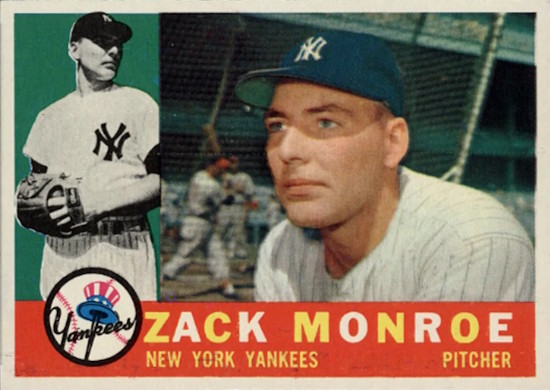
Monroe was inducted into the Bradley University Hall of Fame in 1957, and the school awarded a Zack Monroe Pitching Award for many years. He lived in Bartonville, IL, for most of his life and worked at Johnson Hydraulic. His wife, Barbara, died in 2019, and he is survived by daughters Tonya, Lynette, Monica and Keri, as well as their families. Monroe’s brother Roger works for The Community Word and wrote a lovely tribute to his brother. “I was never able to beat Zack in a single game or sports contest whether it was playing “H-O-R-S-E” or “21” in basketball or ping pong. He beat me at everything including going to Heaven, but I take great joy that he was my brother and my hero,” he wrote.
Back when he was pitching in the minors with San Diego, Monroe met a down-on-his-luck 10-year-old sandlot pitcher who was having control problems. He worked with the kid frequently, giving him both pitching lessons and life lessons. Ten-year-old Merl Ledford never reached the majors, but he became a successful husband, father and lawyer who never forgot the advice. He even traveled from California to Peoria in 2023 to reconnect with his former mentor, 61 years later. Their reunion was recorded by CBS News. “He worked with me to help control that wild pitching. But more than that, he just taught me a lot about how to get along, [which lasted] my whole life,” Ledford said.
Follow me on Instagram: @rip_mlb
Follow me on Facebook: ripbaseball
Follow me on Bluesky: @ripmlb
Follow me on Threads: @rip_mlb
Discover more from RIP Baseball
Subscribe to get the latest posts sent to your email.