
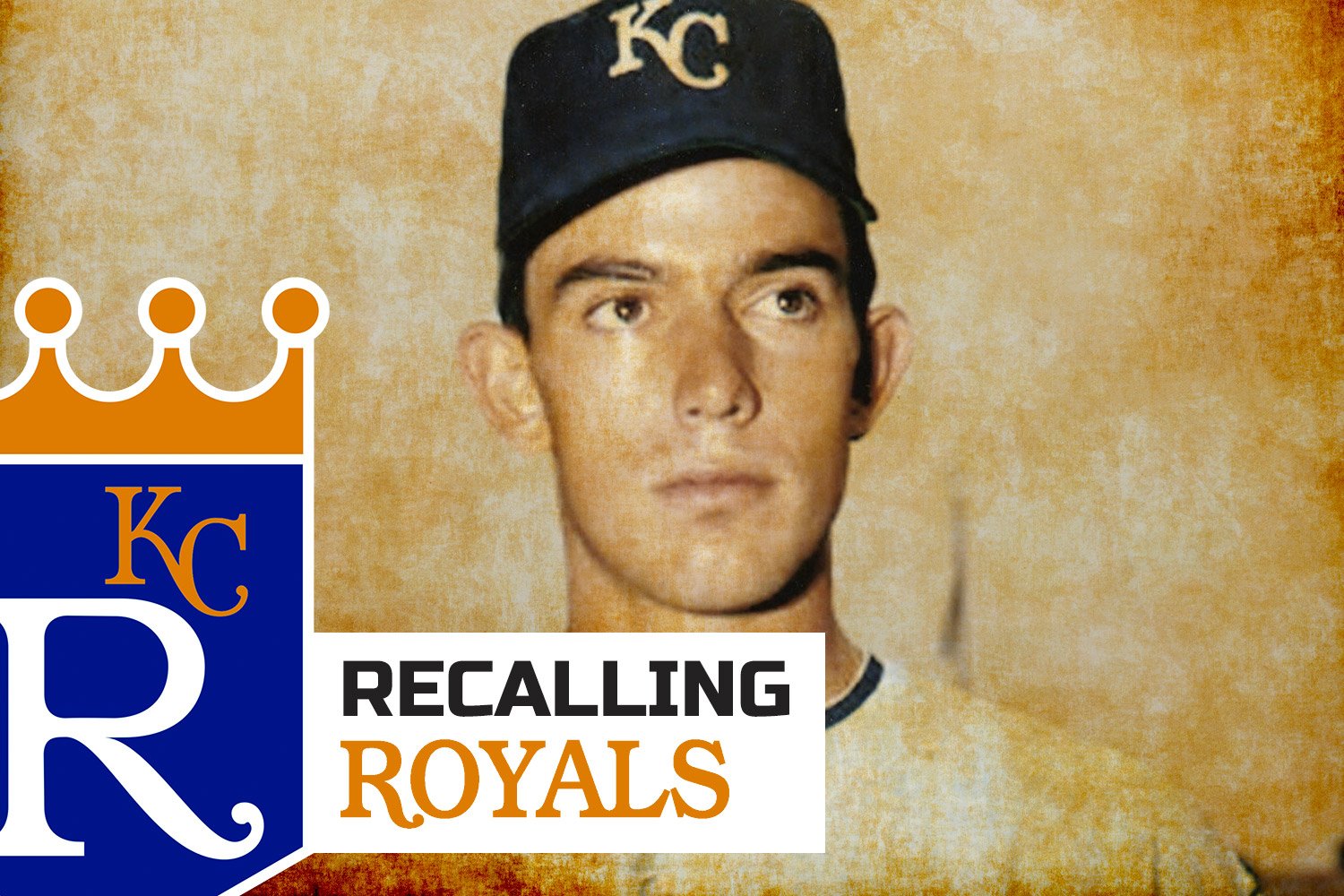
With his recent retirement from broadcasting, it seems like a good time to look back at the career of Buck Martinez.
Martinez will likely be remembered as a Blue Jay by most baseball fans due to his long association with the franchise. He played for Toronto from 1981-1986, then worked as a broadcaster for the team in stints from 1987-2000 and 2010-2025. He even managed the Blue Jays in 2001 and 2002.
But Martinez was a Royal for many years. And he’s an original Royal, part of the expansion 1969 squad. Although he never played more than 95 games in a season in Kansas City, he was a part of the team’s growth from an expansion team to a division winner.
John Albert Martinez was born on November 7, 1948, in Redding, California. His paternal grandparents emigrated from Spain, while his mother was part of the Karuk Tribe of northern California. Martinez was playing amateur baseball in Sacramento when future Royals manager Joe Gordon, then scouting for the California Angels, noticed him. Gordon recommended the Angels sign him, but Philadelphia beat them to the punch. However, the Houston Astros selected Martinez in the Rule 5 draft in 1968. Two weeks later, they sent him to the Royals (with two minor leaguers) in return for minor league catcher Johnny Jones. Gordon, set to manage the initial Royals team, had his man. It was a small example of the shrewd trades the Kansas City front office, headed by GM Cedric Tallis, made in the team’s early days, as Jones never made it past A-ball.
Martinez was finishing his junior year at Sacramento State College and didn’t even join the Royals for spring training, but joined the major league team soon after his school year was over. He made his MLB debut on June 18, 1969, with a flyout as a pinch hitter. Less than two weeks later, on June 28, he made his first start behind the plate. It was a game to remember, as he hit his first major league home run, picked off a runner at second, and tagged out two runners at home, one of them a collision with Minnesota’s Bob Allison. All of this on a hot, humid Saturday afternoon that was brutal enough to send Twins third baseman Rick Renick to the hospital with heat exhaustion.
Martinez ended the year with a .229/.258/.327 line in 214 plate appearances. Not too shabby for a rookie who didn’t even have spring training. He had impressed the team with his defense.
But Martinez would barely get to play in 1970. He was optioned to Triple-A Omaha during spring training, as Ellie Rodriguez won the starting job and the team wanted Martinez to catch every day. But then Buck was called up… to active military duty. The Army stint lasted until early August. Martinez played in just six games for the Royals that year, then headed to Florida for Instructional League play and then on to Puerto Rico for winter ball, where he played for Frank Robinson on the Santurce club.
Martinez reported to spring training in 1971 with his eyes on the starting job, although the Royals had acquired Jerry May from Pittsburgh in the same trade that brought Freddie Patek to Kansas City. Martinez did indeed make the Opening Day roster and even got the nod for the opener, as the Royals were facing a left-hander. But Martinez was soon returned to the minors because the Royals wanted him to play every day. He bounced back and forth between Kansas City and Triple-A Omaha, ending the year with 53 plate appearances for the Royals and a .152/.231/.196 mark. At least he made the American Association all-star team for Omaha.
That obviously took some of the shine off his status as a prospect. Martinez spent the entire 1972 season in Omaha. Perhaps fighting off disappointment, he hit just .174/.299/.282 before a foul tip broke a bone in his right hand in mid-July. While Buck’s arm and defense had never been in question, his bat definitely was a concern.
When Martinez was optioned to Omaha again at the end of spring training in 1973, he apparently took that decision better. He batted .272/.345/.382, earning a September callup. Although he only played in 14 games, he hit .250/.333/.375, putting him back on the Royals’ radar. In fact, Martinez had played in the minors for the last time.
Hitting coach Charley Lau is most famous in Royals history for turning a poor-hitting rookie third baseman into George Brett, but he also helped Martinez turn his career around following that horrid 1972 season.
“I had no rhythm, no timing, no feel for hitting the ball. We worked on it over and over – sometimes he’d even throw it to me underhanded, trying to get it right. Day after day, I’d be down in the cage, maybe some days taking 300, 400 swings. And finally, I saw where it was making a difference. I felt like it was just a matter of putting in the time, like if I’d go out and work on it seven, eight hours a day I would have it. And of course the beautiful thing about Charley… I mean, he never quits. If you show him a sincere effort and a willingness to learn, he’ll be out there with you until… it’s done.”
–Martinez, quoted by Gib Twyman, Kansas City Star, April 3, 1974
After five seasons, the Royals had finally sorted out their catcher situation, with Fran Healy the starter and Martinez now the backup. He played in 43 games, hitting just .215/.317/.290. But when he saw more regular action in September, with the team out of contention, he finished strong with a .261/.333/.413 mark in 51 plate appearances, nearly half his total for the season.
The catching arrangement remained the same for 1975, although the rumor mill in spring training said the Royals were hoping for an upgrade on their backup. But Healy was injured in the first series of the season, and Martinez filled in capably, with a .242/.317/.352 line in 30 of the team’s 44 games through the end of May. Healy got injured again in July, allowing Martinez and Bob Stinson to split catching duties for basically the rest of the season. Martinez got the most starts behind the plate among the trio.
As the 1976 season began, the status quo was still in place, with Healy the starter and Martinez and Stinson slated for backup duty. But things changed quickly, as the Royals dealt Healy to the New York Yankees in mid-May for pitcher Larry Gura. It turned out to be a great deal for the Royals, as Gura, who had fallen out of favor with Yankees manager Billy Martin and hadn’t even appeared in a game for the New Yorkers all season, would go on to win 111 games with Kansas City. It was also a great deal for Martinez, who now seemed to be the starter. Until, that is, he injured himself sliding into second base a few days later. Somehow, he managed to spike his own leg, requiring six stitches. The hit that resulted in the injury gave him an 11-game hitting streak.
He returned to the lineup in early June and quickly re-established himself as the starter as the Royals battled for their first division title. His offensive numbers were still not outstanding (.228/.269/.356 in 295 plate appearances), but he continued to receive praise for his defense. He also performed well in the ALCS, with five hits in 16 plate appearances and four RBI, although the Royals lost the best-of-five series to the Yankees.
But once again, change was coming to the Royals’ catcher position. After the season, Kansas City acquired Darrell Porter in a trade with Milwaukee. Porter, a left-handed hitter, offered more power and had been a highly-rated prospect a few years earlier, although his 1976 season had been a disappointment. The two started the season as a platoon, but Porter soon captured the job with a hot hitting start. As a result, Martinez appeared in only 29 games, and not at all in the ALCS. His Royals career came to an end when he was traded to St. Louis with pitcher Mark Littell for pitcher Al Hrabosky during the winter meetings. The Cardinals, the same day, shipped him to Milwaukee for pitcher George Frazier.
Martinez was a Brewer for three seasons, then was traded to Toronto early in the 1981 season (a deal, incidentally, that kept Ned Yost on the Milwaukee roster). That began an association with the Blue Jays that lasted more than 40 years. But he should be remembered by Royals fans both as a member of the original team and the franchise’s first AL West title team.