
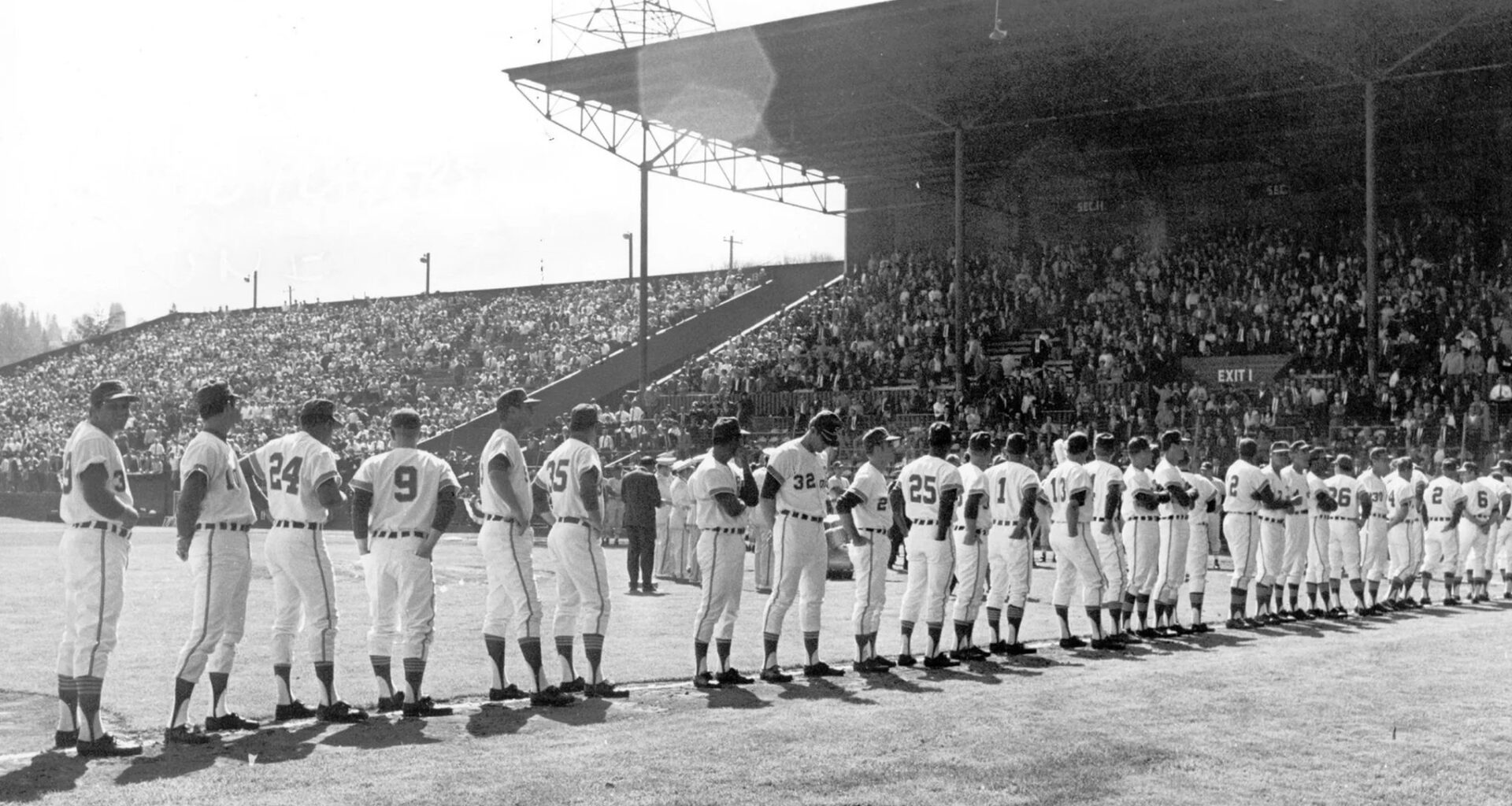
Before reading this part of the Brewers’ voyage to Milwaukee, read part one of the series, “A Failed Launch“.
And in the meantime, popular manager Joe Schultz was fired by GM Marvin Milkes—who would become the Brewers’ first general manager—and speculation began about who was going to be the next Pilots manager. Dave Bristol, Billy Martin, Dick Williams, and Grady Hatton were among the names mentioned.
Two days before Thanksgiving, the Pilots hired Bristol, who had been recently fired by the Cincinnati Reds after guiding them to a record of 89-73 during the season. The estimated contract was a two-year, $80,000 deal. (No, that is not a typo.)
A week later, the American League unanimously voted to accept the sale from Daley to the Danz group. However, the $40 million domed stadium deal remained uncertain, and both sides had concerns.
Just after the New Year’s Eve hangovers had subsided, more complications popped up in early January 1970 when the Bank of California demanded immediate repayment of a $3.5 million loan that was made to the Pilots the previous season. The new ownership group, led by Danz, was going to assume that loan and was working feverishly to settle its financial issues.
Danz later announced a ticket drive that he hoped would raise $1 million to show that the Pilots could count on local support. The ticket drive started slowly, and over the first few days, the team had raised only $200,000 toward the $1 million goal. On January 13, the American League announced they were giving the Denz group nine more days to settle its finances. After only a few days, the Pilots got a five-day extension from the league so Danz and his associates “could find a solution to the financial bottleneck which is holding up the sale” according to the Appleton Post-Crescent.
Just days later, baseball commish Bowie Kuhn stated that if the Pilots did not get their deal squared away, “There is a possibility of a franchise transfer. When and if there is a transfer, one thing is certain—Milwaukee will receive serious consideration.” But he also told the crowd of 700 at the Wisconsin Baseball Writers Association 17th Annual Diamond Dinner in Milwaukee that Dallas-Fort Worth was still in the running. “I wish I could bring you some guarantee that would lighten your heart tonight,” Kuhn said. “But I can’t.”
On January 22, Daley announced that Seattle was “up for grabs.” Danz and his group were unable to meet a 2 pm deadline to refinance or settle the Bank of California loan. Hunt, the owner of the Kansas City Chiefs, and Mercer then formally applied to the American League for the transfer of the team to the DFW area. Selig’s group reportedly offered less money but had a major league-ready stadium as part of the package. Dallas-Fort Worth only had a minor league facility ready to go, even though a big-league park was in the planning stage.
And if there hadn’t been enough chaos already, one day later, the courts got involved when the city of Seattle filed a ‘specific performance’ suit against Pacific Northwest Sports, Inc. (Daley et al) that basically said the Pilots needed to fulfill its five-year lease agreement. It turned ‘hardball’ quickly. King County Superior Court Judge F. A. Walterskirschen threatened a “temporary restraining order barring removal of the franchise” from Seattle. New Seattle Mayor Wes Uhlman intimated that a lawsuit would be filed against any team that bought and moved the Pilots. Uhlman told reporters, “Seattle deserves more than a one-year turn at-bat.”
Milwaukee was also looking for ‘another’ turn at bat, as the Milwaukee Braves had skipped town after the 1965 campaign. Earlier in January, Milwaukee radio station WOKY sent telegrams—the forerunner of email—to all American League clubs and AL president Cronin. The telegram read: “The world’s greatest baseball fans urge you to put the Pilots in Milwaukee. Remember the ‘Miracle of Milwaukee.’ It can happen again.”
Around that time, things started to get nasty. Ewing Kauffman, owner of the expansion Kansas City team and chairman of a four-man board that would help shepherd the troubling transaction, set the purchase price at $8.8 million, down from Daley’s initial ask of $10.5 million. “We’ve done this [set the price] so that Daley and the Sorianos will make less than half a million profit. They don’t deserve a profit. They did not stay in there and pitch.”
Ouch.
Once again, AL owners were split in their visions of the outcome. Some wanted the Pilots to stay in Seattle, and others rooted for either Milwaukee or Dallas-Fort Worth to come forward and win the day. Selig and Co. had Milwaukee County Stadium as an anchor and a valid reason for choosing Milwaukee. On the other hand, DFW would have been the larger cash cow, no pun intended.
And to add a little more intrigue into this convoluted, comical, and controversial piece of commerce, DFW principal Hunt had a ‘private understanding’ with the Cleveland Indians, according to a column by Leonard Koppett of the New York Times. Rumor had it that Hunt wanted to buy the Indians for $13 million after the 1970 season. Koppett whimsically posited that, “Apparently, the oil millionaire (Hunt) now believes a Pilot in the hand is worth two Indians in the handshake.”
You can’t make this stuff up.
On January 28, the Pilots were once again given a nine-day extension to allow the Seattle group, now led by hotel executive Edward Carlson, more time to come up with the now-$9-million asking price. Two days later, an airline executive from Oakland threw his hat into the three-ring circus as a potential buyer. Edward J. Daly was president of World Airways, Inc., an Oakland charter carrier. What was Daly’s sudden interest in buying the Pilots? A friend of his, Oakland A’s owner Charles O. Finley, asked him to.
And it gets better. Carlson and Danz of the Seattle group asked Tommy Mercer of the DFW group to lend them $4 million. “I said we were not in the finance business,” Mercer commented.
Remember when Seattle Mayor Uhlman threatened any non-local buyer with a lawsuit? That number was purportedly now $25 million. Mercer then proposed that the league take over the Pilots and pay $150,000 per team for the year’s baseball operations, rather than each team paying 1/10 of the $25 million lawsuit amount. “It could possibly happen,” Mercer said.
Not to be left out, Bank of California vice president Warren G. Campbell told the Milwaukee Sentinel on February 3 that the Carlson/Danz group was “at least $3.5 million short, and maybe $7 million” short of the necessary money needed for purchase. Campbell also said, “I don’t know how many times I have to repeat it. We want the cash, or a guarantee in the form of other types of security other than the franchise.”
Meanwhile, Milwaukee and DFW waited…patiently.
Coming soon, part three: ladies and gentlemen, the Milwaukee Brewers!
Are you interested in Brewers history? Then check out the Milwaukee Brewers Players Project, a community-driven project to discover and collect great information on every player to wear a Brewers uniform!