
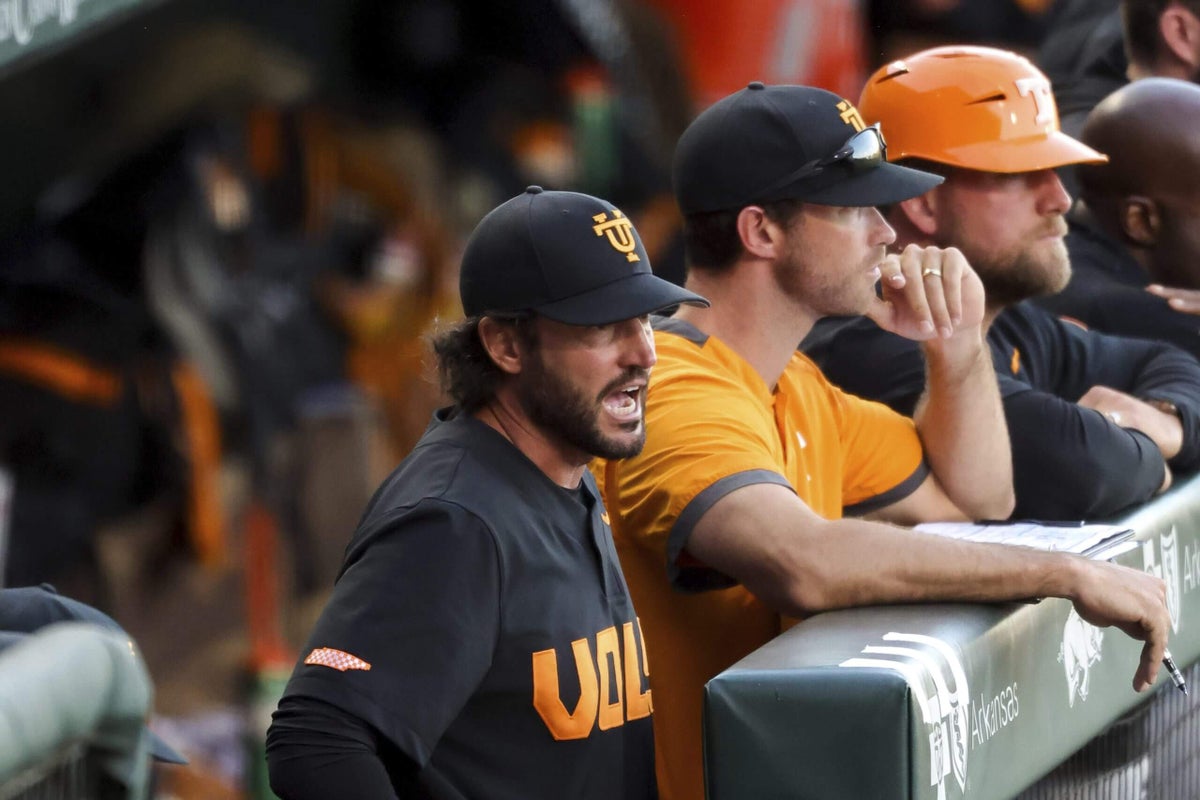
SCOTTSDALE, Ariz. — Ask Tony Vitello about his transition from head coach at the University of Tennessee to rookie manager with the San Francisco Giants and he’ll often point out some of the ways that the gap has closed between NCAA Division I baseball and the professional ranks.
But there’s been one durable distinction aside from the ping of aluminum bats versus the crack of ash or maple. In college, most programs call the vast majority of pitches from the dugout. In the major leagues, pitchers and catchers huddle up with the coaching and analytics staffs in pregame meetings to create a game plan or script. Once the first pitch is thrown, though, the longstanding assumption is that the pitch sequencing decisions, including all the on-the-fly adjustments, rest with the two batterymates.
That area might be starting to blend, too. The Miami Marlins used the final nine games last season to conduct an experiment in which assistant pitching coach Alon Leichman called all pitches from the dugout. The Marlins are committed to carrying over that policy into this season, telling as much to the free agents they pursued and signed. The Colorado Rockies, who hired Leichman to become their pitching coach, are also planning to experiment with pitch signals originating from the dugout.
The trend is generating animated conversations within major-league front offices and coaching staffs. It’s inspiring some strong pushback in some corners and resignation in some others. And it creates perhaps the clearest litmus test for how much the Giants’ out-of the-box manager hire will operate … well, out of the box.
Yes, Vitello said last week, for now he is reserving the right to call pitches from the dugout at times and take the onus off catcher Patrick Bailey.
“There’s a lot of guys that were not happy with last year, right?” Vitello said. “This is a mutually exclusive year, but the past does have an influence, and I think some of these guys are using last year’s frustrations, whether they were in the minor leagues or at the big-league level, as motivation to be better prepared and to be a little hungrier this year. I think there’s an openness to trying new things.”
“I don’t think it’s going to be a hard-line rule,” Vitello continued. “Patrick Bailey is who he is and the flow of the game is crucial. It’ll be case by case, and it’s something we’ll roll through in spring training, but if you’re going to put me on the spot, I’ll say occasionally, yeah, we’ll do it.”
To this point, it’s gone no further than a series of conversations among Vitello, Bailey, Giants president of baseball operations Buster Posey, director of pitching Frank Anderson and pitching coach Justin Meccage. But it’s notable that Posey was a Gold Glove catcher who exclusively called his own games during a 12-year career that included three World Series titles and, in December, will likely include a first-ballot selection to the Hall of Fame. Posey is as traditional as they come. And he’s not stopping this conversation cold.
“As a former catcher myself, I do think you have to give the catcher some leeway and understand that they’re seeing some nuances and subtleties that are hard to see from the dugout,” Posey said. “But at the same time, I’m very rarely a hardline type of guy on anything. It’s always worthwhile to have conversations and different thoughts on various topics. So it’s something to think about.”
Posey was like most college catchers when he played for Mike Martin at Florida State. Even while he was advancing toward the Golden Spikes Award and the Johnny Bench Award, honoring the best college player and college catcher in the country (the latter of which is now called the Buster Posey Award), he’d look to the dugout for each pitch sign and then relay it to the mound. Sometimes Martin would point to Posey to let him know he could take charge. Mostly, though, Posey acted as a compliant middleman. He said he never vetoed a sign from the bench.
“Look, Mike Martin was a well-established veteran coach,” Posey said, smiling. “I wasn’t going to go down that path whatsoever.”
Like most every other college catching draftee, Posey had to learn the art of game-calling in the minor leagues. He became a master at reading swings and subtle movements in the batter’s box and learning when the best pitch to call might deviate from a hitter’s weaknesses or a pitcher’s strengths. The greater the stakes, the more proficient he was at calling the right pitch. Of all the stats that back up his Hall of Fame candidacy, there might be none more subtle or more convincing than this: He caught 56 postseason games in his career, including 15 as a rookie, and 25 percent of those games were shutout victories.
More than anyone, Posey can appreciate the value that a catcher creates behind the plate and the unique perspective they have on a game in real time. He can also appreciate that his current catcher, Bailey, is the two-time defending National League Gold Glove winner who is a distinguished game caller in his own right.
And yet …
“It’s always helpful to have debates and people can present information that makes sense,” Posey said. “It’s worth listening on. So that’s kind of the way that I see things.”
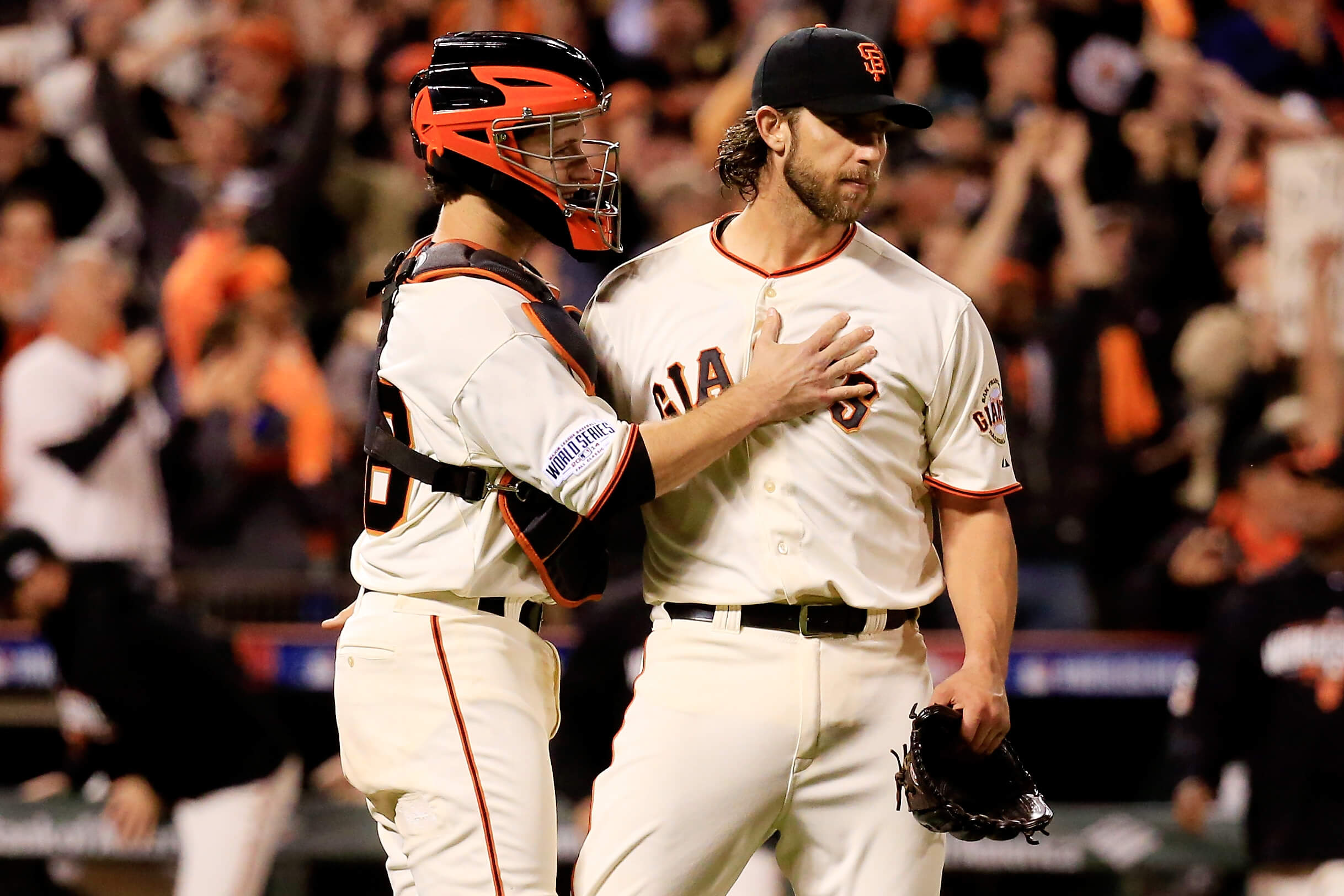
Madison Bumgarner’s four-hitter against the Royals in Game 5 of the 2014 World Series was one of 14 postseason shutouts Buster Posey caught during his career. (Rob Carr / Getty Images)
In all likelihood, the Giants will continue to operate the traditional way the grand majority of the time. Anderson, who was Vitello’s pitching coach at Tennessee and has spent more than 40 years working with pitchers on the college level, lauded Bailey’s skills and said his inclination is that those skills are best leveraged when the game is in his hands. Bailey was the rare college catcher who almost exclusively called his own games at North Carolina State.
But Vitello also values the ability for a new coaching staff to instill different philosophies and ways to win baseball games. It’s why he estimated that Tennessee coaches called more than 85 percent of the pitches in his first two or three seasons in Knoxville. A few years later, when the Vols had a trusted receiver in Cal Stark, Vitello let some slack on the reins. Vitello said that in 2024, when the Vols won the College World Series, they probably had more catcher-called pitches than in any other season.
“So, you know, it’ll be interesting,” Vitello said. “The best year we had, Cal Stark was one of the reasons we were good. We won, right? So a lot of it is personnel and where you’re at in your progression.”
For a team like the Marlins, who have a young, bat-first catcher in Agustín Ramírez, there’s a potential advantage to taking pitch calling off his plate. He can spend more time working on his swing and less time in meetings. Having coaches call pitches could be a way of outsourcing the development process of teaching minor-league catchers the finer points of formulating a game plan, poring over scouting reports and making midstream adjustments. It’s also a way to keep more catching prospects behind the plate, even if they show limited aptitude in that area. There’s also the notion that modern catchers are being overloaded with all the information that goes into pitch selection, along with all the other responsibilities that rule changes have piled on their plate — the pitch clock, the limit on mound visits, and now the automatic ball-strike challenge system.
All of that aside, if you’re the Rockies, who have been stymied by run prevention for the life of the franchise, why not try something new?
“My new pitching coach feels very strongly about it, and he’s presented me with the reasons why, and they are very intriguing reasons,” Rockies manager Warren Schaeffer said. “It’s something that’s being discussed across the game internally. It’s the most important part of the game, what pitches are thrown. There’s nuance there in terms of trusting your catcher and all the preparation he puts into the game. But at the end of the day, I’m definitely open to it. It would take a lot of communication. The whole team would have to be in on it. And there’s lots of ways to go about it. The pitcher still makes the ultimate decision on what to throw.
“In San Francisco? Look, I love Patrick Bailey. He’d be a big key to it. It’d be interesting to see what Pat would say if you tell him, ‘Hey, we’re going to call pitches. What do you think?’ That’s how you’d have to approach it.”
So, what does Bailey think?
“Look, if there’s a way we can win more ballgames, I don’t care how it’s done,” Bailey said. “It’d be a big change, yeah. It’d be very time restrictive because pitchers wouldn’t have much time to shake. Either way, I need to be prepared and get in rhythm with guys and have good communication with the dugout.”
Bailey’s openness to such a fundamental shift in the game might come across as unexpected, yet he also echoed Posey’s sentiments about the value of a catcher who is observant and intuitive.
“If you just want to look at a piece of paper and say, ‘0- 1 count, this guy sucks at this pitch, so we’re going to throw that pitch,’ you can definitely do that,” Bailey said. “But at the end of the day, I definitely value getting a feel for what the other team’s trying to do and go from there. The biggest example is looking back when we played the Blue Jays last year, and thank God we have their hitting coach (Hunter Mense) now. After the game, you’re thinking, ‘Man, they had to have something.’ And it turns out it’s just a really good game plan. When they understand what we’re trying to do, it’s on us to adjust. It’s the hardest thing, too, because you’ve done the homework, you’ve taken the time. It’s like, ‘Hey, this guy shouldn’t be good on this pitch. Why are they taking good swings at these pitches?’
“I mean, if guys start taking good swings at Logan Webb’s changeup, there’s probably an adjustment to be made, right?”
Bailey said the Giants “haven’t gotten granular about” if or how often their coaches will call pitches from the dugout. But if the game is heading in that direction, he said there’s a simple rule change that MLB should make. As of now, only on-field playing personnel are permitted to use PitchCom keypads and receivers.
“You just need to have a PitchCom in the dugout for a coach to press,” Bailey said. “I think it’s pretty stupid if teams are doing that, that a coach can’t push a button. There’s nothing a catcher can do that a coach can’t do.”
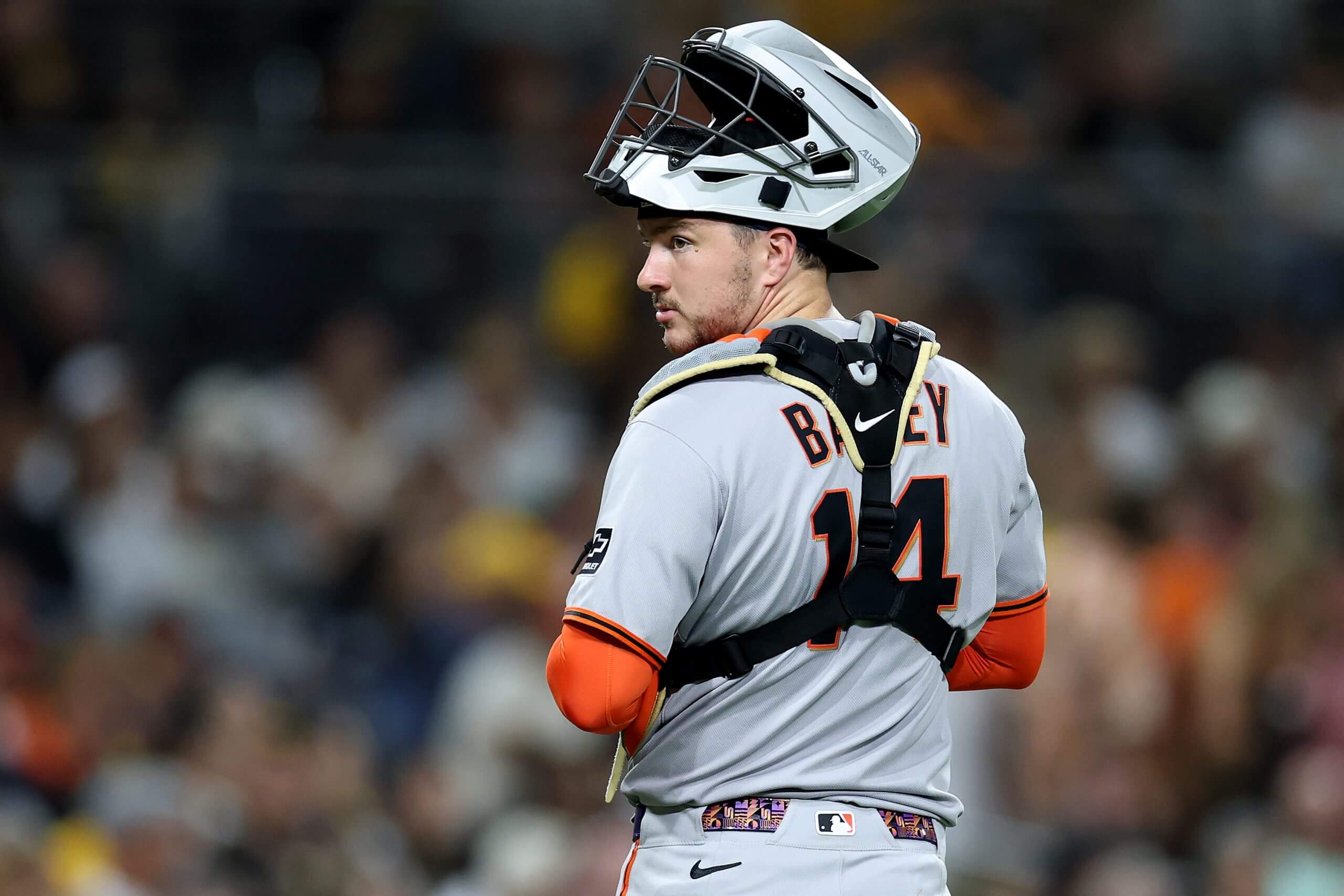
If coaches are going to call pitches, Patrick Bailey says they should have access to a PitchCom device. (Sean M. Haffey / Getty Images)
The Marlins certainly agree.
“We’ve been up front with everybody that we considered bringing into the organization that this is an organizational initiative that we’re not going to compromise,” president of baseball operations Peter Bendix told MLB.com. “It’s not going to be everybody except for this one guy. It’s something that we truly believe is going to help us win more baseball games. It’s going to help our pitchers get better results. We think it’s something that can be a real, meaningful advantage for us.”
Although the Rockies plan to follow suit, the dominoes aren’t toppling around the league yet. A survey of Cactus League managers revealed that with rare exceptions, most of them have not and would not call pitches from the dugout.
“I know it’s happening now in some places, but it won’t happen in Cleveland,” said Guardians manager and former catcher Stephen Vogt. “We haven’t called them because we’re not back there — and I’m biased because I used to be. I don’t know what they’re seeing or feeling. I don’t know where the pitchers are missing or by how much. We’re blessed with three unbelievable game callers. Maybe it’s different if we had a catcher who wasn’t a good game caller, but our guys do all the homework.”
Texas Rangers manager Skip Schumaker is also staunchly pro-catcher-as-game-caller, citing the impact that Yadier Molina made on the pitching staff when they were teammates in St. Louis.
“I’m not a fan of it,” Schumaker said. “I like the human element of the catcher and pitcher navigating a game together. I do see the reasons behind it. The pitching coaches do a lot of the work, they’ll give you the pitches at the right times. With some younger pitchers and catchers, you could sell me on trying to help them navigate a game together. But I think there’s a competitive advantage when you have a smart pitcher and smart catcher. I don’t want that to be lost in the game. Not anybody can catch. Being able to handle the emotions of a pitcher and everything, it’s so much more than pressing a button.
“I don’t know what other teams are doing. I’m just going to worry about my clubhouse. And I’m not going to tell Jacob deGrom what to throw.”
Arizona Diamondbacks manager Torey Lovullo said there have been times that the dugout has taken an active role in pitch selections when a young battery needs guidance, “but it’s not something we practice or preach.”
“We have that right as managers to say, ‘I want to see this pitch right now,’” Lovullo said. “But I believe in the pitcher being able to call games. I believe in the catcher knowing the pitcher and studying and having a game plan and going out there and seeing what’s happening between the two of them. That’s the most important thing for me. So for right now, we’ll stay with what we know has worked. But I don’t want to turn away from saying it’s not possible.”
Cincinnati Reds manager Terry Francona also has an array of signs for the pitching coach to signal pitches when a catcher wants direction or feedback.
“We have a way to help them,” Francona said. “But we want them to care enough to know what’s right and to make adjustments. I don’t believe in calling a game for them. If people do, that’s OK. I’m not saying it’s wrong. That’s one of the beauties of this game: There might be 30 different ways of doing something. Hey, if they pitch good, I don’t care.”
Kansas City Royals manager Matt Quatraro said he has no plan to deviate from traditional game-calling — especially when he has a veteran like Salvador Perez behind the plate.
“Do I think the game could go that way? Yeah,” Quatraro said. “If teams say that gives them the best ability to win, then that’s what the game’s about. It’s within the rules, so I’m not against it. But Salvy has been doing this a lot longer than I have. It’s not just what he sees but it’s his communication ahead of time and his ability to retain. So much goes into game planning and understanding. There’s never really one right pitch. You either execute it or you don’t.”
A 3-2 slider might be the optimal pitch according to the data, but that doesn’t mean much if the pitcher isn’t in the right physical or mental space to throw an effective one. And the catcher is the only person working with that pitcher in real time to gain a sense for that. It’s a concept that Seattle Mariners manager Dan Wilson understood during his catching career, and it’s a quality he appreciates in Gold Glove catcher Cal Raleigh.
“I really trust Cal and what he does and how he sees the game,” Wilson said. “We spend so much time going over hitters. The hope is there aren’t a lot of questions after the game starts, but sometimes there are and that’s the nature of the game. That battery relationship is where the game is often won or lost. They have the best decision-making ability. The way I see it and the way I played it, the catcher is in the best spot. He has the best vision and best sense. He can really feel the game back there. So I don’t know if it’d ever full-scale get to (dugout-generated pitch calling). But who knows? The game has changed a lot.”
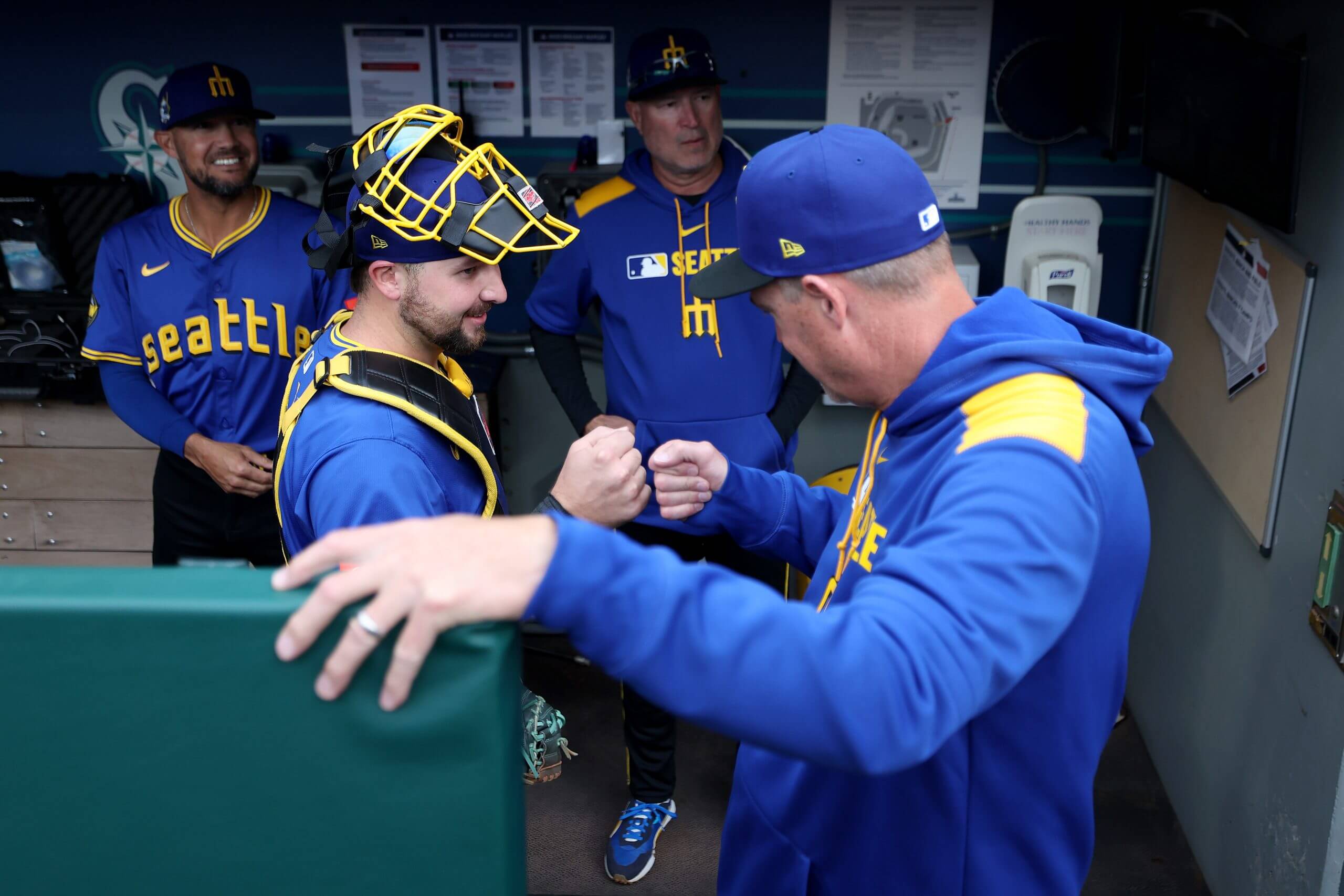
“He has the best vision and best sense,” Mariners manager Dan Wilson said of his starting catcher, Cal Raleigh. “He can really feel the game back there.” (Steph Chambers / Getty Images)
Craig Stammen, the San Diego Padres’ rookie manager, is willing to bet that the trend is just getting started.
“You’ve got 8-year-old youth teams and the dads are trying to call the pitches,” said Stammen, a former big-league relief pitcher. “Most of the kids today have been brought up in that system. So maybe it turns into a position that someone puts on their staff — the game caller. If you’re the Giants and you can have Buster Posey in the dugout calling all the pitches, that’s something to think about. But our approach this year is letting the catchers handle that and the pitchers have the autonomy with them to throw the best pitch possible.”
The Marlins might not be the first major-league team to adopt dugout-called pitches on a widespread basis. Vogt revealed that he played for one team that operated with a similar system. He wouldn’t disclose whether it was the Tampa Bay Rays, where he broke into the big leagues, or the Oakland A’s, where he spent four seasons. (He had briefer stops with the Brewers, Giants, Diamondbacks and Braves as well.) It was not an experience he enjoyed. He greatly preferred the way every other club handled it: giving every liberty to the catcher and having signs ready for the rare times when he was in between or unsure about what pitch to call.
“I maybe did that a couple dozen times in my career,” Vogt said.
Perhaps no current major-league manager has a more complete perspective on the convergence of the pro and college game than Milwaukee Brewers skipper Pat Murphy, who spent a combined 22 years as the head coach at Notre Dame and Arizona State. His approach with college pitchers usually was more about communicating concepts than signaling specific pitches. If he ran a hand up his forearm, it meant the batter was inexperienced and was liable to get himself out. He had signs for “climb the ladder” (set up the high fastball), “don’t be afraid to double up” (throw the same pitch again), “pitch ’em backwards” (use off-speed to set up the fastball), or “you can book ’em” (pitch for the strikeout). If he stabbed the air with two fingers, he was calling for an inside fastball.
“Nobody would suspect that, right?” Murphy said. “Sometimes the catcher would look over at me and say, ‘I got it.’ So that was a nice little relationship. Sometimes we called ’em all if there was a young catcher back there.”
Murphy said there have been rare occasions when the Brewers signaled a pitch from the dugout, but it’s meant as more of a suggestion.
“We’ve got a catcher (William Contreras) who is pretty in tune with the game,” Murphy said. “So it’s, ‘Hey William, you can go right at ’em,’ or, ‘Hey William, you can throw this one in the dirt.’ The good ones want information. But there’s so much put on them, it really is amazing that it hasn’t gotten to the point where every pitch is called for them or scripted.”
Will it?
“I hope not,” Murphy said. “There’s something about the feel of the game. There’s a sense for what the hitter is looking for or how he took that last pitch. But I’ve been saying this for 11 years: This is going to be a thing. Pro baseball always sets the trends and college baseball follows. Now there’s times when it goes the other way. Go back 15 years and you never saw so much emotion from players. Now it’s all over, celebrations, craziness on the bench.
“But when you need a strike, and the options are A, B or C, it’s the execution that matters. There is something real about the catcher having a better idea about that.”
The Marlins are not merely employing dugout-called pitches in the majors. It’s going to be their blanket policy in the minor leagues, too. It remains to be seen if other organizations will adopt that strategy. One thing is for certain: When you graduate catchers to the big leagues who lack the skills to call their own games, then the dugout as pitch orchestrator becomes a self-fulfilling prophecy.
The Giants are willing to explore new concepts with a manager who is stepping straight off a college campus. But a Giants farm system run by Posey, along with vice president of player development Randy Winn, won’t abandon developing acumen among their catchers. That’s one conversation they can stop cold.
“We’re taking away from development if we do it for them,” Winn said. “You learn through trial and error and failure. That’s how you teach.”