
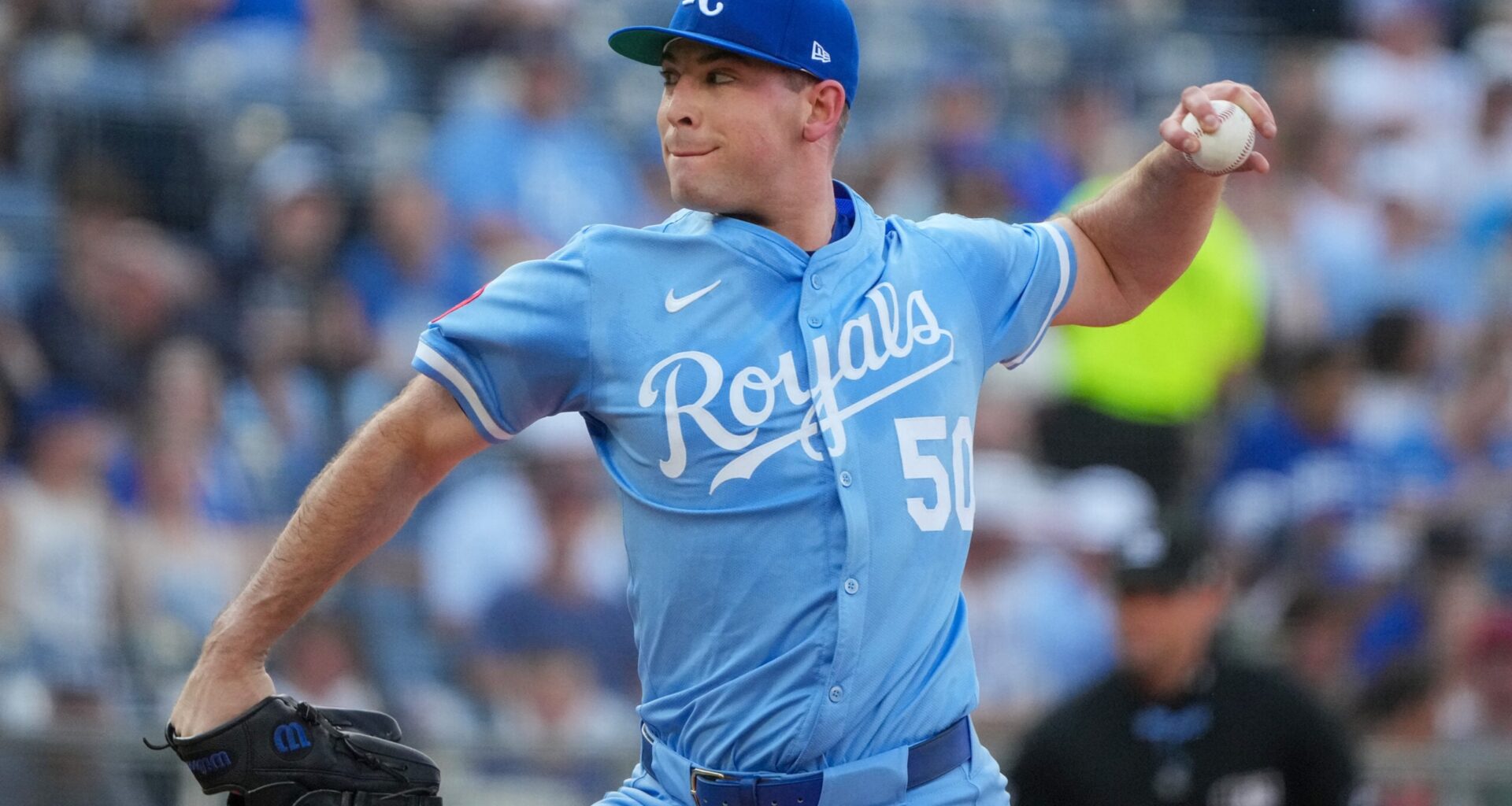
The Kris Bubic return to facing live hitters is more than a spring training update; it directly impacts the Royals’ 2026 rotation outlook.
After emerging as one of the American League’s most effective starters in 2025, Bubic’s season ended with a left rotator cuff strain. According to Reuters, Bubic finished that season with a 2.55 ERA across 116 1/3 innings before being shut down in late July. That production placed him among the league’s most efficient starters at the time of injury.
Now, as reported by MLB.com and echoed in coverage from Roundtable Sports via Yahoo Sports, Bubic has resumed throwing progression and recently faced live hitters in Arizona. That milestone matters because it shifts the conversation from rehabilitation to competitive ramp-up.
This is not sentiment. This is rotation math.
Live Hitters Mark a Competitive Checkpoint
Bullpens are controlled environments. Live hitters introduce reaction, sequencing, and stress.
MLB.com reported that Bubic resumed throwing in November and progressed through a structured offseason program before moving on to game-intensity work. The jump to facing hitters tests more than arm strength. It evaluates command under tempo, recovery between pitches, and confidence in secondary offerings.
Historically, Bubic’s effectiveness has been tied to pitch mix and command. FanGraphs has analyzed his changeup as a defining weapon, noting its movement profile and deception against right-handed hitters. When Bubic commands the changeup, it expands the zone and elevates the fastball’s effectiveness.
If that pitch plays against live bats, the foundation of his success remains intact.
Shoulder Injuries Demand Caution
Elbow recoveries follow clearer surgical timelines. Shoulder injuries are more variable.
Rotator cuff strains require careful workload progression because recurrence risk increases when ramp-up accelerates too quickly. Teams now prioritize layered throwing programs that emphasize gradual intensity increases rather than velocity spikes.
Kansas City’s measured approach reflects that understanding. There is no competitive advantage in rushing a February bullpen if it compromises August innings.
The Royals’ staff appears focused on durability over headlines.
The 2025 Breakout Was Not Accidental
Before the injury, Bubic’s 2025 season represented a significant leap.
Reuters documented his 2.55 ERA and All-Star selection. His command metrics improved, and his ability to limit hard contact strengthened. Advanced data from FanGraphs showed growth in strikeout efficiency and a refined pitch usage pattern that leaned into his strengths rather than chasing velocity.
That evolution matters because it reframes expectations. Bubic is not returning as a depth option. He is returning as a proven top-of-rotation performer when healthy.
Kansas City is not hoping for upside. They are monitoring whether a known asset regains full operational capacity.
Kris Bubic Return Changes the Royals’ Rotation Math
The Royals’ 2026 ceiling depends heavily on the front of the rotation.
Cole Ragans has already established himself as a staff leader. If Bubic returns at pre-injury form, Kansas City pairs two high-level left-handed starters capable of neutralizing lineups and protecting the bullpen.
That shifts roster construction. It reduces pressure on developing arms. It allows manager Matt Quatraro to sequence series more strategically, especially in division play.
The American League Central does not reward instability, and the Royals will be competing against a Detroit Tigers’ pitching rotation that is projected to be a dominant, high-end starting five that is anchored by Tarik Skubal, bolstered by key offseason additions of Framber Valdez and Justin Verlander, along with Jack Flaherty and Casey Mize. A pitching staff that is consistent in innings and run prevention will be rewarded with the division title and a playoff birth. A healthy Bubic directly influences that equation.
Performance Over Narrative
Bubic acknowledges that his career path has not followed a straight line. That perspective matters inside a clubhouse. It signals maturity and process awareness rather than emotional volatility tied to outcomes.
Kansas City does not need a comeback story. It needs durable production.
Facing live hitters does not guarantee success. It signals progress within a structured buildup. The real evaluation will come when Bubic logs consecutive outings, maintains velocity bands, and recovers without regression.
Until then, the appropriate lens is disciplined optimism.
Ceiling, Not Sentiment
Bubic’s return is not a marketing angle. It is a competitive variable.
If he replicates his 2025 form, the Royals elevate from intriguing to structurally sound at the top of the rotation. If durability holds, the club’s margin for error widens across the pitching staff.
Spring headlines fade quickly. Sustainable rotation strength does not.
For Kansas City in 2026, that is the difference between staying competitive and controlling the division race.
Main Photo Credit: Denny Medley-Imagn Images