
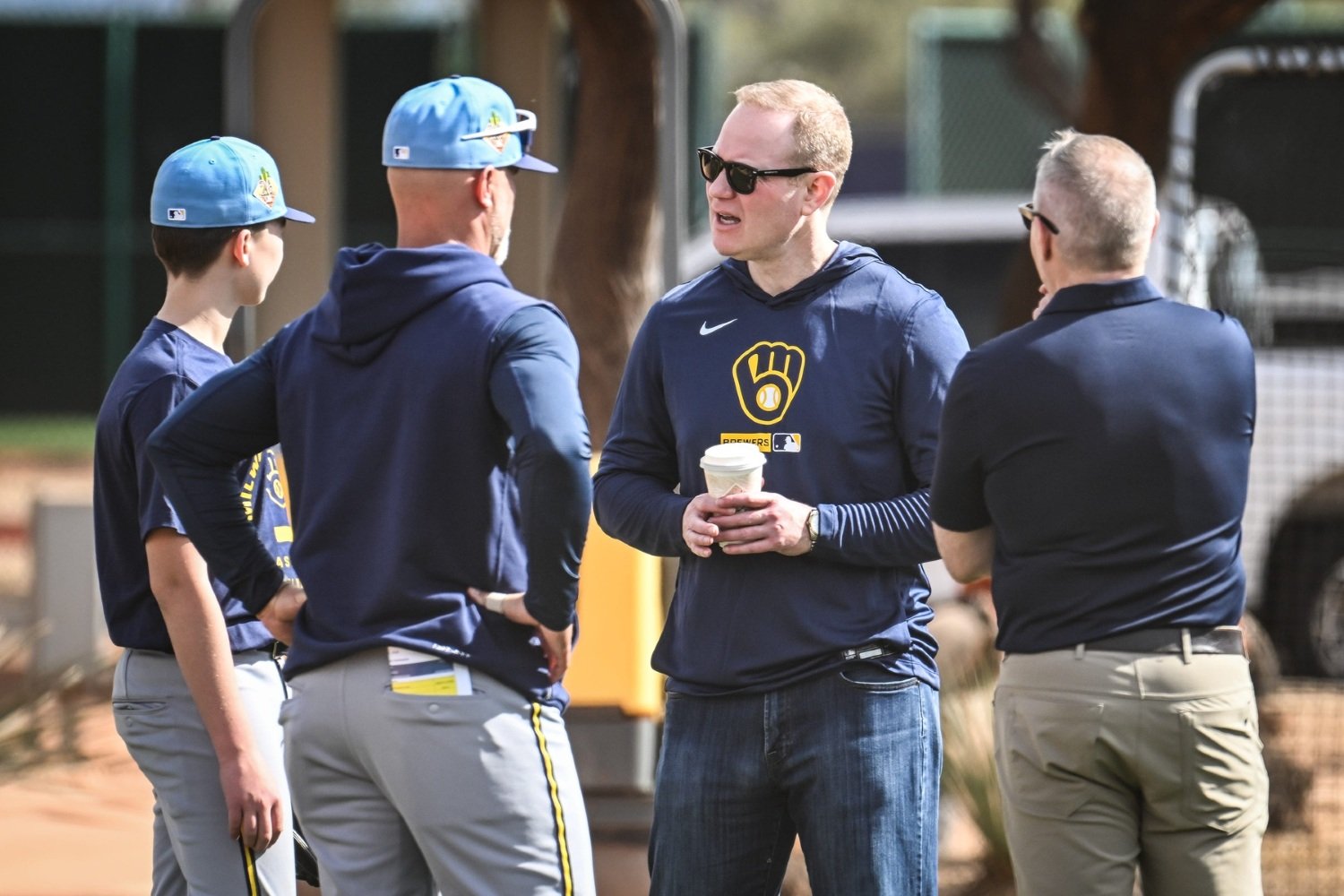
People love to talk about the Milwaukee Brewers’ payroll. People also like to talk about the on-field success the Brewers have, with postseason appearances in seven of the last eight seasons. Sure, there are only two postseason series victories in that span, but a short series (one, three or five games) can be determined by luck, as much as talent or even teamwork.
Thus, Brewers president of baseball operations Matt Arnold sought to keep the train on that track this offseason. The Brewers appeared to be in good shape entering the winter, with no glaring holes to patch. More power from the starting lineup would be nice, but some of that could be achieved from what the Crew already had. Is outfielder Jackson Chourio capable of 30 homers? How about 20 from second baseman Brice Turang? Over a full season, first baseman Andrew Vaughn can crank out 30, right? And what can the Brewers get from a healthy Garrett Mitchell, who remains toolsy and tantalizing despite all the missed time? Believing positive answers to those questions await, Arnold focused on amassing maximal pitching depth this winter.
With camp underway in Phoenix, it is time to assess what Arnold did this offseason. In a winter that didn’t need a lot of news to be made, Arnold created enough headlines to keep things interesting, but didn’t acquire enough talent to impress projection systems, which once again make the Cubs the favorites in the NL Central.
Will the Brewers prove them wrong again? It will take 162 games to figure that out.
For now, let’s review the six moves made that affected the MLB roster before pitchers and catchers reported to Phoenix. That doesn’t include Friday’s addition of Luis Rengifo, who plugs a hole that Arnold created just four days earlier, but that move feels relatively minor, anyway.
Grading Every Brewers Move This Offseason
Free-Agent Signing: RHP Brandon Woodruff to 1-year, $22.025 million contract
While some fans were surprised that the Crew would actually hand out a qualifying offer, it was the right thing to do. If Woodruff were to sign elsewhere, they needed to at least get a draft pick to compensate for the loss. Instead of testing the free-agent market beyond his three-week trial period, Woodruff accepted the offer and will stick around for (in all likelihood) a final season in Milwaukee. This came after Woodruff declined his end of a mutual option that would have paid him $20 million in 2026, instead receiving a $10-million buyout. That $10 million was figured into the Brewers’ budget for 2025, when Woodruff nominally made just $5 million, so the raise here is not as drastic as it might first appear, but it’s substantial.
The biggest reason Woodruff accepted the QO was the shoulder injury that (again) ended his season. The right-handed starter, who has been in the organization since being drafted in the 11th round out of Mississippi State in 2014, missed the last two weeks of the regular season and the postseason due to a strained lat. This followed his return from surgery in September 2023 on his right shoulder, from which it took him 21 months to fully return.
When he did come back, though, it was like he never missed a beat. The two-time All-Star posted a 3.17 FIP in 12 starts, with career bests of a 5.4% walk rate and a 32.3% strikeout rate. He appears to be fully healthy at the start of spring training. Arnold said Woodruff’s return played a role in the trade of Freddy Peralta.
Grade: A
Free-Agent Signing: OF Akil Baddoo to 1-year, $1.25-million contract
Given all the outfield depth the Brewers already had, Baddoo was a curious addition. He signed a split contract that will pay him less while he is in the minors, which is probably where he’ll spend most of the campaign.
The left-handed-hitting outfielder, who mainly plays left, was a success story as a Rule 5 pick before the 2021 season. Baddoo ended up starting 107 and appearing in 124 games for a Tigers team that went 77-85. He put together a .259/.330/.436 line in 2021, hitting 13 homers, driving in 55 runs and stealing 18 bases in 22 attempts. But those numbers plummeted over the next four seasons, as he put up a combined .201/.288/.323 mark with 15 homers, 49 RBIs and 25 steals in 223 games. He was designated for assignment by the Tigers after the 2024 season, but returned on a minor-league deal and played in just seven MLB games in 2025.
Baddoo is simply a depth piece, in case injuries take their toll on the outfield.
Grade: C-
Trade: LHP Ángel Zerpa acquired from Royals for OF Isaac Collins and RHP Nick Mears
This deal had fans scratching their heads. Collins is coming off a surprising 2025 in which he finished fourth in the NL Rookie of the Year voting, but also wasn’t a big part of their postseason lineup, getting 10 plate appearances over seven games. Mears had arguably the best of his six MLB seasons, with a career-high 63 appearances and career-low 0.97 WHIP to go along with a 3.86 FIP (3.49 ERA).
But in Zerpa, the Brewers saw a left-hander who could either relieve or start and had an additional year of control over Mears. Unlike Mears, Zerpa can also be optioned to the minors. Collins, a superb defender perhaps squeezed out of regular playing time with a healthy Mitchell, still has five more years of club control, but probably wouldn’t have been in the team’s plans for more than two of those years. Zerpa has 129 appearances over the last two seasons with the Royals, with FIPs of 3.97 in 2024 and 3.86 in 2025.
With some fine-tuning, perhaps more can be unlocked with Zerpa. As a sinkerballer, he should work well with the Brewers’ stellar infield defense. Zerpa could work his way into a role as the top lefty in Pat Murphy‘s bullpen, pending the roles, health and performance of Jared Koenig and Aaron Ashby.
Grade: B-
Trade: IF-OF Jett Williams and RHP Brandon Sproat acquired from Mets for RHP Freddy Peralta and RHP Tobias Myers
This was the headline move of the offseason, and one on which speculation began just hours after the Brewers were eliminated from the postseason by the Los Angeles Dodgers.
Losing Peralta is a tough blow to the team in general and the rotation, specifically. Peralta grew from a fresh-faced rookie with braces to a clubhouse leader and two-time Opening Day starting pitcher who led the NL in wins in 2025. Those are the attributes that also made him attractive to other teams, augmented by the fact that he’s set to make a very affordable $8 million in 2026. Myers didn’t have a guaranteed spot on the big-league staff, as a starter or reliever, so his loss is minimal—especially given the other notable move the team made, after this one.
In exchange, Arnold extracted two of the Mets’ top five prospects, in infielder-outfielder Jett Williams and right-handed starter Brandon Sproat. While Williams is the better (at least more highly rated) of the two prospects, Sproat will get most of the attention immediately; he’s in competition for the rotation spot vacated by the very trade in which he arrived. A specialist at inducing grounders, Sproat is seen more as a No. 3-type starter than as a potential ace, but the team seems fine with that. H made his big-league debut in 2025, with four late-season starts for the Mets.
Williams, however, is more dynamic. Think of a right-handed-hitting Sal Frelick with a bit more power and more of a threat to steal bases, while being able to play either middle-infield spot or center. Williams had 34 games at Triple-A in 2025, so he probably needs a bit more seasoning before joining the parent club. That also suits the Brewers, as they don’t have a need up the middle at the moment. Williams is likely to get some work at third base following the Caleb Durbin trade, though they’ve also patched the hole that move briefly created.
Grade: B+
Trade: LHP Kyle Harrison, IF David Hamilton and LHP Shane Drohan acquired from Red Sox for 3B Caleb Durbin, IF Andruw Monasterio and IF Anthony Seigler
This one hit like a surprise snowstorm in late April (or, I guess, a heat wave in February). The Brewers took Durbin, the third-place finisher in last year’s NL Rookie of the Year voting, and two spare-part infielders, and acquired a similar utility player and two left-handed starting pitchers who have a ton of potential.
Durbin was the guts of the return in the Devin Williams trade with the New York Yankees following the 2024 season. He was bypassed in spring training by Vinny Capra and Oliver Dunn, partially because Capra was out of options but partially, too, because it didn’t look like Durbin could handle third base defensively. But it was Durbin who was one of the underlying stars of the Brewers’ run to an MLB-best 97 wins, making leaps and bounds with the glove and being enough of an offensive contributor to keep the line moving. His departure left a gap at the hot corner just days before pitchers and catchers were to report. Monasterio was a solid backup infielder, but his days were numbered, anyway. Seigler was a break-glass-in-case-of-emergency guy, with more versatility than real utility.
Getting Harrison is the initial headline of this deal. He was part of the four-player return the Red Sox got in the Rafael Devers trade with the San Francisco Giants—three of whom are now with yet another organization. Harrison, just two years removed from being the Giants’ No. 1 prospect, still has five years of club control, though he’s already made 37 MLB starts and five relief appearances since debuting in 2023. He has a career 4.43 FIP and, like Zerpa, could benefit from Milwaukee’s strong developmental infrastructure, though he already benefited from Boston’s, too.
Hamilton returns to the Brewers’ organization (he was shipped, along with Jackie Bradley Jr. and another prospect, to the Red Sox for Hunter Renfroe after the 2021 season), and is the favorite to be the Monasterio replacement as the backup infielder. Drohan is the piece in this deal to keep an eye on. He has battled some injuries, but had a nice stint at Triple-A in 2025 to increase his value.
Was this a deal that needed to be made? No. Was it one that could pay off handsomely for the Crew? Most definitely, especially if you believe that what Durbin showed in 2025 was close to his ceiling.
Grade: A-
Free-Agent Signing: C Gary Sánchez to a 1-year, $1.5 million contract
Sánchez returned a day before pitchers and catchers reported, for a minimal price. He figures to get most of his action as a pinch-hitter, as William Contreras hates taking a day off and Christian Yelich seems locked into the designated hitter role. Sánchez can still provide the long ball and is a solid backup catcher, as the Crew found out in 2024. It might be that Contreras finally plays less this year, whether he likes it or not.
Grade: B-
Conclusion
The moves executed by Arnold and his front office this offseason felt like efforts to optimize the team’s chances in the medium term, even if that meant getting very slightly worse in the short term. However, the underlying logic of each move seems sound.
The best move of the offseason could be bringing back Woodruff to sit atop the rotation. He is likely to be the Opening Day starter for the third time (2020, 2021), as long as he truly is healthy—even if that honor is conferred more out of deference to his veteran bona fides than because he’s expected to be the ace. If he can stay in the rotation for the whole season, the signing will stand out. But it also could stand out for the wrong reasons, if Woodruff’s shoulder has more issues. Zerpa, Harrison and Sproat are the newcomers likely to have the most impact in 2026.
While fans might have rather seen Peralta sign an extension and Durbin still holding down third base, this is what the Brewers do, and why they have won three straight NL Central championships.
Final grade: B