
The Minnesota Twins are in a terrible predicament. With Pablo López likely to undergo Tommy John surgery before the end of the month, they’re suddenly short a frontline starting pitcher, in a rotation mix that was meant to be the team’s utmost strength heading into 2026. New chairman Tom Pohlad has issued a clear (though unfunded) mandate that the team be competitive this season, but it’s hard to see how they can do so with the personnel on hand, given the staggering injury to their leader and ace.
Compounding the loss of López is the fact that he is the highest-paid player on a team defined and constrained by its lack of payroll flexibility. López is due $21.5 million in 2026; the Twins won’t pay any other player more than $15 million. López and Byron Buxton are the only guys making more than $6.7 million this year. It’s possible that the team will recoup some of the lost salary via an insurance claim, but it’s unlikely that they’ll be given substantial money with which to recruit any representative replacement of their star righty.
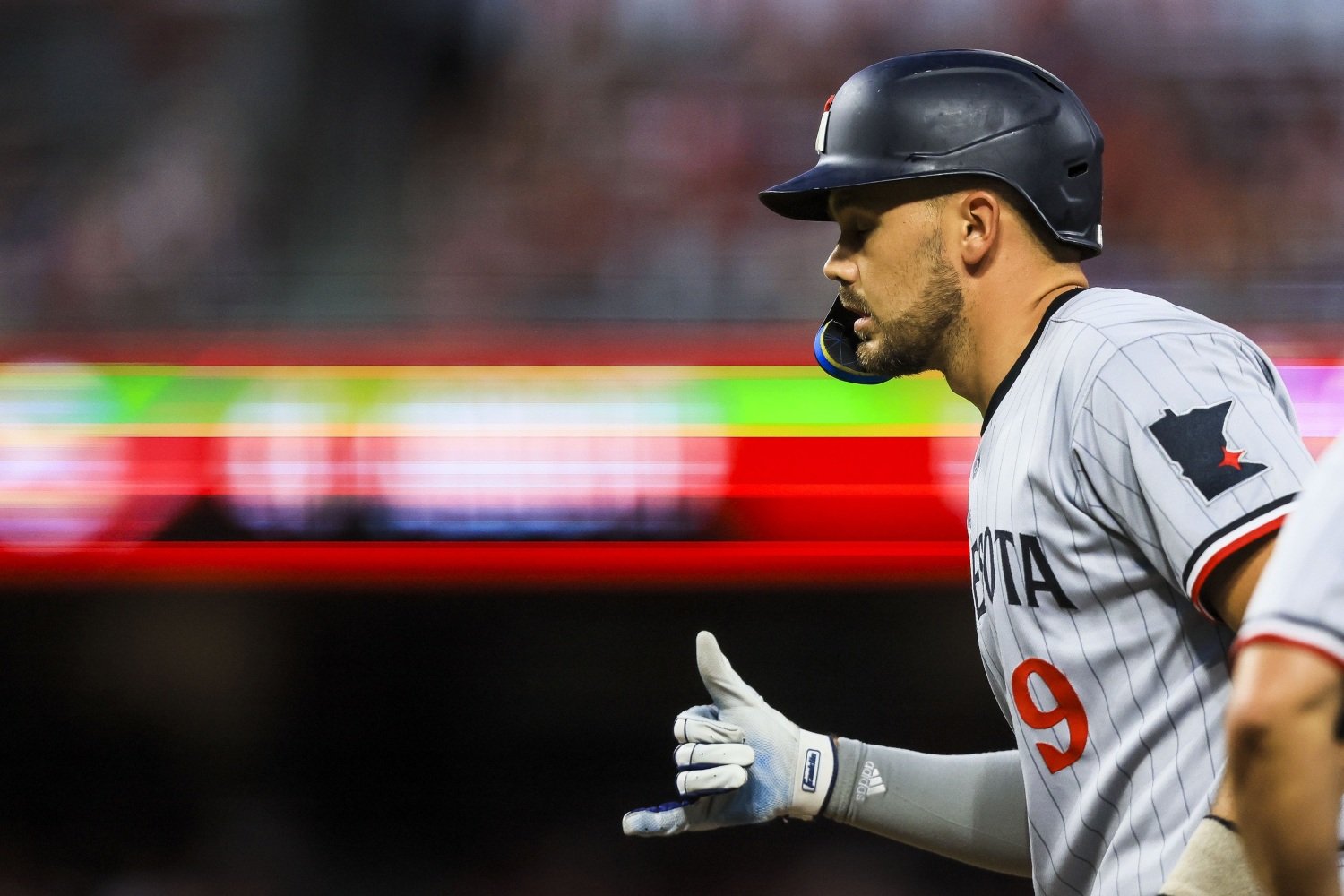
One way they could do so, however, would be to trade Trevor Larnach for pitching help. Larnach, soon to turn 29, is set to make nearly $4.5 million this year, but his role on the team has been obviated by the acquisitions of Josh Bell and Victor Caratini. He batted a respectable .254/.330/.428 against right-handed pitchers last season, but he has little defensive value and is not likely to be substantially better than Bell or Caratini as a DH in 2026. He has no place to play in the crowded (if underwhelming) Twins outfield mix, and is an injury risk even when he manages to lumber underneath a ball out in left field.
With two years of team control remaining and coming off a season in which he made an apparently unconscious, ill-advised swing change, Larnach probably has some appeal to teams as a reclamation project. Until now, the Twins have been uninterested in trading him on those terms, holding out instead for a robust return that reflects the potential they saw in him when they made him a first-round pick and (over the years) a priority piece of the roster. If they come down on their asking price, though, they could match up with another team on a deal that would move them forward in the short term and the long term.
Five teams stand out as having a surfeit of pitching depth and a need for left-handed help at DH or in left field. That doesn’t mean they could find a perfect fit with the Twins on a trade, but these clubs make promising suitors if the team wants to offload Larnach. Moving him would need to bring back a pitcher who augments their depth, though it wouldn’t bring anyone similar to López. The other, ancillary benefit of such a move would be freeing up a few million dollars to spend, perhaps on a last-second bullpen addition.
Arizona Diamondbacks
Somewhat shockingly, the Diamondbacks have brought back both Merrill Kelly and Zac Gallen in free agency. That leaves them with a bunch of good options in the starting rotation, especially once Corbin Burnes returns from the Tommy John surgery he underwent last spring. It wasn’t really what the team initially planned to do, though. As a result, they’d already brought in Michael Soroka to round out a rotation that also includes compelling young arms Brandon Pfaadt and Ryne Nelson.
Meanwhile, the team dealt away outfielder Jake McCarthy and utility option Blaze Alexander, leaving them with extremely shaky options for the corner outfield spots and at DH. They’ll go with Pavin Smith as the DH against most righties, and defense-first youngster Jorge Barrosa in left field. If Corbin Carroll is at all delayed in his return from a broken hamate bone, the team’s corner outfield outlook will get truly destitute.
Earlier this winter, Minnesota had interest in right-handed journeyman Taylor Clarke, who ultimately signed with Arizona. The low-wattage version of a deal sending Larnach to Arizona would be to get Clarke in exchange, filling innings and giving the Twins a small amount of upside, plus the aforementioned monetary savings to put toward relief help. The alternative version would make the team more expensive, not less so, but it would be buzzier: Minnesota could take on some portion of the $46 million left on the contract of left-handed starter Eduardo Rodríguez.
Rodríguez, who will turn 33 in April, has posted an ERA just over 5.00 in his first two seasons with Arizona, but when he’s right, he can still be a solid mid-rotation starter. He’d be a sponge for innings, rather than a respectable candidate for a playoff rotation spot, but the Twins could find multiple ways to extract value from him, if they found the right unlocks for a misused arsenal. The Diamondbacks would have to eat much of the money owed to Rodríguez, but that’s not out of the question.
Chicago Cubs
With a loaded rotation, the Cubs will send at least three intriguing starters to Triple-A Iowa this spring, barring a spate of injuries. If 2021 first-round pick Jordan Wicks were panning out as hoped, he’d be more in the thick of the battle for a rotation spot, but as it is, he’s a sturdy lefty with a plus changeup whose velocity has ticked up into the mid-90s in recent stints. Lanky right-handed starter Ben Brown would form a perfect trio with Taj Bradley and Mick Abel: three hard-throwing righties with tantalizing starter ceilings but major risk of ending up as a reliever, instead. Kitchen-sink swingman Javier Assad is nearing age 30 and still hasn’t gotten a proper chance to establish himself in Chicago, despite putting up good numbers every time the team gives him a shot. None of the three are making significant sums in 2026. All three can be optioned to the minors. Chicago projects to have an all-right-handed-hitting bench, and currently has no choice but to slot Moisés Ballesteros in as their regular DH—a daunting proposition not only because Ballesteros is young and inexperienced, but because the Venezuelan prospect hasn’t yet made it to Cubs camp due to visa issues. Larnach for one of Brown, Wicks or Assad could work out perfectly for both sides.
Cincinnati Reds
How much are you missing Chase Petty these days? He’s not looking like a future star, but he remains an optionable arm with upside. Like Wicks, he was a 2021 first-round pick but hasn’t yet found his stride in the majors. Like Brown, though, he has real promise even if he needs to be converted to the bullpen. Cincinnati’s top starters are too good for the Twins to snatch them up in exchange for Larnach, but in addition to Petty, they have some relief arms they could spare and who would be notable upgrades for Minnesota.
Houston Astros
Loaded though they are on the infield, the Astros have a sketchy outfield picture to deal with. If the season began today, they’d give lots of at-bats to the likes of Joey Loperfido and Zach Cole in the corner spots, especially when facing right-handed pitchers. Larnach is slightly better and slightly cheaper than Jesús Sánchez, whom Houston traded for Loperfido at the beginning of camp as they rearrange deck chairs. He’d be a good fit for their home park.
Meanwhile, the Astros are awash in flawed but useful starting pitching. Jason Alexander, Spencer Arrighetti, AJ Blubaugh, Colton Gordon, Kai-Wei Teng and Miguel Ullola are all optionable, but none are in line for many starts in the majors with Houston. In varying degrees and ways, all six are worth a look for the Twins. Swapping Larnach for one of them would give the team more controllable pitching and that financial flexibility they might need to improve the bullpen.
Washington Nationals
This would be something akin to a challenge trade. The rebuilding Nationals aren’t going to surrender good pitchers under long-term control for a player like Larnach. However, he would solve some problems for them in filling out the lineup on a day-to-day basis, and they have some post-hype arms who might appeal to the Twins. Former All-Star (even if it was largely an obligatory selection, based on the rule that every team must be represented) Josiah Gray hasn’t recovered as hoped from an injury detour, and only has the same amount of team control left that Larnach has, but he’s also set to make $1.35 million this year, so he’d bring the team substantial savings. Righty Jake Irvin comes with Minnesota connections and more team control than Gray, though he, too, has been rough lately.
Larnach can’t command an especially rich return in a trade. The Twins are past the point of deluding themselves on that front. However, he could still net the team some viable pitching depth, which has become a more salient and serious need in the wake of Tuesday’s news about López. General manager Jeremy Zoll will have to do something to repair the rupture of his roster. Finally moving Larnach might be the best way to go about it.