
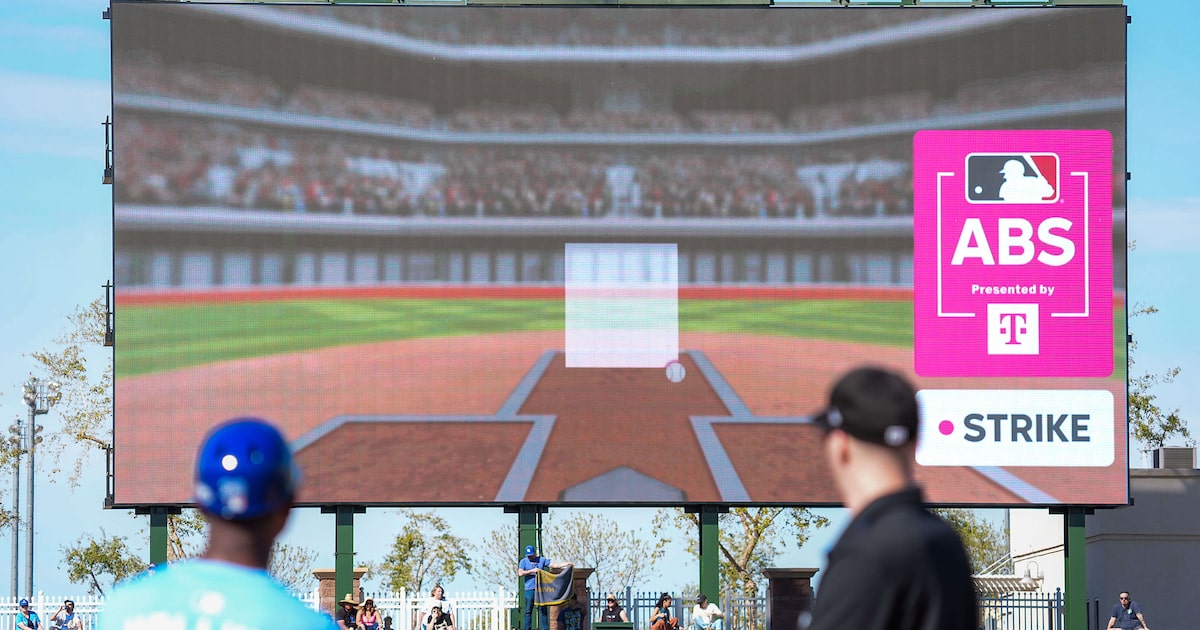
SURPRISE, Ariz. — The arrival of a full-on automated ball-strike (ABS) challenge system on opening day means the Texas Rangers must figure out two big issues: To whom they will give more leeway to use the system and when to use it.
Spring training games will be primarily about figuring out the first part.
Manager Skip Schumaker said he is open to players experimenting with the system whenever they are in games during spring, particularly because many of his starters will only be in the game for four or five innings early.
“I think spring training is going to be so much different than the regular season, because [in the regular season] there’s the high-leverage situations that come up during the game. But a lot of guys will be out of the game in the later innings early on. So you want them to use it and to feel it out. Typically, though, you want to use it in higher leverage situations, so we have our R&D department working on what has and hasn’t worked at Triple-A [where the system was in use].
Rangers
“It’s going to be a learning curve for all of us, umpires included. I’m excited to see it. I think there’s a lot of players who have been anticipating this for a long time, including myself, when I was a player catching wind of it.”
A year ago, MLB tried the system out during spring training and everything seemed to work rather seamlessly. Teams were granted two challenges per game. They must be indicated by either the batter, the pitcher or the catcher by tapping his helmet immediately after the call. That would trigger the video review, which would be shown on the scoreboard to indicate a ball or a strike. If the challenging team is correct, it retains its challenge. If not, it loses one. If teams go to extra innings, which really won’t be an issue in spring training, each team would be granted a challenge per inning, but no team can ever have more than two challenges.
While pitchers and catchers can challenge calls, perhaps the biggest place where it may make a positive difference for the Rangers is in the hands of discerning hitters. Successful challenges could be a big factor in improving the Rangers offense.
Overall, Rangers hitters ranked in the bottom tier of the league in most “challenge-worthy” pitches, those that were on what MLB’s Statcast tracking system considers the “shadow” of the strike zone (on the edges, either in or just out of the zone).
But that doesn’t tell the full picture.
It’s possible that no example will offer a complete picture of the value of missed calls. Let’s, however, take one specific situation: Two-strike counts in which the tying or go-ahead run was either at the plate or on the bases. By definition, that is high leverage. The Rangers saw 14 such pitches that were called strikes, about league average, but only three of them were actually in the zone. In games encompassing those 11 missed calls that went for third strikes, the Rangers were 1-10. Twice, they ended up getting walked off. It had an impact.
Conventional wisdom is that the challenge will be a valuable tool for discerning hitters like Wyatt Langford, who had 49 pitches overall on the shadowy edges called strikes. It was in the top 10 percentile in the league. Of those, 36 were actually outside the zone.
There are others. Evan Carter and Brandon Nimmo are considered particularly selective; while Corey Seager is aggressive, he rarely swings at pitches off the edges. But some others should also be considered. Josh Jung and Josh Smith each had a team-high six pitches in the shadows called third strikes. Nine of those 12 pitches appeared out of the zone, according to the tracking system.
Langford and Jake Burger each had four such pitches. There is real data to back up entrusting them with challenges. But Schumaker and staff must also determine who may have bad vision when it comes to pitch location on the edges. It’s harder to determine who thought pitches were outside the zone, took them, ended up getting a called strike and who would have challenged, had there been a vehicle foe that.
“I think it’s part of spring training and watching the game,” Schumacher said. “I think there are definitely some veteran guys that will get the benefit of the doubt and that you can trust. And then, as we move forward, into the season, if you start building trust more and more or less, however, you want to spin it, it’s all so new to everybody that I think we’re trying to figure out exactly how to go about it.”
Rangers’ new-look catching tandem of Higashioka, Jansen welcoming whatever’s asked of themTony Clark reportedly set to resign as MLB players’ union head as possible cap fight looms
Find more Rangers coverage from The Dallas Morning News here.
Click or tap here to sign up for our Rangers newsletter.