
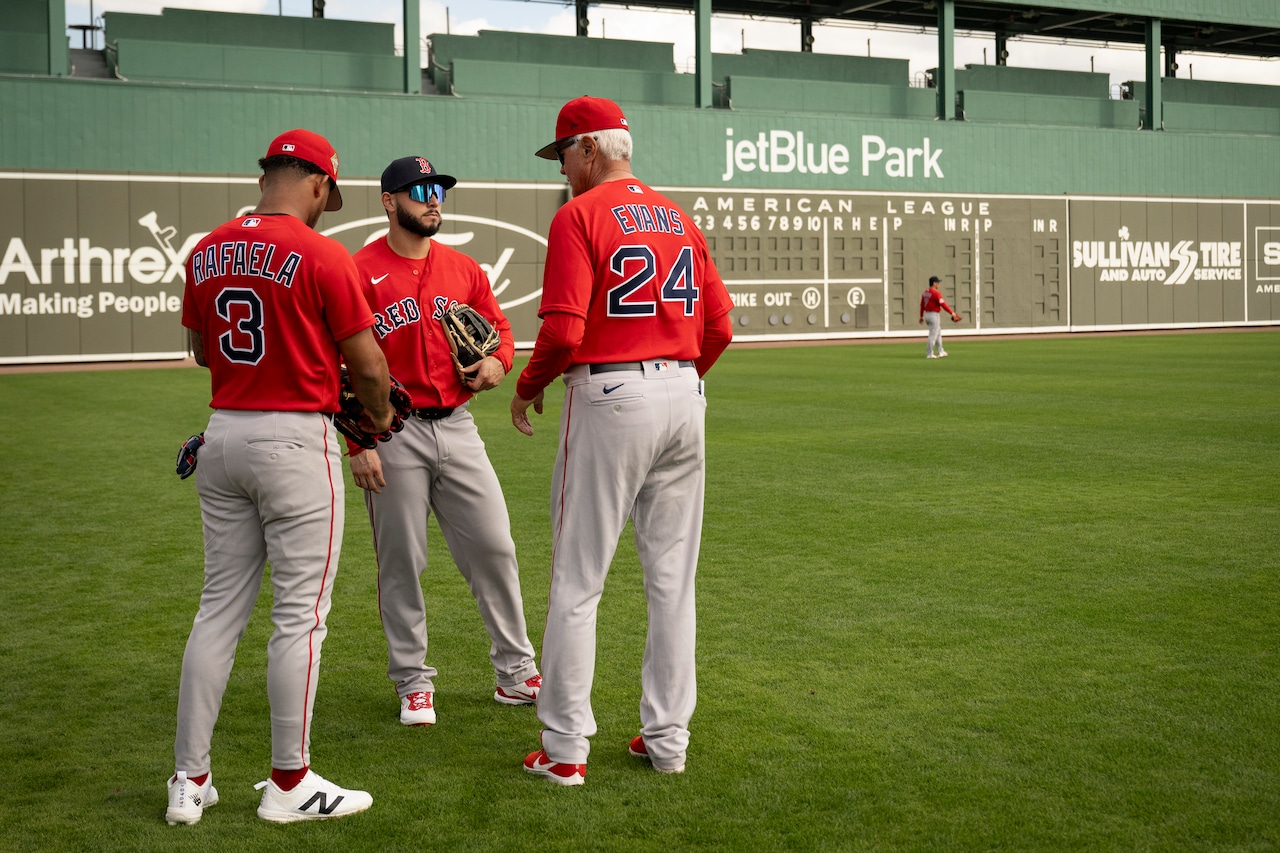
FORT MYERS, Fla. — Over a 19-year career with the Red Sox, Dwight Evans won eight Gold Gloves for his play in right field, becoming the standard for the position.
His name is included on a short list of players regarded as among the best to play right, mixed with the likes of Roberto Clemente, Al Kaline, Ichiro Suzuki and select others.
So when Evans, who works as a special instructor during spring training, talks about the position, people listen. And when he calls Wilyer Abreu, the Red Sox’ current right fielder, “special,” it carries extra weight.
Abreu has won Gold Gloves in right in each of the last two years, leaving him well behind Evans. But other than Evans, only Mookie Betts (four) has won more Gold Gloves among Sox right fielders.
“He does a lot of good things out there,” said Evans. “He’s got a really good arm. And he wants to be good. He wants the ball hit to him, which is important. He knows situations. He’s never out there not knowing what to do. He’s on top of it.
“He’s got two Gold Gloves for a reason. He’s a great, great player. He’s special. He has fun playing the game, and that’s a missing element for a lot of players. They’re so serious, but he truly has a lot of fun. And he’s fun to watch.”
Abreu has more than end-of-the-year hardware to show for his excellence — the advanced defensive metrics help stake his claim, too. In 2024, Abreu was credited with 17 defensive runs saved; last year, he had 15.
According to Statcast, Abreu finished in the 90th percentile last year in defensive run value. His range was in the 94th percentile and his arm strength was 97. And as measured by Outs Above Average, Abreu, with seven, finished second only to Arizona’s Corbin Carroll among all MLB right fielders.
Right field in Fenway has its many challenges, from the amount of ground to cover – more than any other right field in MLB — to its arduous sun-field, to the many strange angles and dimensions.
But as Evans sees it, Abreu prepares himself well to handle the demands of Fenway.
“He anticipates and that’s important,” said Evans. “I always say great plays are made before they happen because they’re made in your mind. You go through all the scenarios in your mind, and Wilyer does that and so does Ceddanne (Rafaela in center); they have to.
“He goes hard and he hustles, but he’s always anticipating. He’s always ahead of the game.”
Modern outfielders have the benefit of playing in the Information Age, with detailed spray charts on every hitter available on a card they carry in their pocket. Evans didn’t have that luxury in his career, and had to learn hitters’ tendencies by watching and making mental notes.
“You had to know your players,” said Evans, “and I think that helps players to learn how to play the game himself. Today, there’s a lot of coaching that goes, which is fine. But when I played, you had to know your opponents and you had to know your pitcher.
“If you gave me one of these cards, I wouldn’t know what to do with it. Now, they have (information) in their ear about what pitch is coming. All of that is helpful.”
Asked to compare Abreu with Betts, Evans measures his words carefully.
“I loved Mookie,” said Evans. “He’s a guy you build your organization around. I’m not saying Wilyer’s not there yet, but there’s no saying he can’t get there, either. He’s a strong kid, and he has that ability. I think Mookie was blessed with more speed, but Wilyer is very athletic. He has a good first step, gets great jumps and he’s always moving.
“I don’t think it’s necessarily a fair comparison; Mookie is one of my all-time favorites.”
Evans knows every nook-and-cranny to Fenway’s right field dimension, from the way the wall juts out beyond the right field foul pole to the low-rise wall down the line and the lack of foul territory. He’s tried to share his knowledge with Abreu, an eager student.
“It’s the toughest outfield in baseball,” said Evans. “It flat-out is, for all the elements and angles. I’ve tried to share some of that.”
“He’s given me a lot of good advice,” confirmed Abreu. “He was the best ever playing there, so every time we talk, he’s got some good tips, especially with the Pesky Pole, because that’s the most difficult part to play, especially when the ball kicks off the wall with all the angles. He’s told me how important it is to make quick decisions out there, when the ball is heading (to the area for the wall that juts out). It’s either go back and wait for the ball, or come in and cut it off. That’s the toughest call to make.
“It’s not easy to win eight Gold Gloves anywhere. It’s so impressive. He’s an example to follow, and I’m lucky to have him helping me.”
Evans has a right arm that was the stuff of legend, so much so that his assist totals were modest after baserunners learned to not challenge him.
Abreu’s arm isn’t in the same category — few were or are — but it plays well above-average, as the metrics indicate.
“He’s accurate and he releases quick and his feet are underneath him so he’s got some drive when he throws,” noted Evans. “He just does a lot of good things out there.