
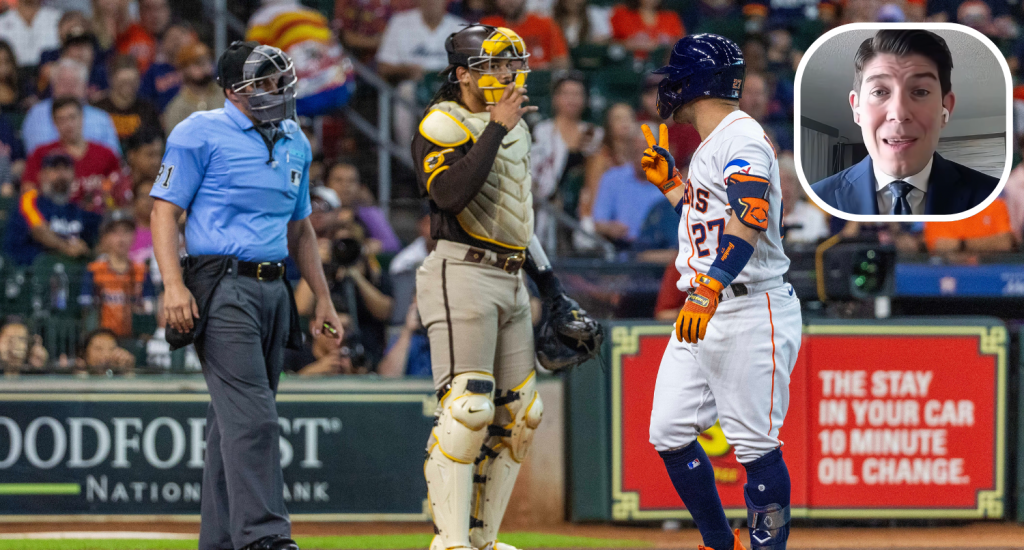
The strike zone box on MLB broadcasts is about to look different this season, and Jeff Passan says it’s because the league is still terrified of what happened in Houston.
The ESPN reporter appeared on The Rich Eisen Show this week and confirmed a report from the Chicago Sun-Times that the graphic showing pitch location on screen will no longer indicate whether a pitch was called a ball or a strike, which is a change designed to prevent teams from using real-time broadcast data to decide whether to challenge calls under the new Automated Ball-Strike Challenge System (ABS).
Eisen asked Passan directly whether MLB was altering the strike zone box specifically to prevent teams from exploiting live broadcasts during challenges. Passan said yes, and then explained why the league is going to such lengths.
“The truth is, though, Rich, like this is such a Major League Baseball response,” Passan said. “What happened with the Houston Astros and the cheating scandal there, they want to be above board on absolutely everything that they can.”
The changes are more extensive than just removing a graphic. Passan explained that the strike zone box will still appear on screen, but the visual distinction between balls and strikes is being eliminated.
“I believe that it’s just going to be more that the graphic that comes off on the screen is not going to indicate whether it’s in the supposed strike zone or the strike zone that’s marked on TV,” Passan continued. “I think SNY — the Mets broadcaster — actually did it this way, where it was just a hollow circle in the area that showed where it was, but it didn’t say that’s a strike or that’s a ball.”
As we covered on Monday, that’s not the only restriction MLB is implementing. The Athletic’s Sam Blum reported that broadcast feeds showing the strike zone box will operate on a nine-second delay, MLB Gameday will run on a five-second delay for pitch location data, and the low-latency feed inside ballparks won’t show the strike zone box or pitch location dots. Fans watching at home, fans tracking Gameday, and fans sitting in the stadium will all be seeing something different, and none of it will be in real time.
The strike zone box has also been stripped from jumbotrons and any in-stadium monitors accessible to players or fans. It’s only visible inside broadcast booths now, where production crews can use it, but players can’t see it.
All of this is to prevent a scenario where someone in the dugout watches a monitor, sees whether the pitch was in the zone, and somehow signals that information to the batter or pitcher before they decide whether to challenge. Passan acknowledged the concern is at least theoretically legitimate.
“Could teams theoretically see the thing on the screen and come up with a system to relay it to home plate quickly?” Passan said. “I suppose so.”
But he doesn’t think it’s actually going to happen. Players have to challenge within a second or two of a pitch being called — they tap their head immediately after the call — and Passan believes the window is too tight for any elaborate signaling system to work. More importantly, he thinks players will trust their own eyes.
“I think over time we’re going to see from players that they’re not even going to bother looking into the dugout,” Passan said. “They’re going to trust their eyes and what it tells them, and they’re going to challenge based on that.”
The data from ABS trials support that. Passan noted that it’s been about a 50% correct-call rate and a 50% overturn rate in minor league and spring training trials so far. If players were relying on some sophisticated system fed by broadcast graphics, you’d expect better than coin-flip accuracy. The 50% success rate suggests players are just guessing based on what they saw.
Passan is still optimistic about ABS overall, even if the broadcast restrictions feel excessive.
“I think it’s going to be great,” Passan said. “It’s not going to be the pitch clock. It’s not going to have that demonstrable an effect, but I think it’s ultimately going to be a good thing for baseball. And some of those blown calls that we’ve seen on balls and strikes late in important games, there will be a backstop for them.”
The pitch clock has fundamentally altered the pace of the game, with an immediate, measurable impact. ABS challenges aren’t going to do that. They’ll correct some bad calls and create a few dramatic moments when challenges overturn important pitches, but the game itself won’t look or feel that different. The broadcast experience, however, will be noticeably more restricted, all because MLB is still haunted by what the Astros did half a decade ago.
It’s hard to argue that the league shouldn’t be cautious. The Astros scandal was a disaster that damaged baseball’s credibility, led to suspensions and firings, and left a permanent stain on a World Series title. If MLB wants to eliminate any repeat, that’s understandable. But there’s something almost comical about the lengths the league is going to in order to prevent a form of cheating that might not even be practical.