

Last season, the Royals traded for Jonathan India with the plan of him being the leadoff man to hit ahead of Bobby Witt Jr. India held that role until early August due to his regression in on-base ability. Mike Yastrzemski and Maikel Garcia became the main leadoff hitters against right and left-handed pitchers, respectively, after India lost the job. Adam Frazier and Carter Jensen also got a few spot starts at leadoff. With Yastrzemski no longer an option, who should the Royals rely on to set the tone at the top of the order?
A modern leadoff hitter is not necessarily the fastest player on the roster. A leadoff hitter should be able to excel at getting on base so that the middle of the order can get them home while also avoiding empty plate appearances by recording excess strikeouts. A leadoff hitter must also have the ability to excel on the basepaths and increase the chance of scoring by advancing extra bases and avoiding unnecessary outs.
There are a few players who could leadoff for the Royals in 2026. India will likely get another opportunity to win the job in spring training, since that was the reason they traded for him a year ago. Garcia could continue with the job that he had at the end of last season. New acquisition Isaac Collins had one start in the leadoff spot and saw a lot of time batting second last season in Milwaukee. Though not projected to be a starter, Lane Thomas has experience in the leadoff spot and could challenge for a larger role with the Royals if he can have a bounce-back season.
Jensen could be another candidate since he got a couple of starts last season, but since his sample size at the major league level is only 69 plate appearances, it will be hard to compare his metrics with the other options. Ideally, the leadoff man is an everyday player, which makes Jensen less likely to be a candidate as Salvador Perez’s backup. If he can continue his hot start in the major leagues, he might force himself into contention.
Why not Bobby Witt Jr.? Witt is undoubtedly the best player in the Royals lineup and grades better than each of these players in almost every metric. Moving Witt to the top of the order will impede his ability to drive in runs and provide extra run-creating value. As the second batter in the order, his on-base ability will still lead to runs being driven in the middle of the order. As the second hitter, he could do the job of driving in runs and setting the table for the rest of the lineup.
Let’s break down each of the candidates’ profiles to see how they stack up as leadoff candidates.
Getting On Base
Good leadoff hitters excel at getting on base, whether that be from walks or hits. A good way to measure this is Weighted On Base Average (wOBA). wOBA assigns weights to each on-base method based on their offensive value, rather than batting average or on-base percentage, which weighs each hit equally. Below is a chart with last season’s wOBA for each player in addition to their career average and 2026 projections according to THE BAT X model from Frangraphs.
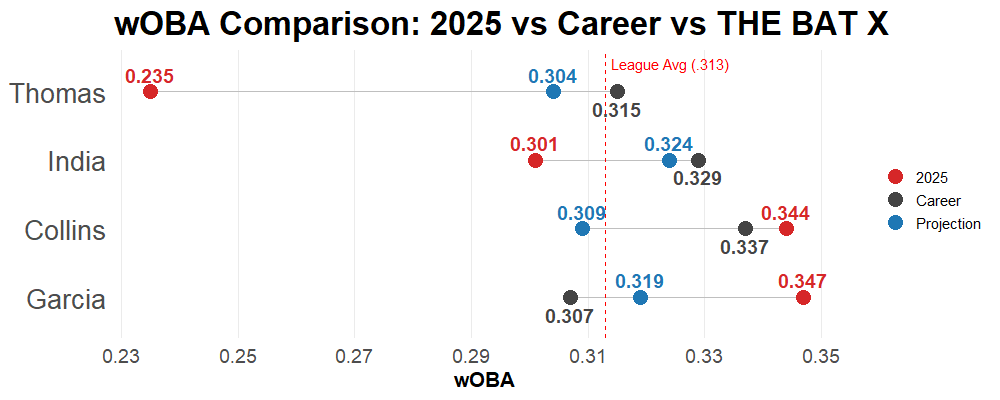
Last season, Garcia and Collins led with wOBAs just over .340, while Thomas and India underperformed their career averages. Projections see Collins as a regression candidate with his 2026 wOBA taking a hit and dropping to .309. This could be due to his expected wOBA being over 20 points below his production last year. Projections appear to be bullish on India making a comeback in 2026, similar to his production in Cincinnati.
Hard Contact
Hard contact is often more predictive of sustainable output than traditional metrics. Generally, it is more likely that a hard-hit ball will fall for a hit than a soft-hit ball. Hard contact is commonly measured by hard hit rate and barrel rate. Below are tables comparing each of the players’ hard contact Statcast metrics. Projections are not available for Statcast metrics.
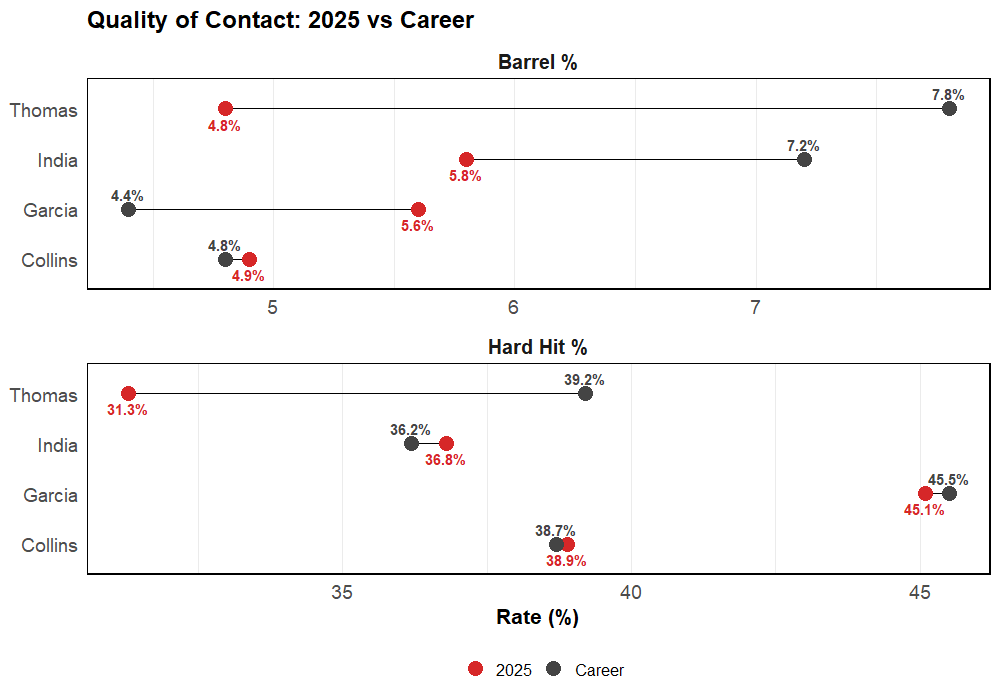
Garcia has the best career hard hit rate of 45.5%, but he pairs that with the lowest average barrel rate of the group despite his better performance in 2025. Of the four players, Thomas’s career averages present the highest combination of hard hits and barrels at 39.2% and 7.8%, respectively. Thomas’s regression and injury history, however, could be enough evidence to think those career numbers are less likely to return in 2026. If India is able to return to barreling the ball more than 7% of the time, that could bode well for its chances to lead off in 2026.
Plate Discipline
Avoiding strikeouts is ideal for a leadoff hitter. Striking out removes the opportunity to get on base. It is also key to not chase the ball out of the zone or whiff on strike in the zone. A player who doesn’t chase or whiff balls will also tend to increase the pitch counts for starting pitchers and get them out of the game sooner than later. High walk rates also show signs of good plate discipline and an increase in on-base percentage.
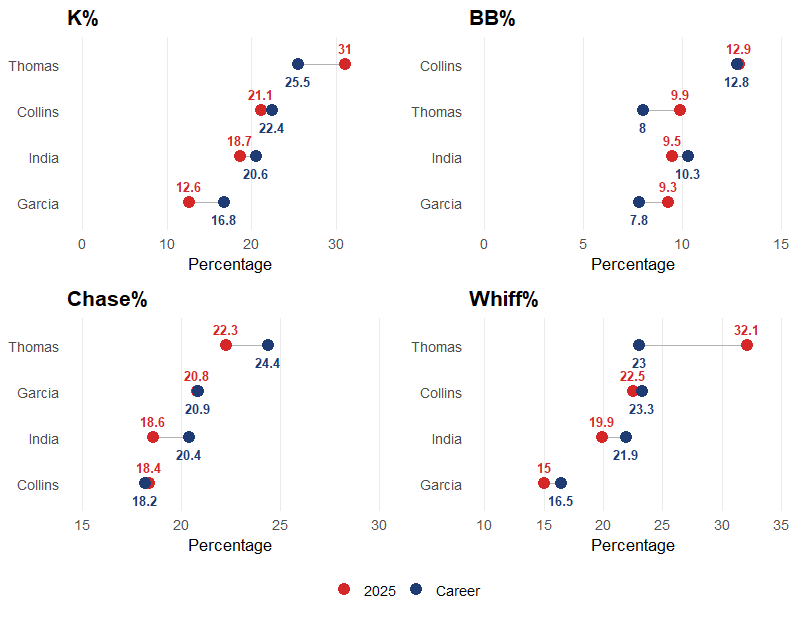
These metrics are a little all over the place, but what stands out is that Thomas is lowest in this category with the worst whiff, strikeout, and chase rates of this group, and not a particularly good walk rate. Collins stands out with the best walk and chase rates, and Garcia stands out with the best strikeout and whiff rates. India is more steady across the board as it is not the worst in any of these metrics compared to the other players.
Baserunning and Speed
Modern leadoff hitters are not necessarily the speedsters that they once were required to be, but it certainly does help. Being fast can be the difference between scoring from first on a ball hit in the gap or staying on third and still needing to be driven in. Steals can also help by getting into scoring position after a single and increasing the odds of being driven in.
While speed makes taking extra bases and stealing bases easier, that does not necessarily make a player a better baserunner. Being able to read a pitcher’s delivery on a steal and knowing when to advance an extra base based on the fielders’ decisions can increase the baserunning acumen of any player, regardless of speed. These skills are essential for increasing the odds for the middle of the order to drive in more runs.
Baserunning value is measured in totalling extra runs via extra bases taken and runs via stolen bases. Below are the percentiles each player falls in for baserunning value and sprint speed in 2025.
Player
Baserunning Value
Sprint Speed
India
18th percentile
71st percentile
Garcia
48th percentile
63rd percentile
Collins
68th percentile
58th percentile
Thomas
DNQ
94th percentile
All of these players are above average, with Thomas being the fastest in the 94th percentile of players in sprint speed. However, due to his limited playing time, he did not have enough of a body of work to qualify for the ranking. Over his career, his baserunning value has been close to average or slightly above average.
Collins provided the highest baserunning value despite being the slower player in the group. If he can maintain his on-base abilities, his baserunning ability could be valuable to the Royals’ offense.
India did not have good output in baserunning last season despite being the second-fastest player here. He was caught stealing in all three of his attempts last season despite totaling double-digit steals in three of his four seasons in Cincinnati.
Verdict
Each player brings different strengths to the leadoff spot. India excels at plate discipline and at barreling the ball. Garcia excels in on-base ability and a high hard hit rate. Collins provides strong baserunning and plate discipline. Thomas provides speed and power potential.
There is no clear-cut favorite for the everyday leadoff man. It will be important to see how these players perform in spring training to determine whether any can show production beyond their current skill sets to win the leadoff spot.