
The tools are new. Mistakes will be made as we try to figure out how to best use them. But if you want an edge on your fantasy league mates, or if you’re an executive running a major-league team, you’re going to have to use the new swing metrics to augment your analysis of players in the league.
There’s a whole suite of new metrics over at Baseball Savant thanks to the tireless work of their squad of engineers and analysts, but three metrics in particular stand out as incredibly important: Bat Speed, Swing Tilt and Intercept Point. These three metrics can paint a powerfully predictive picture of a player in the tiniest of samples, but they each contain some pitfalls.
Let’s take a look at each metric and see if we can use them to uncover some potential breakouts at the major-league level.
Bat Speed
It might be tempting to look past Bat Speed as an accurate predictor of hitting success due to such revelations as “Freddie Freeman has 19th percentile Bat Speed” and “Luis Arraez has the slowest Bat Speed in baseball,” but there are exceptions to every rule. If you take the long view and look at how well Bat Speed predicts power for the rest of the season — and how quickly — it becomes hard to ignore the stat. It takes three swings to create a reliable enough sample to predict power as well as Barrel Rate, one of the other most powerful stats on Baseball Savant. Three swings!
This is what Jordan Rosenblum, founder of OOPSY projections, found when he took a look back at the last few years of samples we have (Bat Speed was introduced in 2024 and we have some 2023 data, as well). Three swings of Bat Speed was enough, but it takes 50-60 balls in play to have a believable Barrel number. And while Barrels in the first half are correlated with second half results on balls in play at a strong level, Bat Speed is not far behind. Here are those correlation coefficients:
Correlation strength of hitting metrics
First Half MetricCorrelation to Second Half WOBACON
Barrels/BBE
0.53
xwOBA
0.52
Hard Hit%
0.51
Avg Bat Speed
0.5
Hard Swing Rate
0.49
wOBAcon
0.4
Swing Length
0.27
Attack Angle
0.26
Ideal Attack Angle%
0.18
Squared Up%
-0.17
Look at how close Bat Speed is in predictive strength. And one game can give you a good sample.
That said, there are pitfalls. Bat Speed is a process metric, but it’s also a result metric. Meaning the pitcher can affect the player’s Bat Speed. The count and the player’s intent can also affect it. Because Bat Speed is measured at contact, longer swings — or hitting the ball out in front — can change measured Bat Speed. Which is why, once you have some good results on the field in a larger sample, those results are preferable.
In summary:
Bat Speed is powerfully predictive, on the level of xwOBA and Barrels
It takes a tiny sample — as few as three swings — to come online
It’s most useful for debuts and prospects
For veterans, make sure to investigate the context of those swings
Given all that, there are some small-sample players who swung the bat fast last year who should catch your attention:
Jac Caglianone, OF/1B, Kansas City Royals (77.4 mph)
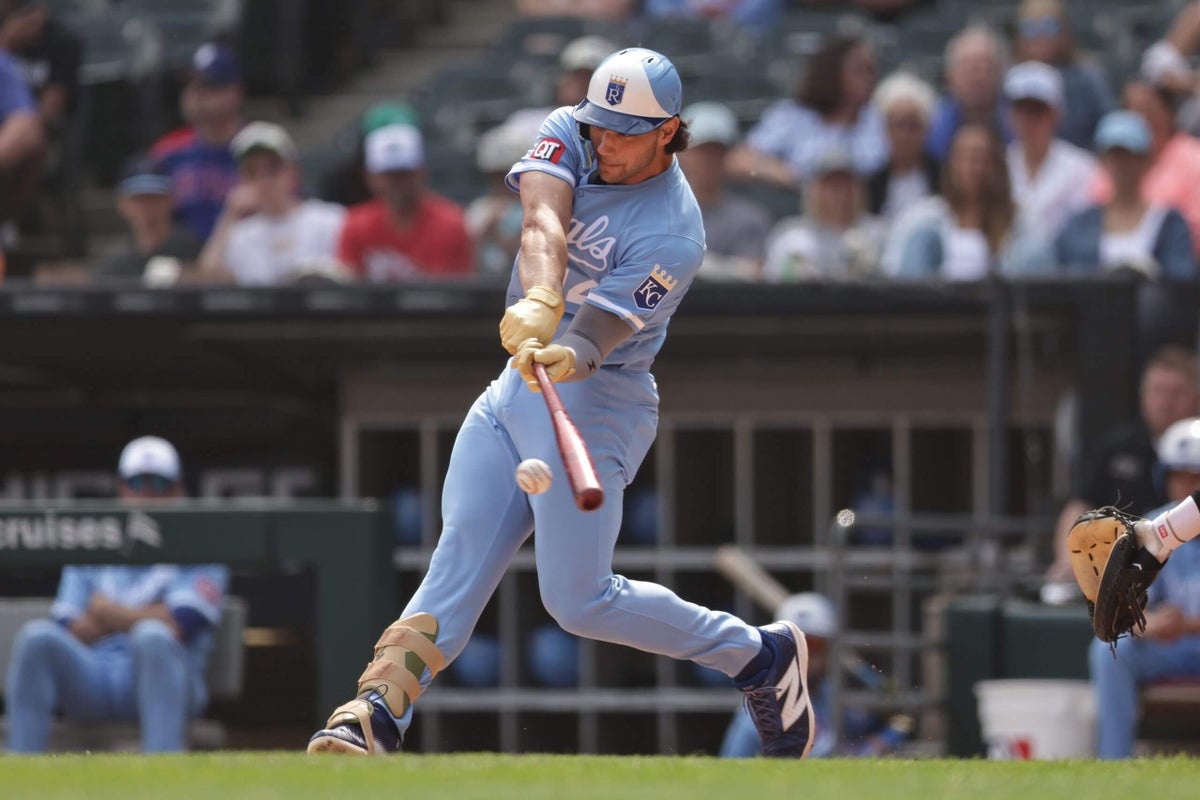
This one’s almost too easy. The sixth pick in the 2024 MLB Draft destroyed the minor leagues, but then struggled in his first taste of the big leagues. You don’t necessarily need to know that Caglianone has top-10 type Bat Speed to know that he could be a beast this year. But it is nice to see that he has more Bat Speed than Kyle Schwarber, Nick Kurtz and Aaron Judge — though he makes contact a little further out in front than Judge, so we’ll have to say “maybe” on that one. Rubbing elbows with these kinds of stars seems to suggest the power is going to come for Caglianone. His swing is a little flat, and he hit a few too many ground balls last year, but the fences at Kauffman Stadium are coming in, and this top pick is about to blast off. Even if you use swing shape, along with Bat Speed to find a comp, he’s got a great one — Junior Caminero.
Garrett Mitchell, OF, Milwaukee Brewers (76.1 mph)
Another first-round pick (pick 20 in the 2020 draft), Mitchell is now 27 and has put together 443 plate appearances across four seasons in the major leagues — with 2025 being his worst season of the bunch. He strikes out a little too much and has had trouble staying healthy, but the Bat Speed numbers suggest that, if his shoulder is healthy, the power is still in there waiting to be let loose. As a lefty with power and patience and good center-field defense, Mitchell offers more upside than Blake Perkins and could make that patch of grass his own this year by mashing at the plate.
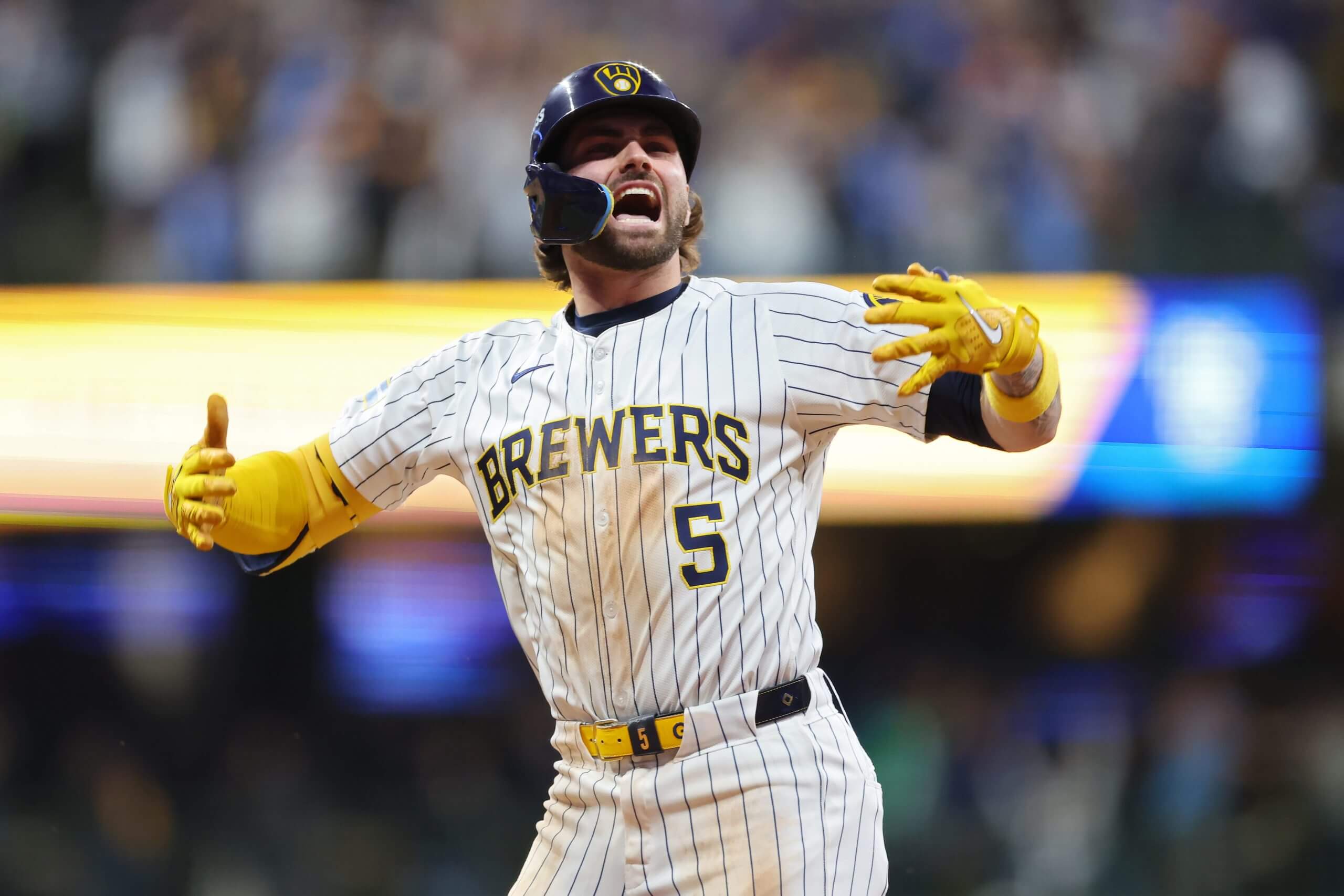
Garrett Mitchell has had trouble staying healthy but if he can stay on the field, he could have a big year for the Brewers. (Stacy Revere / Getty Images)
Owen Caissie, OF, Miami Marlins (74.8 mph)
There is a correlation between Bat Speed and in-zone swing and miss. So there’s obviously some risk with Caissie, who came up and struck out over 40 percent of the time last season in his first try at the big leagues with the Chicago Cubs. But his minor-league numbers suggest he could at least get that strikeout number closer to 30 percent, and the Bat Speed says the power is legit. He’ll get a lot of rope with his new team in Miami and should lock down an everyday role. In fact, the shape of his swing, along with the Bat Speed and some of the contact problems are almost an exact match to someone who did this just last year in Miami: Kyle Stowers.
Swing Tilt
A big uppercut swing has a high tilt number, like what you’d find with Riley Greene (45 degrees) or Nick Kurtz (39 degrees). A flat swing has a low number, like what you’d find with Alejandro Kirk (24 degrees) or Caminero (26 degrees). But what does it mean to have a high-tilt or low-tilt swing?
Generally, a high-tilt swing is better at lifting the ball and hitting balls that are low in the zone. That makes sense if you think of the angle of an incoming breaking ball, and the angle of the swing. Generally, you’ll find the best power hitters have high-tilt swings. But while a low-tilt swing makes for more ground balls, it can be good at producing contact, because it’s great against fastballs (which come in straighter). You can be successful with either swing, but generally the high-tilt hitters have more power potential.
The fact that there are these different ways to be successful has made it hard to make bat path grades that satisfy the entire population. Multiple MLB general managers have privately expressed to me their doubts about their own internal bat path grades, especially when put up against their internal pitching models. Over at Driveline baseball, their baseball operations department solved this problem by creating two separate bat path grades, one for the ability to make contact (Contact+) and one for the ability to slug the ball (Power+).
While the Marlins’ Javier Sanoja and his 21 degree swing lead the Contact+ leaderboards, the Power+ leaderboard is full of more lofted swings:
Here are a couple of possible sleepers who stand out when you look at the Power+ and Contact+ leaderboards from last year:
Jordan Walker, OF, St. Louis Cardinals (51 Contact+ / 69 Power+)
Walker swung the bat nearly 79 mph late last season, and just on Bat Speed alone, the 23-year-old should have had more success hitting for power by now. The path is flat, which is why he’s hit grounders, but there are other guys with flat bat paths and this much Bat Speed who have hit a ton of homers, like Caminero. In any case, there’s enough raw clay here to keep looking at Walker, and then there’s the news he spent the whole offseason trying to work on his path. Don’t give up on him yet even if the first 1,000 plate appearances haven’t fit what the model expects.
James Outman, OF, Minnesota Twins (28 Contact+ / 61 Power+)
It’s not a swing that will make for a lot of contact. The model doesn’t think so, and his 34.5 percent career strikeout rate doesn’t think so, either. But Outman swings the bat fast and has good tilt. And he may have some opportunity now that he’s on a Twins team that could use a polished fourth outfielder who can play center. He’s out of options, and if he plays well in the spring, the team may choose him over a younger player to keep him off waivers.
Intercept Point
This one is tricky, because there are some generalities that you can make about where a hitter makes contact, but there are still ways that a player’s individual context will matter. Back in 2015, Justin Turner told us about the benefits of getting the ball out in front. With Statcast, we can now say that the average contact point is 30 inches in front of a player’s center of mass and that 30 inches is also the best place for contact and batting average, but that 36 inches is better for home runs. Cal Raleigh averaged 36 inches out in front last year and hit a record-breaking number of homers.
That gives us a bit of a rubric that we can take to individual hitters. Do you have a hitter who’s making hard contact but not putting the ball in the air enough? That hitter should probably try to get the ball out in front. Do you have a hitter who’s swinging the bat hard but not making enough contact? That hitter should probably let the ball travel a little and sacrifice some of the top-end power for contact.
In general:
The average contact point is 30 inches in front of the batter’s center of mass
Use contact point relative to center of mass, not front of plate
The best contact point for contact is around 30 inches
The best contact point for power is 36 inches out in front
Getting the ball out in front is good for launch angle and power
Letting the ball travel is good for hard-hit rate and contact
High-tilt, high Bat Speed hitters should let the ball travel
Low-tilt, high Bat Speed hitters should get the ball out in front
Here are a few players who could make a tweak and see different results:
Caleb Durbin, IF, Boston Red Sox (28 degree Tilt / 27.8 inch Intercept)
The new Red Sox third baseman has a game built around contact, so maybe he doesn’t want to try to get the ball out in front and sacrifice any contact. On the other hand, he’s a right-handed hitter headed to Fenway and he has a lot of contact to sacrifice. With a flatter swing like his, he could benefit from making contact later in his swing, when the bat is on more of an upward trajectory. That would lead to more balls in the air and more balls off that big ol’ Green Monster.
James Wood, OF, Washington Nationals (76 mph / 40 degree Tilt / 32.7 inch Intercept)
Wood doesn’t need to do a lot more, as he’s already a great young player with power and speed. But if there’s a flaw in his work at the plate, it’s the strikeout rate. One way the 23-year-old can reduce that strikeout rate is to be more aggressive on pitches in the zone. Can he manage that by watching the ball just a little bit longer before making his decision? Managing his timing so that he’s a little more opposite-field focused, lets the ball travel a little longer and jumps on strikes more often could cut his strikeout rate by leaps and bounds and push him into super-stardom.