
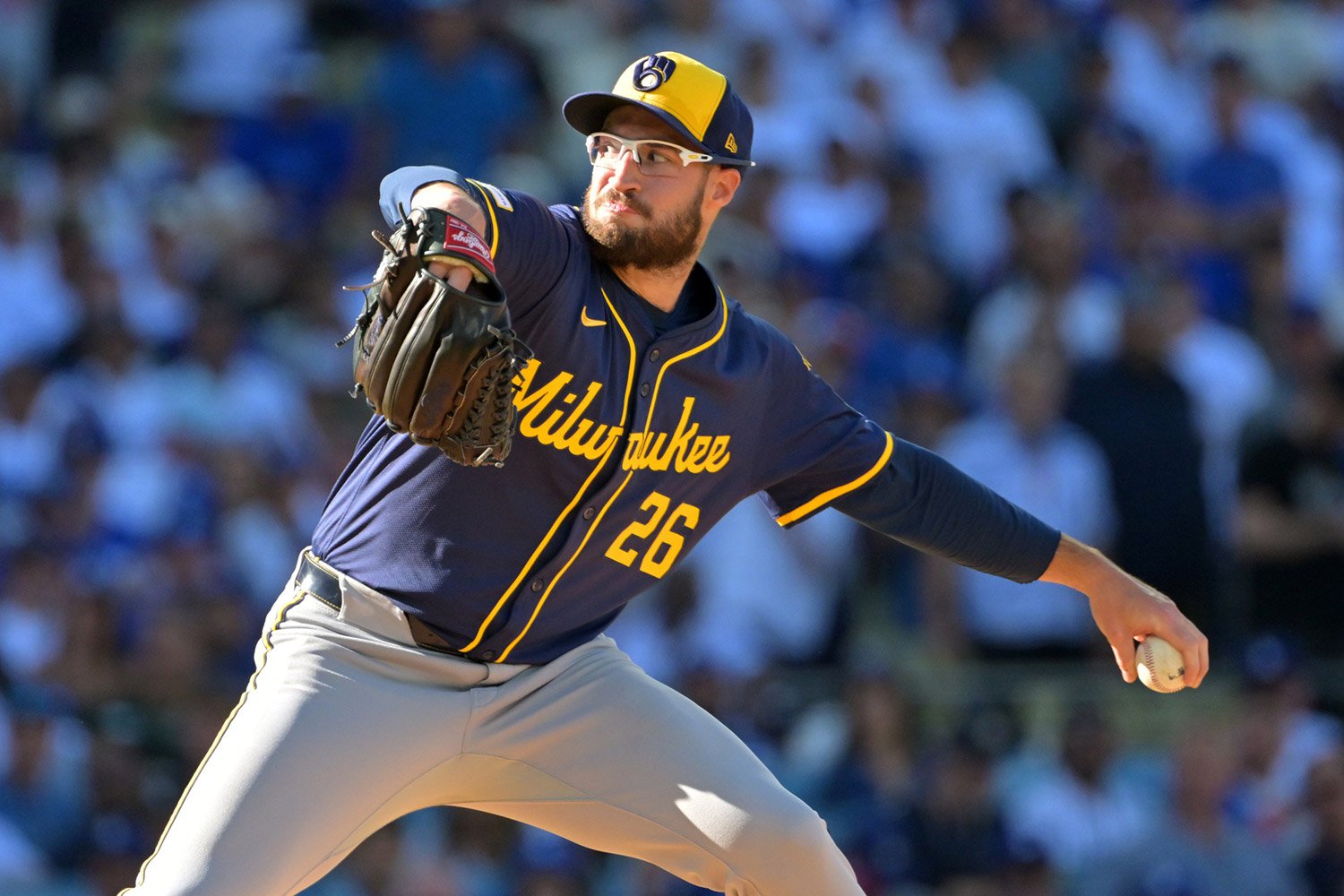
Aaron Ashby is entering his fifth year in Milwaukee and has been an above-average pitcher for the Brewers, posting career numbers of 114 ERA+ and a FIP of 3.46. Let’s say, for the sake of argument, that Nashville is not a realistic option, as in, ‘he’s too good to send down.’ Where will he fit into Milwaukee’s plans?
Ashby was a fourth-round pick in the 2018 draft out of Crowder College in Neosho, Missouri, and made good progress through the Brewers chain, arriving in Milwaukee in just his third year, and has been a solid contributor ever since.
The Brewers have two main questions with their pitching staff: who is going to start, and who is going to stay in Milwaukee?
Let’s answer the first question. Currently, the Brewers have six southpaws that have the versatility to make the rotation or pitch out of the pen. Newcomers Kyle Harrison and Shane Drohan came over in the Caleb Durbin trade from Boston, joining Robert Gasser, Angel Zerpa, DL Hall, and Ashby. All these guys could potentially join the rotation, or they could reside in the pen.
Back in 2022, Ashby made 19 starts for Milwaukee. He averaged nearly five innings per start, striking out at a high rate of 26.2%, but unfortunately, his 10.4% walk rate was pretty bad. Last year in 43 appearances (including one opener game) he whiffed 28.1% while improving a little on his walk rate, dropping it to 8.9%.
Ashby began spring training last year as a starter but suffered an oblique injury and missed the first third of the season. When he came back, he was inserted into a regular bullpen role, pitching in all leverage situations.
Realistically, Quinn Priester, Brandon Woodruff, Chad Patrick, and Jacob Misiorowski are front-runners for the first four starting spots. Logan Henderson and Brandon Sproat are on the periphery. They are all right-handers. Add to that Harrison, Gasser, Ashby, Zerpa, Hall, and Drohan, and you have nearly a baker’s dozen of arms to choose from. Some will get injured, some will underperform, and before you know it, the Brewers could be scrambling to cobble a rotation together. Let’s hope that doesn’t happen.
Aaron Ashby’s Stuff
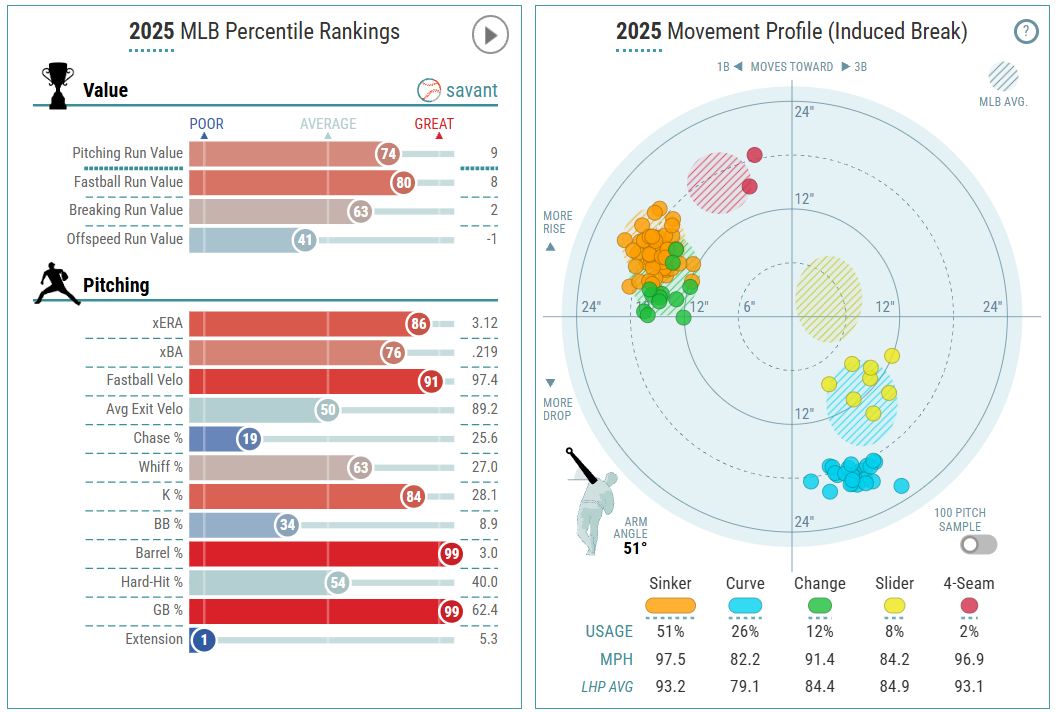
Ashby depends heavily on his sinker, which he throws over 50% of the time, and backs it up with his curveball, which he throws once every four pitches. His most effective pitch is his curveball, which has a 7.6″ drop, more than the major league average. It produced 27 strikeouts for a K rate of 47%. His slider has big movement as well, 9″ more than the major league average. Ashby has changed his arm angle over the years, going from high-three-quarters in 2022 when he was a starter to a more over-the-top guy last year with an arm angle of 51%.
Aaron Ashby’s Pitch Arsenal
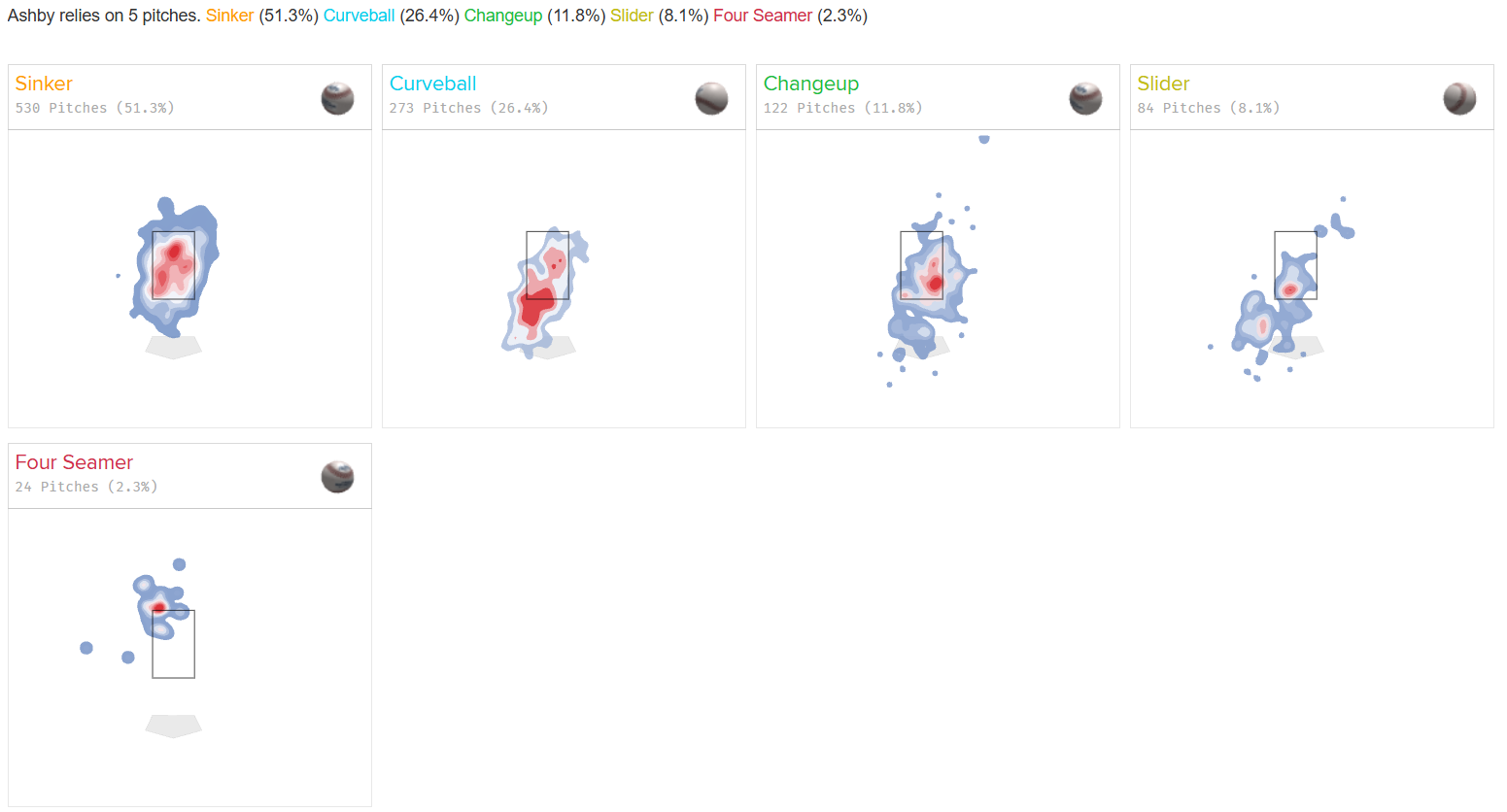
Ashby uses his sinker and curve three-quarters of the time overall, while using his changeup at a 12% rate, while the slider (8%) and four-seam (2%) are the lesser-used pitches in his repertoire. He relies more on the sinker to lefty hitters (58%) and doubles the slider offering up to 18%. When facing righties, the slider and the four-seam go in the back pocket (5% total) while the curve and slider come out half the time, along with the old reliable sinker at 47%. That sinker gets beat into the dirt more often than not (62%), and with an infield like the Brewers have, that is a good thing.
Year
Pitch Type
#
# RHB
# LHB
%
MPH
PA
AB
H
1B
2B
3B
HR
SO
BBE
BA
xBA
SLG
xSLG
wOBA
xwOBA
EV
LA
Spin
Ext.
Whiff%
PutAway%
2025
Sinker
530
305
225
51.3
97.5
136
119
29
24
2
1
2
21
101
.244
.259
.328
.354
.291
.311
90.2
-1
2151
5.3
16.4
22.8
2025
Curveball
273
192
81
26.4
82.2
57
49
7
5
2
0
0
27
22
.143
.150
.184
.185
.219
.225
88.0
3
2737
5.3
43.9
34.6
2025
Changeup
122
120
2
11.8
91.4
38
35
10
6
3
1
0
9
26
.286
.250
.429
.353
.325
.282
89.2
4
1902
5.3
31.3
25.0
2025
Slider
84
14
70
8.1
84.2
31
28
6
5
0
0
1
17
11
.214
.140
.321
.242
.277
.218
76.2
0
2661
5.3
51.5
29.3
2025
Four Seamer
24
17
7
2.3
96.9
8
7
2
2
0
0
0
2
5
.286
.189
.286
.207
.307
.243
78.8
-12
2263
5.3
28.6
11.8
2024
Sinker
216
136
80
44.6
96.2
56
49
12
9
2
0
1
8
42
.245
.211
.347
.327
.297
.297
90.4
1
2120
5.2
12.6
15.1
2024
Changeup
99
91
8
20.5
88.8
27
23
5
1
3
0
1
4
20
.217
.252
.478
.422
.337
.339
86.5
6
1775
5.2
36.4
13.3
2024
Curveball
93
77
16
19.2
82.2
14
14
1
1
0
0
0
9
5
.071
.161
.071
.241
.063
.174
94.6
-5
2636
5.3
42.9
34.6
2024
Slider
66
26
40
13.6
83.2
19
18
2
1
1
0
0
12
6
.111
.138
.167
.277
.149
.201
85.6
9
2541
5.2
43.8
35.3
2024
Four Seamer
10
9
1
2.1
96.9
3
3
0
0
0
0
0
0
3
.000
.155
.000
.467
.000
.255
95.4
32
2214
5.3
0.0
0.0
What Should Aaron Ashby’s Role Be in 2026?
In his major league career, Ashby has appeared in 97 games, of which 26 were starts. He started 66 times in the minors among his 95 appearances, so he definitely has the chops to fit into the rotation. Given the heavy right-handed presence in the tentative rotation, manager Pat Murphy will probably be looking to insert one southpaw into that mix.
The question is: which of the groups listed above will be that left-hander? I would put Harrison or Gasser at the top of that list, but given an underperformance and the likelihood of an injury or two, you might as well flip a coin or roll the dice to decide.
No matter where he ends up, Ashby will play a huge role for the Brewers in 2026.