
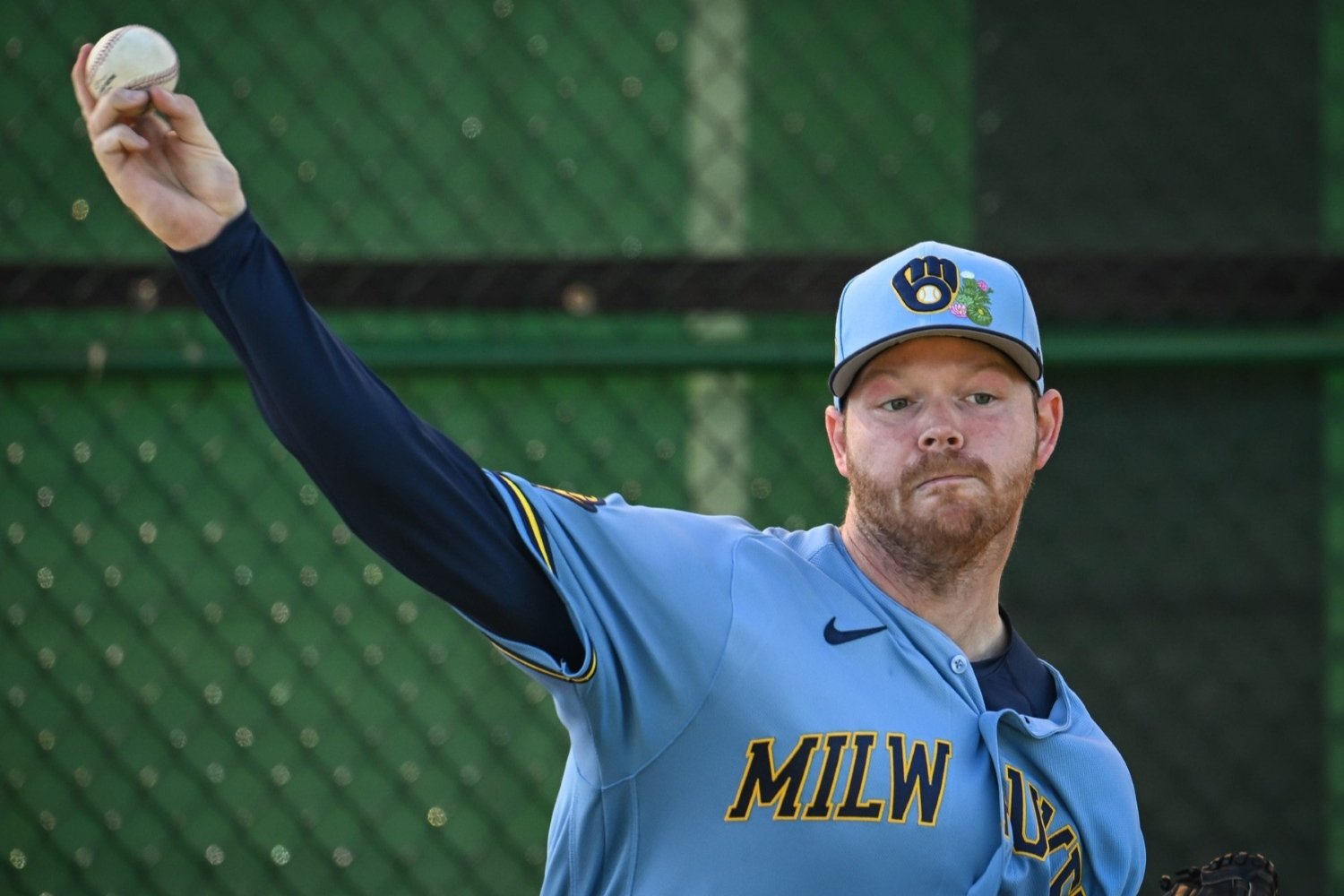
Given his recent injury history, Brandon Woodruff and the Brewers are taking things slow this spring. Woodruff, whose comeback from career-threatening shoulder surgery was truncated by a season-ending lat injury last September, is building up more gradually than most of Milwaukee’s starters, to the point that he is not guaranteed to be ready for Opening Day. Both player and team are more interested in having a healthy Woodruff during the stretch run than in April.
“We don’t want to push him too fast, necessarily, because we want to have those bullets available at the end of the season, for sure, and he is coming off a real injury here,” president of baseball operations Matt Arnold said last week.
The Brewers expect Woodruff to be available this year, though, and they expect him to be a major rotation piece once he’s ready to go. The club affirmed that confidence by extending him the $22.025-million qualifying offer in November, which Woodruff accepted to return to the only organization he’s ever known.
“In terms of the qualifying offer and accepting it, it was a pretty easy decision for me,” he said. “If I had to spend one year pitching somewhere in my career—and fortunately, I’ve been here my whole big-league career so far—this was easy, I’d love to throw it here. I had a few other opportunities, but nothing that compared to here.”
For the first time in two years, Woodruff is coming off a normal offseason, a welcome change of pace from a grueling rehab process. The slower buildup is to ensure he stays healthy, and has nothing to do with how he’s feeling.
“This spring training, compared to last, not even comparable in terms of the way I feel,” Woodruff said.
As he worked his way back, the question was not only when Woodruff would return to the big leagues, but how he would perform when that time arrived. Unsurprisingly, a major shoulder surgery sapped some of his velocity. His four-seamer and two-seamer averaged north of 96 mph in his prime, but they sat at 93 in his return.
Woodruff was no less effective, though, authoring a 3.20 ERA, 2.90 SIERA, and 32.3% strikeout rate, the latter two of which were career bests. He announced his return with authority, tossing six innings of one-run baseball with eight strikeouts on July 6, 2025, against the Marlins in Miami—the location of his previous big-league start, nearly 22 months prior.
“His command was really good,” Pat Murphy said. “His poise. He had that same gunfighter mentality. It’s precious. That game in Miami, it still gives me chills thinking about it.”
In some ways, Woodruff still looked like his vintage self. When he threw his four-seamer, he still went right at hitters. It still induced whiffs on 32.1% of swings, essentially the same elite rate as when it sat in the upper 90s. While its horizontal movement bordered on glove-side cut more than it once did, at 17.6 inches of induced vertical break, it still had above-average carry at the top of the zone.
It was clear from that first outing, though, that this was an evolved Woodruff. Yes, the four-seamer could still miss bats, but he used it a career-low 30.7% of the time and developed new ways to supplement it.
“Last year was a very, very big teaching moment for me in my career and how I can pitch,” he said, “how I can go about pitching and doing different things and expanding on my arsenal a little bit, and not having the velo.”
Throughout that afternoon in Miami, Woodruff repeatedly dotted the outside corner with comeback two-seamers to right-handed batters. He continued doing it for the rest of the season to a greater extent than before his injury, when he almost exclusively used the two-seamer to jam righties inside with running velocity.
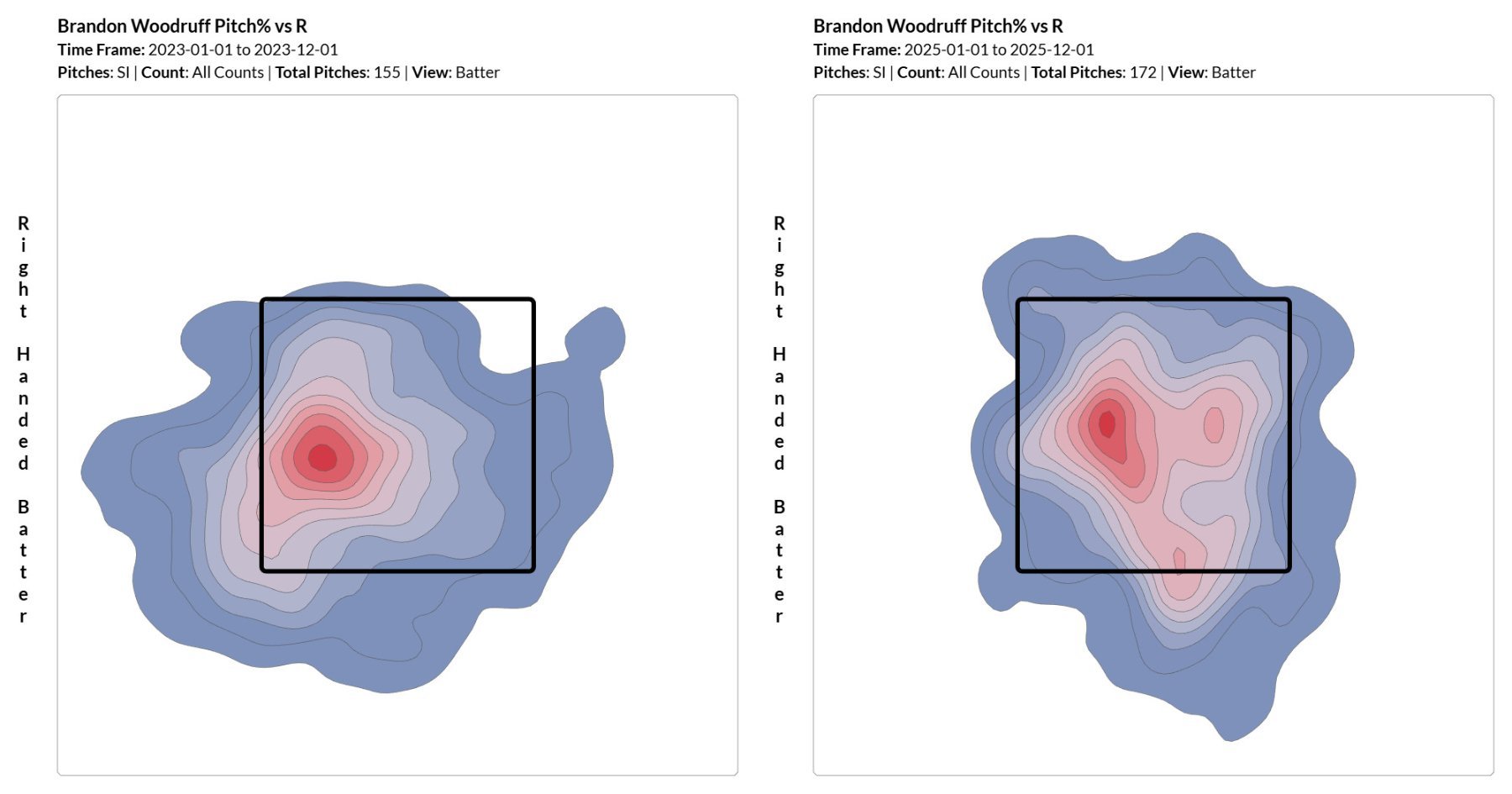
“I started doing that in ’23, too, before having surgery,” he said of the back-door two-seamer. “I’ve always wanted to do it, but I never really needed to do it. That was kind of a different layer for me. So then when I came back and started rehabbing and getting in games, I made sure to kind of keep that in my pocket a little bit.”
“For the two-seamer to come along the way it has, it’s changed him a little bit,” Murphy said.
Woodruff also added a third fastball to his mix. Leveraging his newfound inclination to cut the ball slightly more, he developed a riding cutter using an offset four-seam grip. Sitting at 89 mph with 13 inches of induced vertical break, it mirrored his four-seamer and sinker out of the hand before cutting a few inches toward his glove side, helping him establish an effective tunnel with those two-seamers on the outside corner.
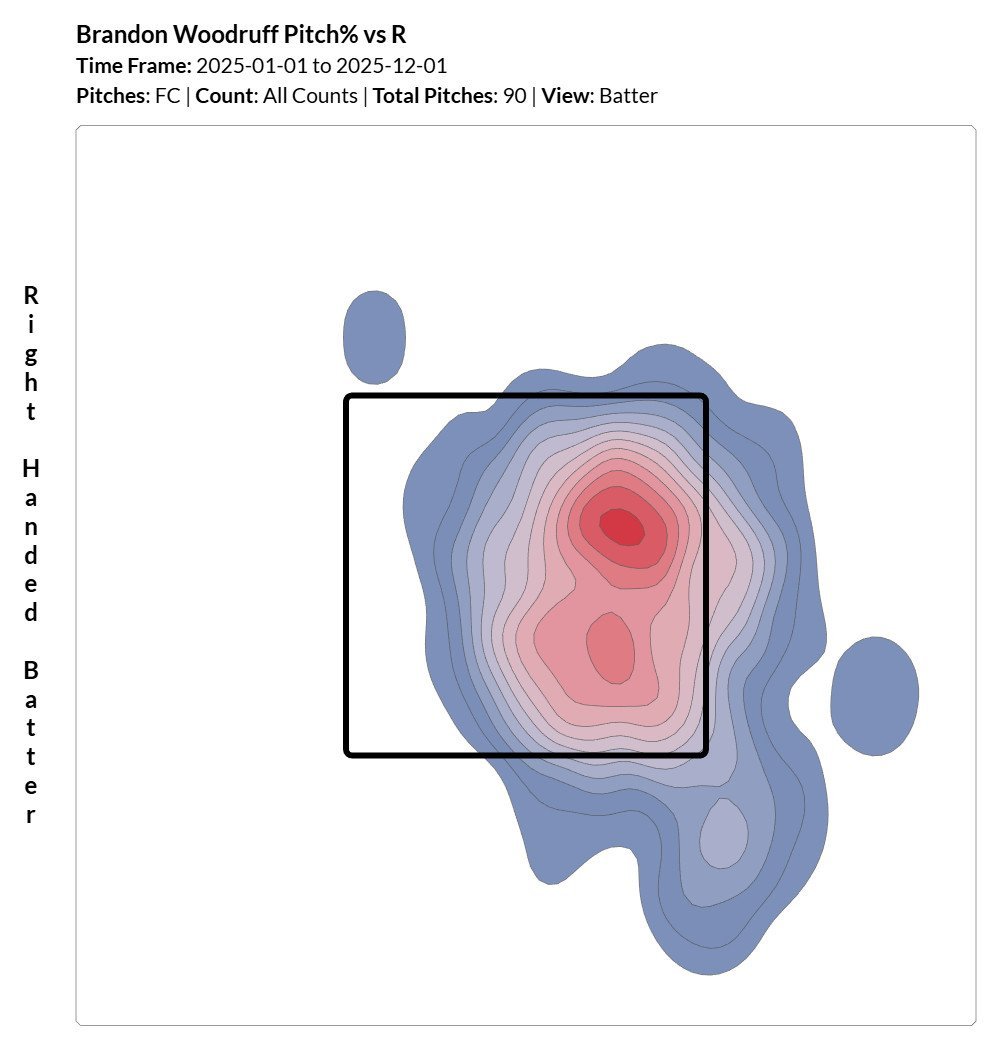
“Just trying to play lanes,” Woodruff said. “I think that’s a big part of pitching, is understanding how your stuff plays. It’s all planes, trying to get a pitch to come out of the same area, the same kind of box, essentially, and have those shapes play together.”
One of his intended changes didn’t stick. Woodruff developed a sweeper during his rehab process to better complement his fastballs and separate from his curveball, but after throwing seven of them across his first two starts, he threw just five the rest of the season. Poor results were part of the reason—the sweeper surrendered a home run in each of those first two outings—but more than anything, Woodruff struggled to throw it consistently.
“It’s a pitch for me where I have to really get extended out in front and get in front of the baseball,” he explained. “It’s a pitch for me that’s pretty tough to [throw]. I have to really think about throwing this thing way out in front. There might be a couple of good ones in there, but I’m the type of guy – I’ve always been like that – if I’m throwing something that isn’t consistent or what I like, I kind of work around that and then use it when I really need to bring it out. It’s kind of a back-pocket pitch for me.”
Instead, he leaned heavily on that trio of fastballs and a changeup that has improved over the years. How Woodruff deployed those four pitches, however, often varied from one game to the next.
.jpeg.2b80b1681c6b9ca853b041776d56df69.jpeg)
“I just kind of went with the flow,” he said. “It’s one of those things where I try to read the hitter as much as possible, and I throw what they are telling me to throw … I have a plan, and I know my strengths, but I kind of let the hitter tell me everything.”
Woodruff didn’t know what results to expect in his return last year, focusing more on the goal of making it back to a mound. Murphy was also unsure how he would perform, but he was unsurprised that he made the necessary adjustments to retire hitters in new ways.
“I don’t know that I could have predicted that, but I know that when I watched him attack his rehab and just be so diligent day in and day out, I’m like, ‘Man, this guy’s hungry. He’s hungry,'” Murphy said. “It didn’t surprise me totally, because of the way he attacked his rehab, the process to come back.”
With the 2026 season approaching, Woodruff remains hungry, but just as he learned to expand his arsenal and methods for attacking hitters, he’s also navigating changes to his body and how he must approach his workload.
“I still have to be smart going forward for this year,” he said. “I didn’t throw a ton of innings. But as far as right now, physically, I feel really good.”