
Here’s a look back at what happened in the Chicago area on Feb. 26, according to the Tribune’s archives.
Is an important event missing from this date? Email us.
Sports front flashback: Feb. 27, 2004
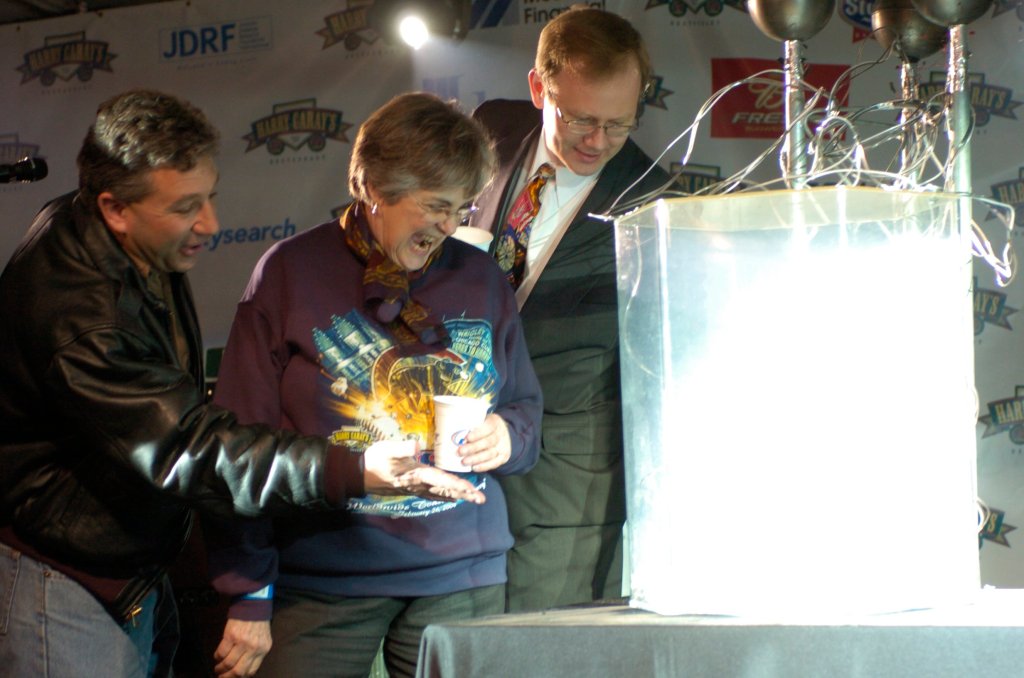
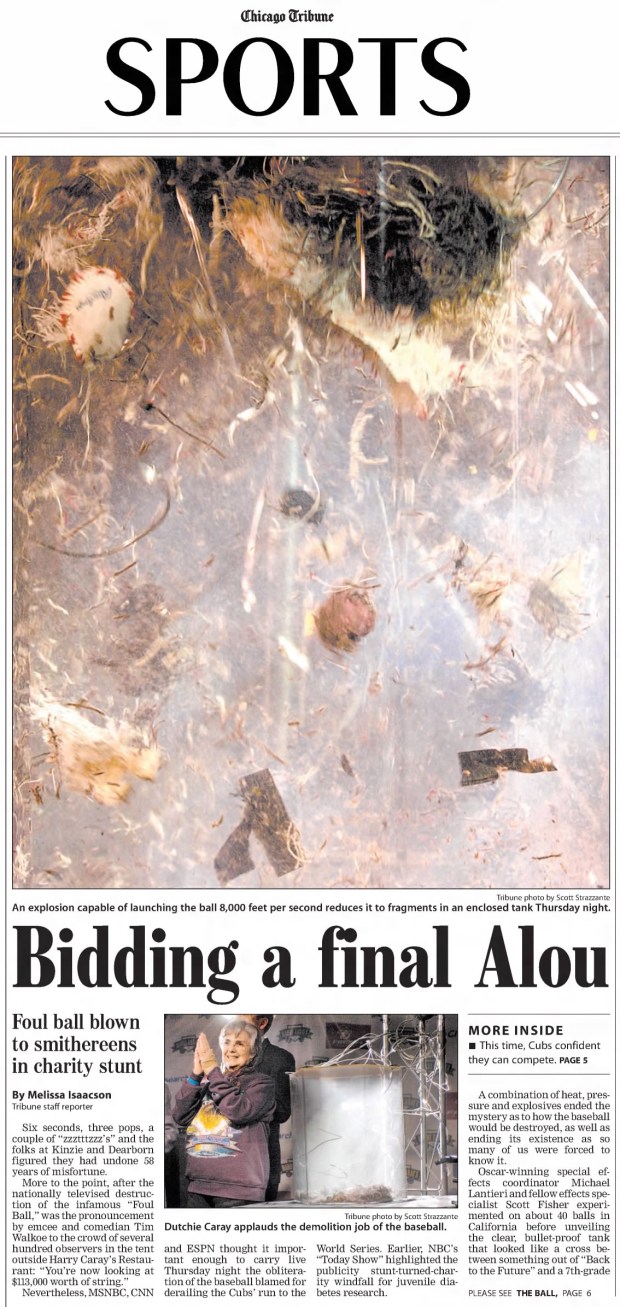 The so-called “Bartman ball” was destroyed on Feb. 26, 2004, at Harry Caray’s restaurant in River North. (Chicago Tribune)
2004: “You’re now looking at $113,000 worth of string.”
The baseball that was deflected by Chicago Cubs fan Steve Bartman during Game 6 of the 2003 National League Championship Series against the Florida Marlins on Oct. 14, 2003, at Wrigley Field, went up in smoke outside Harry Caray’s restaurant in River North. A combination of heat, pressure and explosives was used by special effects experts to demolish the ball, which had been purchased by the restaurant’s manager.
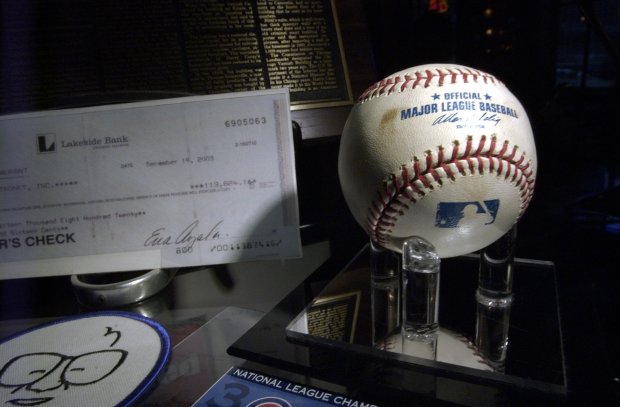 The infamous baseball from Game 6 of the 2003 National League Championship Series against the Florida Marlins at Wrigley Field was on display at Harry Caray’s restaurant in downtown Chicago in early 2004. Grant DePorter, manager of the restaurant, purchased the ball on Dec. 19, 2003, from Mastronet Inc. for the price of $113,824.16 and raised more than a million dollars for charity to destroy it. (Bonnie Trafelet/Chicago Tribune)
Donations and commemorative memorabilia for the event helped raise about $1 million for the Juvenile Diabetes Research Foundation.
Organizers hoped Bartman would appear for the gimmick, but he didn’t.
“I feel bad for Bartman,” Cubs announcer Ron Santo told the Tribune from his Arizona home. “He was not the reason we lost that ballgame.”
Remnants of the ball were served as part of a special sauce at the restaurant in 2005.
Weather records (from the National Weather Service, Chicago)
High temperature: 71 degrees (2024)
Low temperature: Minus 1 degree (1963)
Precipitation: 1.95 inches (2009)
Snowfall: 4.8 inches (2013)
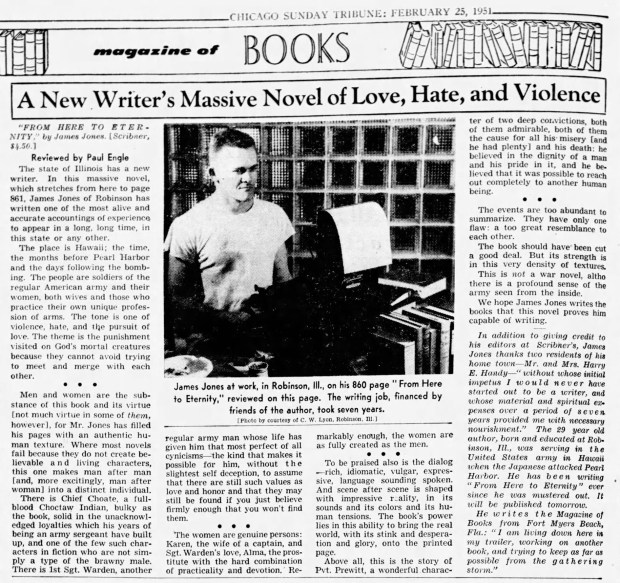 The Tribune described James Jones’ “massive” 861-page novel “From Here to Eternity” as having “an authentic human texture” when it was released on Feb. 26, 1951. (Chicago Tribune)
1951: Illinois native and U.S. Army veteran James Jones published “From Here to Eternity,” which was adapted into an Academy Award-winning movie in 1953 starring Burt Lancaster, Deborah Kerr, Donna Reed and Frank Sinatra. The book, about American soldiers stationed in Hawaii before the Dec. 7, 1941, attack on Pearl Harbor, reflected a “tone of violence, hate, and the pursuit of love,” according to Paul Engle, who reviewed it for the Tribune.
Engle’s one major criticism — the book was too long. “The events are too abundant to summarize. They have only one flaw: a too great resemblance to each other. … But its strength is in this very density of textures.”
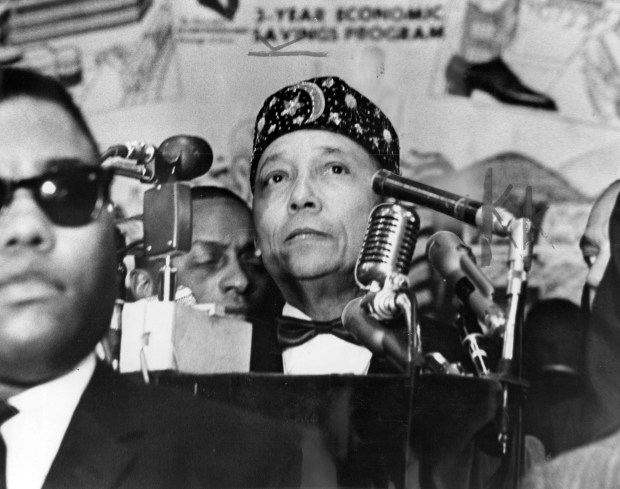 Elijah Muhammad addresses a crowd at the Coliseum on Feb. 26, 1965, in Chicago. In his speech, the head of the Black Muslims assailed Malcolm X, who was assassinated the previous week. (Chicago Tribune historical photo)
1965: Just days after Malcolm X was assassinated, Nation of Islam leader Elijah Muhammad told 2,500 followers at the start of a three-day convention at the Coliseum that “Malcolm was a hypocrite,” after bringing “hate and mudslinging” to Chicago weeks earlier.
Surrounded by more than 100 bodyguards, the man who called himself “the messenger of Allah” warned, “If you try to snuff out the life of Elijah, you are inviting your own doom.” Two brothers of Malcolm X — who had left the Black Muslims 14 months prior to form his own Afro-American Unity party — denounced their dead brother for “his mistakes” and both said they would not attend their brother’s funeral in New York.
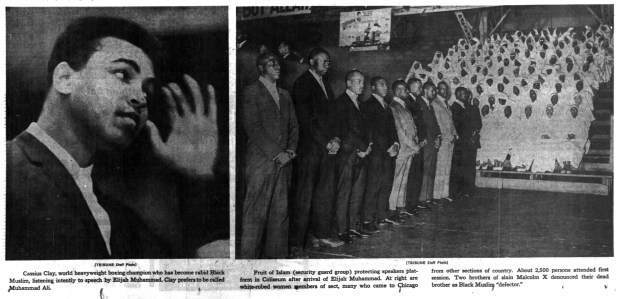 Security was high and tensions flared as the Nation of Islam’s three-day conference commenced on Feb. 26, 1965, at the Coliseum in Chicago. Malcolm X, a former member of the group, had been assassinated just five days earlier in New York. (Chicago Tribune)
Boxer Muhammad Ali delivered an impromptu speech at the closing of the first day’s program, and said it would be impossible for any of Malcolm’s followers to kill Muhammad: “If they got even close to Elijah Muhammad, Almighty God just might knock the earth out of orbit.”
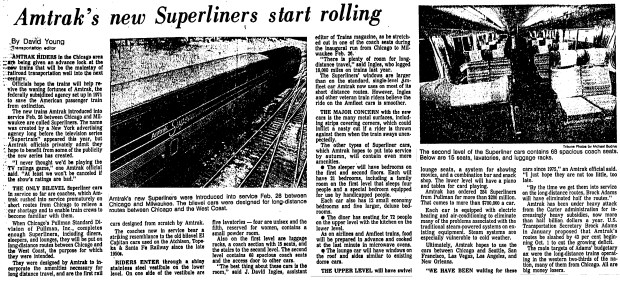 Amtrak’s bilevel train car Superliner, which debuted in Chicago in early 1979, was named for the television series “Supertrain.” (Chicago Tribune)
1979: A new bilevel train was introduced on the Chicago to Milwaukee route: the Superliner. The $750,000 double-decker rail car made its initial run “carrying 63 pleasantly surprised passengers,” the Tribune reported. “The surprise occurred because the new cars had received virtually no advance publicity.” The Superliner began its first long-distance travel between Chicago and Seattle in October 1979.
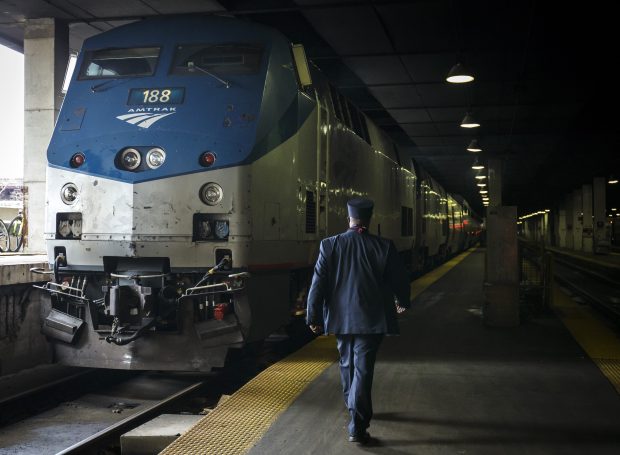 An Amtrak Empire Builder train prepares to depart on March 28, 2017, at Union Station in Chicago. (Brian Cassella/Chicago Tribune)
Want more vintage Chicago?
Subscribe to the free Vintage Chicago Tribune newsletter, join our Chicagoland history Facebook group, stay current with Today in Chicago History and follow us on Instagram for more from Chicago’s past.
Have an idea for Vintage Chicago Tribune? Share it with Kori Rumore and Marianne Mather at krumore@chicagotribune.com and mmather@chicagotribune.com