
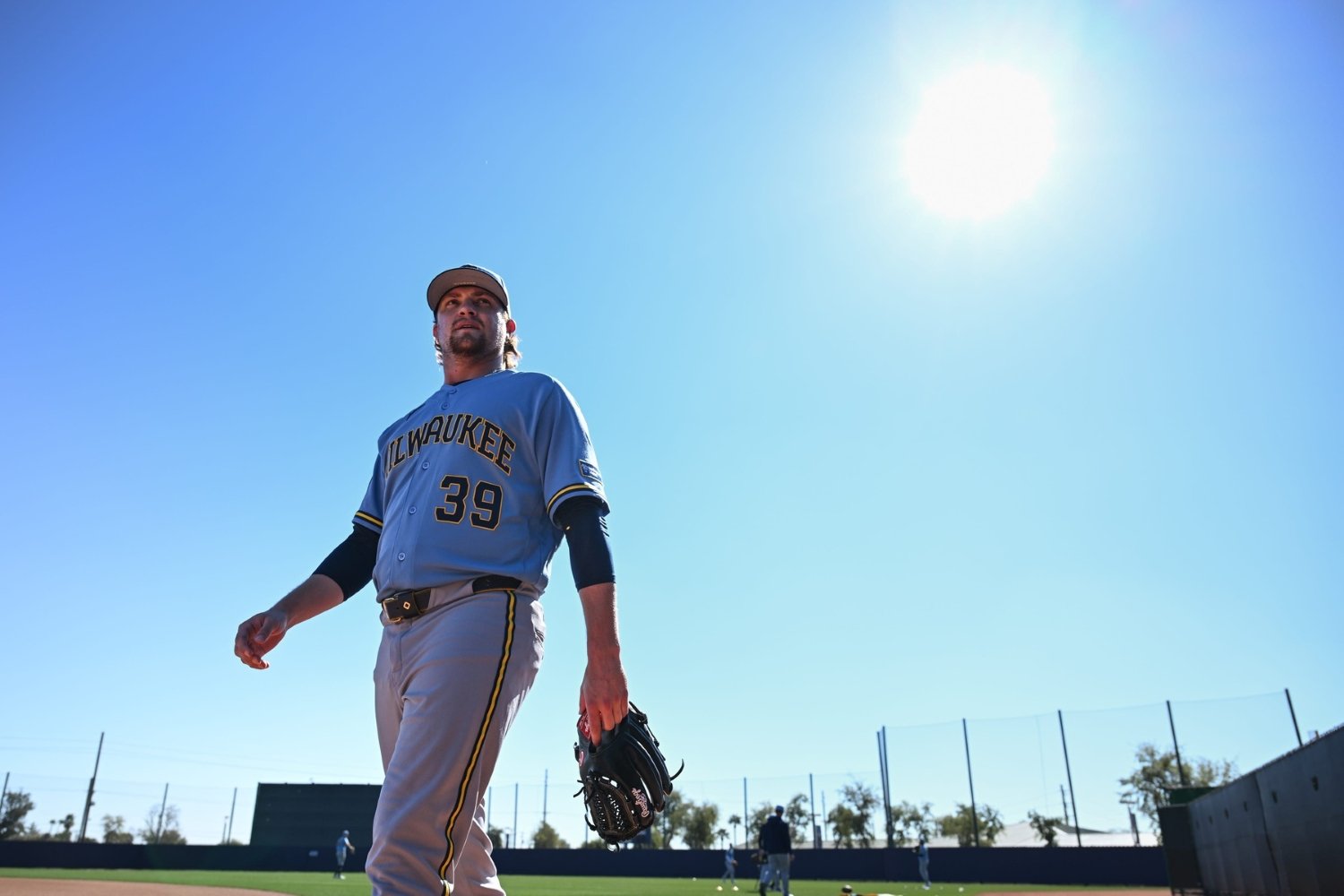
He wasn’t quite as flashy as his 6-foot-7 fellow rookie, but don’t get it twisted: Chad Patrick played a significant role in Milwaukee’s success in 2025. He posted a 3.53 FIP (the best figure of anyone on the Brewers with more than 80 innings pitched) and accumulated 2.6 fWAR, second only to Freddy Peralta on the team’s pitching staff.
To those who didn’t get a chance to follow him very closely, this might come as a surprise, since none of his peripherals are particularly impressive. Outside of a 25.2% strikeout rate, his Statcast metrics are pretty average across the board. So, can he continue his success in 2026, or will opposing hitters finally figure him out, necessitating a decrease in workload or leverage?
Chad Patrick’s Strengths
Patrick’s primary pitch was his cutter, which he threw 41.1% of the time. Unlike the famous cutter of former Milwaukee ace Corbin Burnes, it’s more of a hard slider than a fastball, coming in at an average velocity of just 87.9 mph. As a result, though, it gets significantly more movement than your typical cutter, which allowed him to get a whiff rate of 27.2% on it. It did run into a few barrels here and there, but overall, a hard-hit rate of 39.7% isn’t bad. For context, Drew Rasmussen had the most valuable cutter by Run Value last year, and it had a hard hit rate of 42.3% and a whiff rate of 26.8%.
To complement this pitch, Patrick also threw a sinker and a four-seam fastball, which were remarkably similar in both usage (23%) and velocity (94.1 mph). His heater was particularly effective due to its 16.6 inches of induced vertical break and his ability to consistently command it at the top of the zone.
His sinker didn’t miss many bats, but it was great at generating soft contact, as is expected. It didn’t stand out compared to other sinkers around the league, but it was an effective tool nonetheless, especially for getting double plays when needed.
His trio of fastballs was responsible for most of his production last year. He typically attacked right-handed hitters with sinkers and left-handed hitters with four-seam fastballs, while doling out cutters to everyone.
Chad Patrick’s Weaknesses
His fastballs are dandy, but his secondary pitches fail to meet the same lofty standard. For the majority of his time in the big leagues, he used his slider against righties and changeups against lefties, but his offspeed stuff was getting battered. He held onto it through the end of the season, but ended up slowly phasing out his slider in favor of a slurve that had encouraging results over a small sample.
One of the most challenging aspects of being a starting pitcher is needing to face the entire lineup multiple times. At minimum, a six-inning appearance requires facing everyone in the lineup twice, so the ability to give hitters different looks is necessary for long-term success.
This is where Patrick’s lack of a truly effective arsenal of breaking balls really hurts him. When facing hitters for the second time in a game, he holds them to just a .597 OPS. When facing them for the third time, this balloons to an .875 OPS. It’s a significant issue that eventually pushed the team to option him later in the season.
If the slurve ends up sticking around for the long haul (and if he’s able to refine his offspeed offerings, in general), he could have a very compelling five-pitch mix. If he enters 2026 still holding onto the stuff that worked in 2025, it may be tough for him to hold down a stable spot in the Brewers’ rotation.
What Should Chad Patrick’s Role Be In 2026?
In 2024, there was a young hurler by the name of Tobias Myers who posted similarly strong numbers in his rookie campaign, keeping an injury-battered rotation afloat. The next year, he pitched just 50 ⅔ big-league innings, spending the rest of the time in roster purgatory with 12 starts in Triple-A. He was eventually included in the Freddy Peralta trade, the final signal that Milwaukee simply didn’t believe in his ability to sustain the success he found in his freshman season.
The possibility that Patrick follows a similar path isn’t out of the question just yet. Milwaukee has an excess of starting pitchers, and most of them are younger than Patrick is, with more upside. Given the return from the Mets and Red Sox trades this offseason, acquiring young starting pitching depth seems to have been the guiding theme for the front office this winter, giving guys like Patrick more competition for a coveted spot in the rotation.
For starters (see what I did there?), he probably won’t be in the bullpen. There’s no room there, either, especially since the Brewers already have two long relievers in Aaron Ashby and DL Hall. He’s more than likely going to be a starter, but whether it’s in Milwaukee or in Nashville depends on how he stacks up against his teammates in spring training. With even a slight step forward, he’d be a solid back-of-the-rotation arm, but regression or stagnation could push him far enough down the roster to spend a significant portion of the season in the minor leagues.
Thanks to his strong numbers last year, he’s starting (ohp, did it again) with a good reputation, but baseball—like all sports—runs on “what have you done for me lately?” It’s an inquiry that only Patrick can answer, but there’s no doubt that he has the pieces and wherewithal to prove himself at the big-league level.