
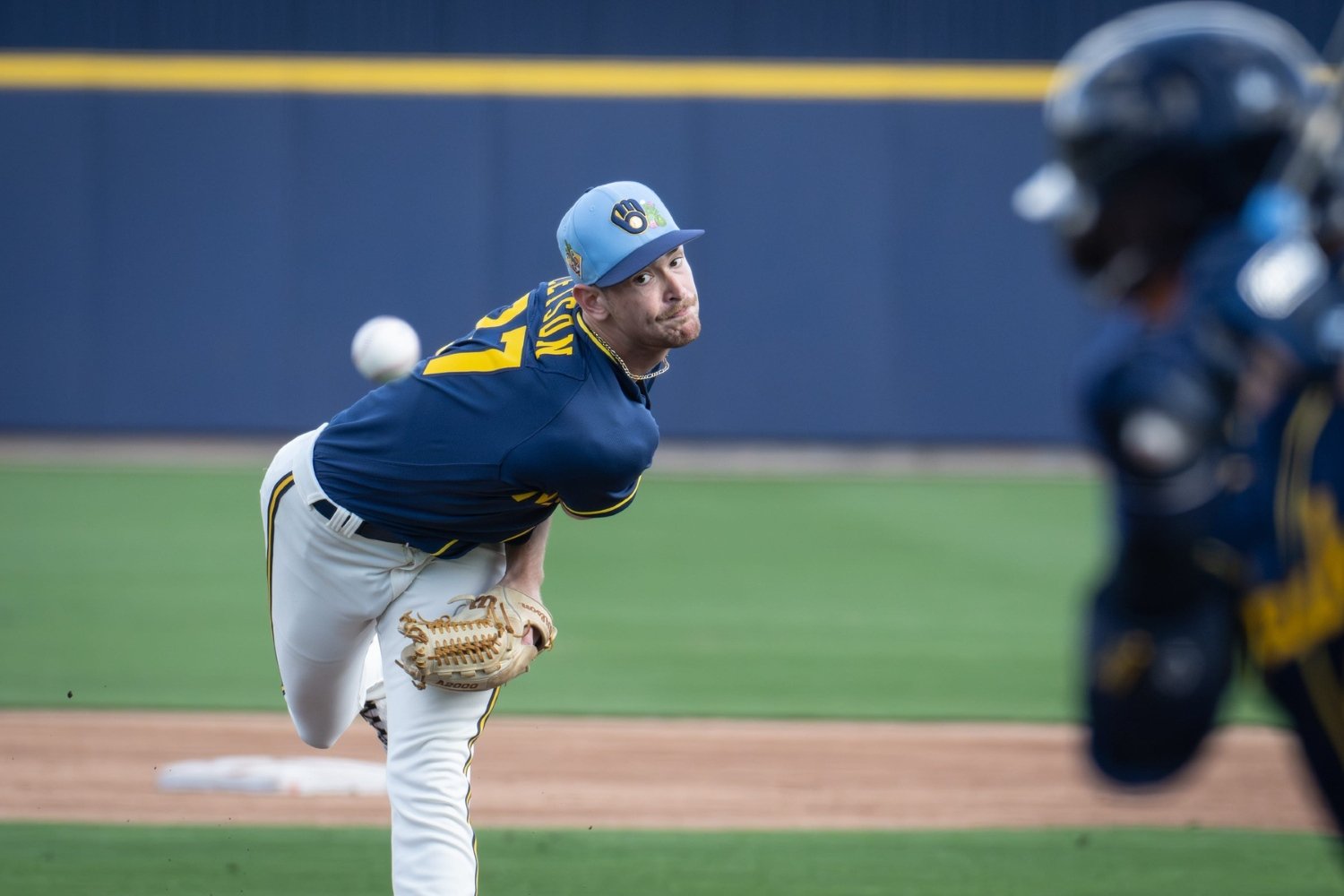
#9 Bishop Letson (Wisconsin Timber Rattlers, Biloxi Shuckers)
Bishop Letson brings one of the highest-upside pitching profiles in the Brewers’ system, and showed why during his limited time on the mound in 2025. The 11th-round pick from the 2023 draft, signed by area scout Ginger Poulson, delivered dominant results when healthy, showcasing a rare blend of swing-and-miss ability, ground-ball induction, and overall stuff. Although shoulder fatigue limited him to just 41 1/3 innings, his performance during that stretch was extremely impressive.
ERA
FIP
xFIP
IP
G
GS
CG
ShO
K%
BB%
K-BB%
HR/9
SwStr%
Whiff%
WHIP
BABIP
LOB%
LD%
GB%
FB%
IFFB%
HR/FB
2.40
2.59
2.70
41.1
11
9
0
0
30.8%
7.5%
23.3%
0.44
12.6%
28.0%
1.04
0.305
72.8%
14.7%
52.6%
32.6%
9.7%
6.5%
What to Like
Letson ranked in the 90th percentile across Minor League Baseball in both strikeout rate and ground-ball rate. This combination highlights both his ability to overpower hitters and generate weak contact.
His fastball serves as the foundation of the arsenal. While the average velocity sits around 94 MPH, the pitch plays well above its radar gun reading due to elite extension and release characteristics. Letson generates approximately 7.5 feet of extension, helping the fastball to get on hitters quickly and giving it additional perceived velocity. That level of extension compares favorably to some of the most dominant power arms in the game, and it allows the pitch to miss bats consistently while also setting up the rest of his repertoire.
The sweeper stands out as another potential plus offering and serves as a key secondary weapon. The pitch averages around 16 inches of glove-side movement and shows consistent shape and command against both right-handed and left-handed hitters. Letson demonstrates confidence in using the pitch in multiple counts and situations, making it a reliable swing-and-miss option, especially against righties.
Beyond those two primary pitches, Letson features a deep, well-rounded mix. His sinker and changeup both project as above-average offerings. The sinker generates roughly 17 inches of arm-side run, producing significant movement and helping generate ground-ball contact. The changeup shows similar horizontal movement with roughly 18 inches of run, but adds additional vertical depth, giving it strong deception and effectiveness against opposite-handed hitters. While further separation in movement profiles between the two pitches could enhance their effectiveness, both offerings already provide value within his arsenal.
During a stint on the injured list in 2025, Letson also developed a cutter that sits around 90 MPH. The pitch currently grades as average but shows encouraging traits, and given how new it is, it could also develop into an above-average offering. The presence of five usable pitches gives Letson multiple ways to attack hitters and supports a long-term starting profile.
In addition to the quality of the arsenal, Letson’s delivery and overall mechanics add to his appeal. He features a fluid, repeatable motion that allows him to generate that big extension and consistent movement profiles across his pitches.
What to Work On
Health and durability remain the most significant areas to monitor moving forward. Shoulder fatigue limited Letson’s workload in 2025, and building the ability to handle a full-season starter’s workload will be an important step in his development. Establishing consistent availability and maintaining his stuff over longer outings will be key to reaching his ceiling.
Command and overall pitch consistency also remain developmental priorities. While his walk numbers were strong in 2025, the underlying command is still developing and may face greater challenges against more advanced hitters. Continued refinement of his control within the strike zone would maximize the effectiveness of his arsenal and improve his ability to work through lineups more than two times.
Separating the shape of his sinker and changeup further could also enhance the overall effectiveness of his pitch mix. While both pitches feature strong arm-side movement, adding more vertical differential between them could make each offering more difficult for hitters to recognize. Continued development of his cutter will also be important, as turning that pitch into a reliably average offering would strengthen an already deep arsenal and make him more platoon-proof.
What’s Next
Letson’s development in 2026 will largely center on health. If he remains healthy, can throw more innings, and builds on the dominance he showed in 2025, while beginning the year in Double-A, he has the potential to jump much higher on not only this list, but also the Top 100 lists nationally. The long-term profile points toward significant upside in a major-league rotation. With a five-pitch mix that includes multiple potential plus offerings and a delivery that features elite extension, the ingredients are present for a high-impact starter if things continue to go well—and if he’s consistently on the mound.
What are your thoughts on Letson? What are you hoping to see from him in 2026? Let us know in the comments!
Interested in learning more about the Milwaukee Brewers’ top prospects? Check out our comprehensive top prospects list that includes up-to-date stats, articles and videos about every prospect, scouting reports, and more!