
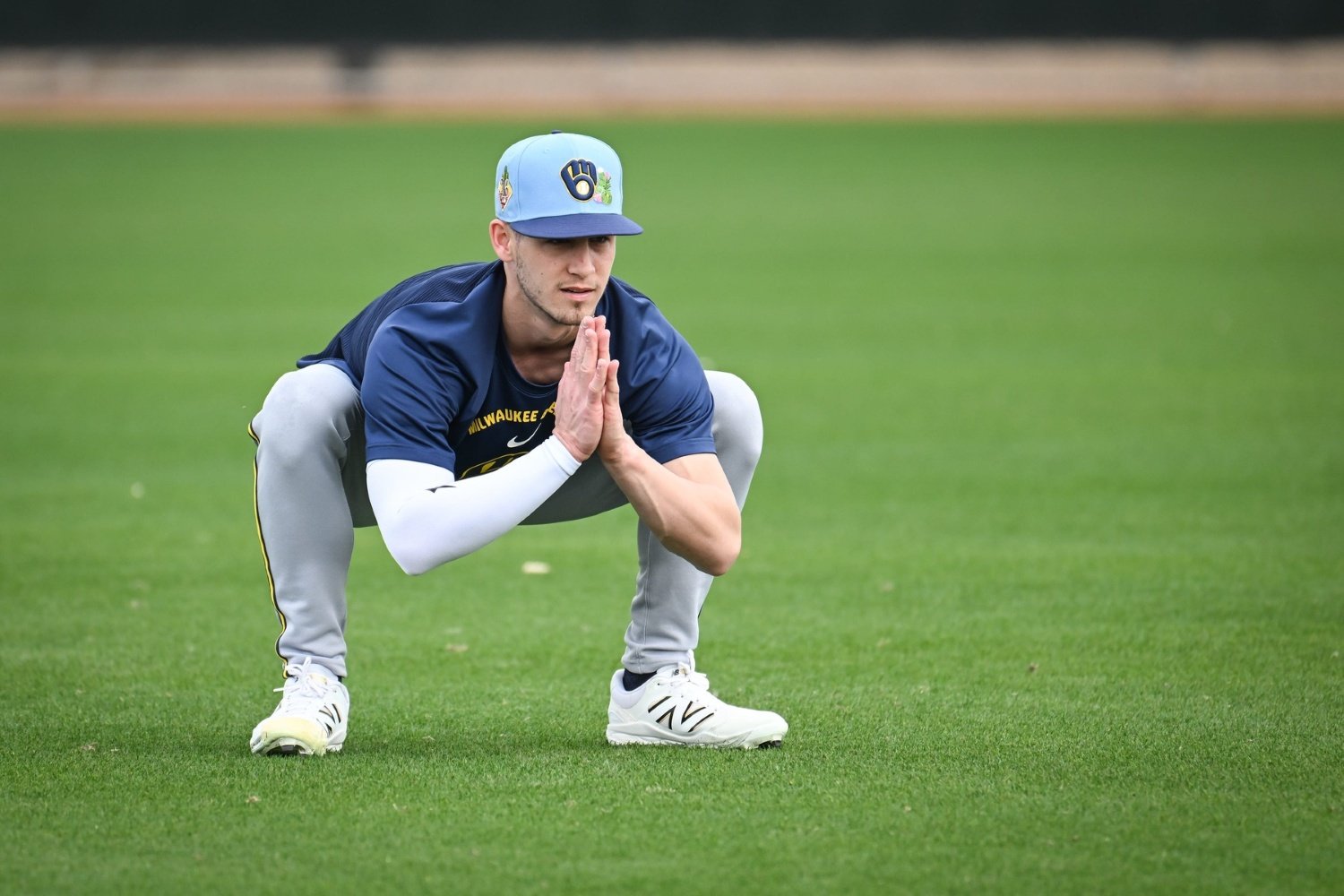
Coleman Crow has built a deep, well-rounded arsenal, adding a sweeper this spring to a mix that already included three or four pitches.
“I was primarily four-seamer, cutter, curveball,” Crow said, discussing his self-conception of the mix through last season. “But yeah, I’ve started throwing a little bit of a sweeper. It’s a little bit of a bigger slider shape.”
That was a gap in his previous movement profile, because although the cutter he throws is much closer to the slider than to the fastball end of the cutter spectrum, it doesn’t have much lateral movement. The sweeper gives him greater horizontal swerve, though less depth than his big-breaking curve.
“It’s very easy for me to throw any ball that spins,” Crow said, matter-of-factly identifying his strength as a pitcher. “Spinning the baseball is pretty easy for me, so I felt like it could be a good pickup for me. I started throwing it [last week] and I feel like it can be a good addition for me.”
That he took to the pitch so quickly that he could bring it into Cactus League games immediately speaks to the righty’s feel for spin. He’s a natural supinator, which makes it hard for him to execute a plus sinker or changeup but works in his favor on every flavor of breaking ball. His fastball has natural relative cut, too. What’s caught Pat Murphy‘s eye, however, is how well he locates whatever he throws.
“He throws the ball where he wants to, and I think that’s coming back in the game,” Murphy told reporters. “Everybody’s stuff is 95-plus these days. He throws it where he wants to. Can’t tell me that’s not important, and he can do it.”
With several offerings to keep hitters guessing and his control outpacing his raw stuff, it’s tempting to view Crow as a starter. However, durability has been a major concern for him even during his minor-league journey, and for this season, Murphy views him in a different role.
“It’s hard for the littler guys”—Crow is an unimposing 6 feet and 175 pounds—”to be strong enough to be starters throughout a major-league season,” the manager said. “You know, you really got to be in condition. I see him this year as a middle relief—ultimately, as a reliever for our team this year.”
That could be in short relief, especially if the sweeper proves as effective as Brewers coaches believe it could be. It’s at least as likely, though, that Crow will end up filling a role similar to the one Chad Patrick served in late in 2025. Murphy said he cited Patrick as an example when meeting with Crow earlier this month—and that he told Crow he expects him to pitch in the majors this year, but out of the pen.
Crow acknowledged those conversations and said he’s ready to fill any role for the team, but the expectation is that he’ll be a reliever whenever he’s called up to the parent club. He’s already begun thinking about the transition to that role, and the changes it imparts on the daily routine of a pitcher.
“I definitely think there is a transition period and there’s a learning curve with it,” Crow said. “I’m getting there, with dialing back the throwing some days and ramping it up some days.”
This is the first real evidence of the Brewers doing proactive culling to their long list of potential starting pitchers this season. They lost Freddy Peralta and Jose Quintana this winter, but trades (including the one that sent away Peralta) added Brandon Sproat, Kyle Harrison and Shane Drohan to what was already a very deep rotation mix. Converting Crow to a relief role (even if he remains stretched out while in the minors) begins to clarify the situation for everyone involved.
With an appearance (as a starter, but in the curtailed and contained environs of spring training) on three days’ rest Saturday, Crow is clearly being groomed for work on shorter turnarounds than modern starters. That could speed his path to the majors, though, especially as the team plays it slow with some of their other key arms to avoid injuries. He’s embracing that idea and preparing as though his contributions will be in relief. For Brewers fans, it’ll be interesting to see how his stuff plays in that altered role—and with the sweeper as a new way to pose matchup problems against right-leaning pockets of opposing lineups.