
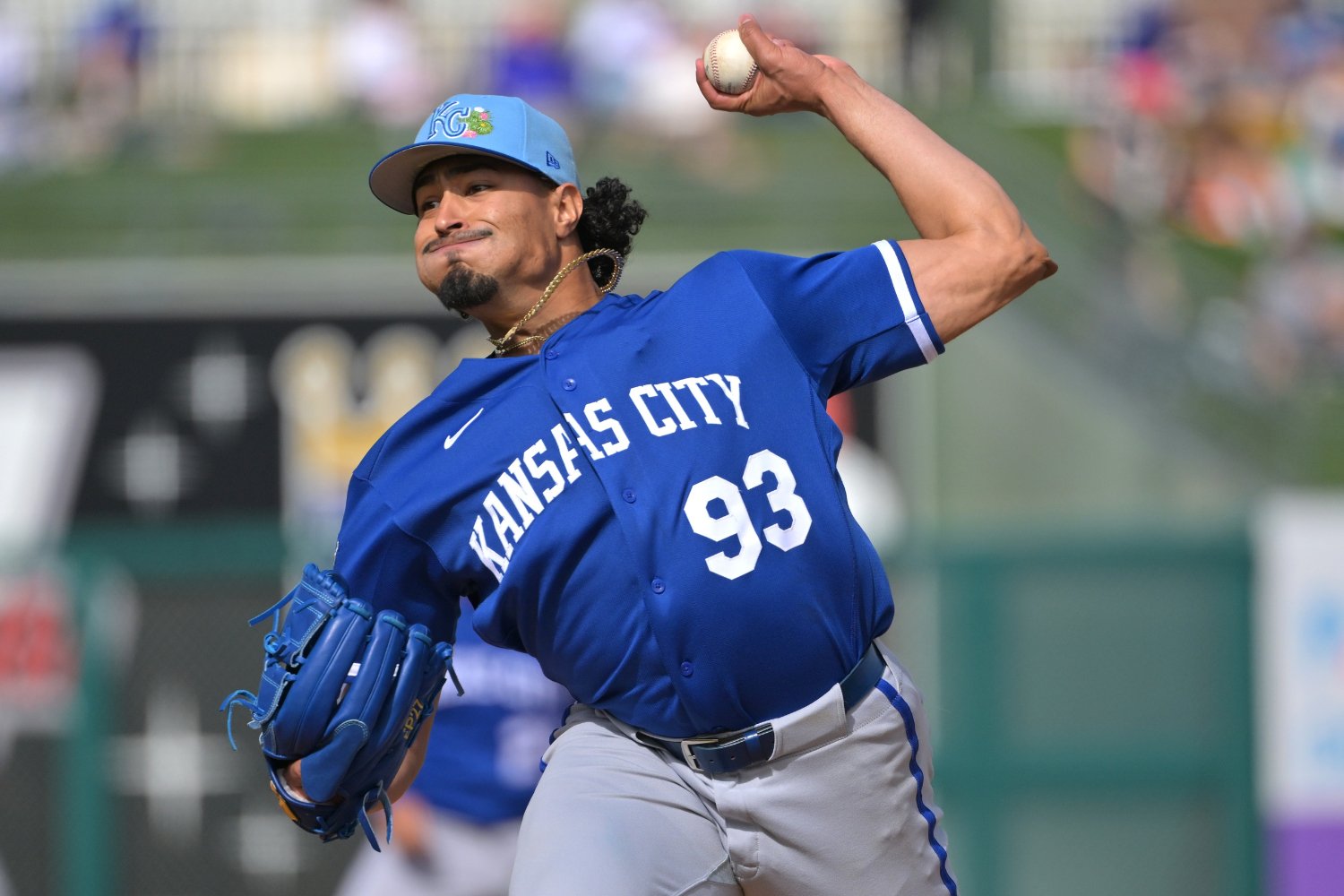
A big key for the Royals last year was the improvement in the bullpen from 2024 to 2025.
While the bullpen improved after the Trade Deadline acquisition of Lucas Erceg, it was an inconsistent group in 2024, and the metrics proved it. Royals relievers ranked 20th in bullpen ERA (4.13), 28th in K/9 (8.06), 23rd in K/BB ratio (2.36), and 26th in SIERA (4.02). It’s honestly amazing that the Royals won 86 games and made the playoffs with a bullpen that mediocre.
In 2025, thanks to the acquisition of Carlos Estevez and the improvement of some other relievers, Kansas City’s bullpen showed some growth in terms of results. They ranked 7th in bullpen ERA (3.63), 19th in K-BB ratio (2.46), and 21st in SIERA (3.99). However, the only blemish for this bullpen was the lack of strikeouts, as they actually ranked worse in K/9 with a 7.76 mark (which ranked 29th).
Thus, Royals GM JJ Picollo made it a priority to acquire relievers who could get strikeouts and whiffs. Trades for Philadelphia’s Matt Strahm and Milwaukee’s Nick Mears confirmed that priority. That said, one intriguing Minor League signing this spring has been Helcris Olivarez, who pitched in the San Francisco Giants organization a season ago.
In four outings and four IP, Olivarez has a 2.25 ERA, 1.50 WHIP, 3.87 FIP, and 3.00 K/BB ratio. The strikeouts haven’t been great, as he has a 16.7% K% so far in Cactus League play. That said, he’s limited the walks (5.6% BB%), something that has plagued him in the past in the Minor Leagues. For context, in 37 appearances in Double-A and Triple-A combined last year, he had a 24.6% BB% and 1.7% K-BB%. Safe to say, those kinds of numbers aren’t going to cut it in the Majors.
However, what has been different with Olivarez so far this spring? What kind of role could Olivarez have in the Royals’ bullpen in 2026? What are some recent Royals bullpen success stories that are similar to Olivarez? Let’s break down those questions using Fangraphs and TJ Stats data and applications.
Olivarez’s Four-Seamer and Curve Have Been Key This Spring
The 25-year-old Dominican lefty hasn’t generated a ton of strikeouts this spring, with only three strikeouts so far. That said, he’s producing a decent chase and whiff, while minimizing hard contact, as illustrated by his reasonable xwOBACON. Those metrics can be seen via his TJ Stats summary of his performance this spring below.
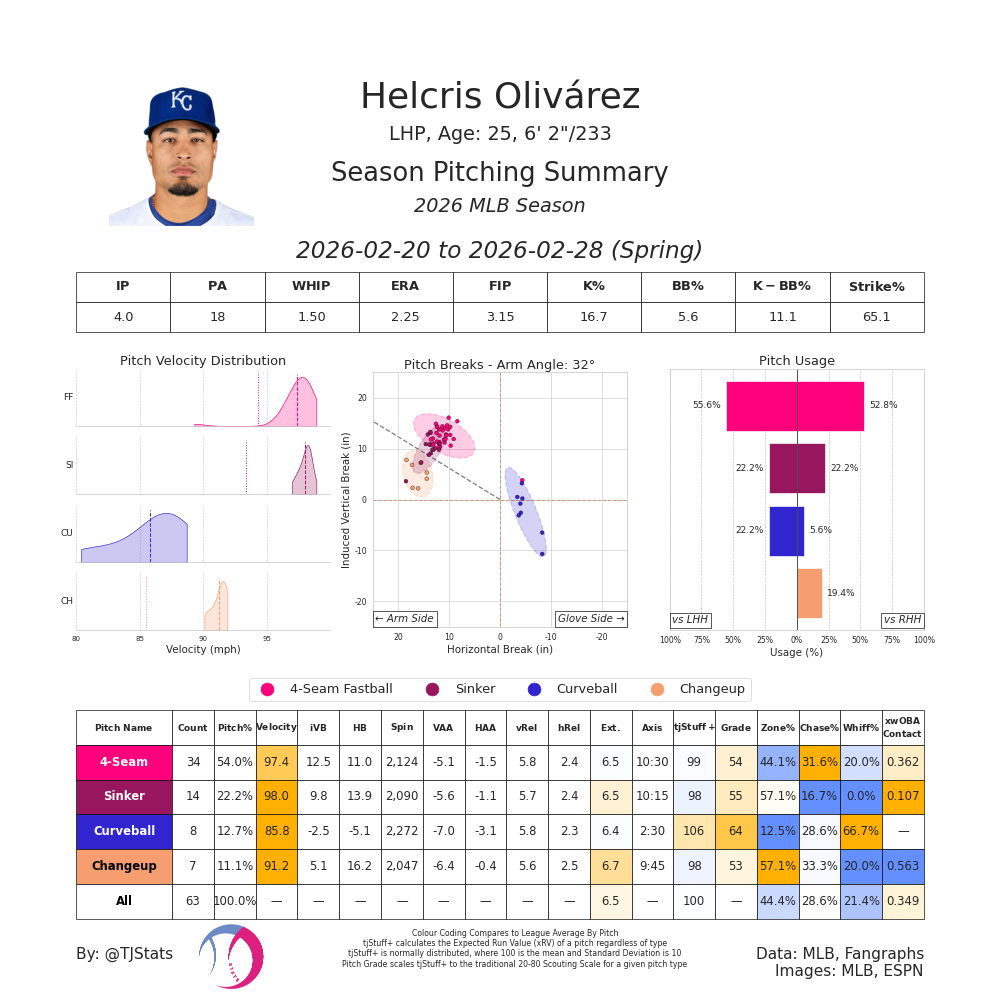
When it comes to TJ Stuff+, there’s a lot to be encouraged about with Olivarez’s profile. While his overall TJ Stuff+ is 100 and he has only one pitch with a TJ Stuff+ over 100 (his curve, which has a 106 mark), all four of his offerings have pitching grades over 50. That shows that he has a balanced profile, and he does have one elite pitch in his curveball, which has a pitching grade of 64 and a whiff rate of 66.7%.
Olivarez hasn’t generated an outstanding chase rate (28.6%), and his whiff rate has been below average (21.4%). That said, his four-seamer chase has been solid (31.6%), and he’s been limiting hard contact on his fastball, with his four-seamer posting a .362 xwOBACON and his sinker posting a .107 xwOBACON. I believe a reason for the lower chase and whiff rates is due to his erratic control, as he has a 44.4% zone rate so far this spring.
Below is Olivarez’s pitch chart from yesterday’s Cactus League game. Notice that it was feast or famine for him when it came to locating his pitches against the Rockies on Saturday.
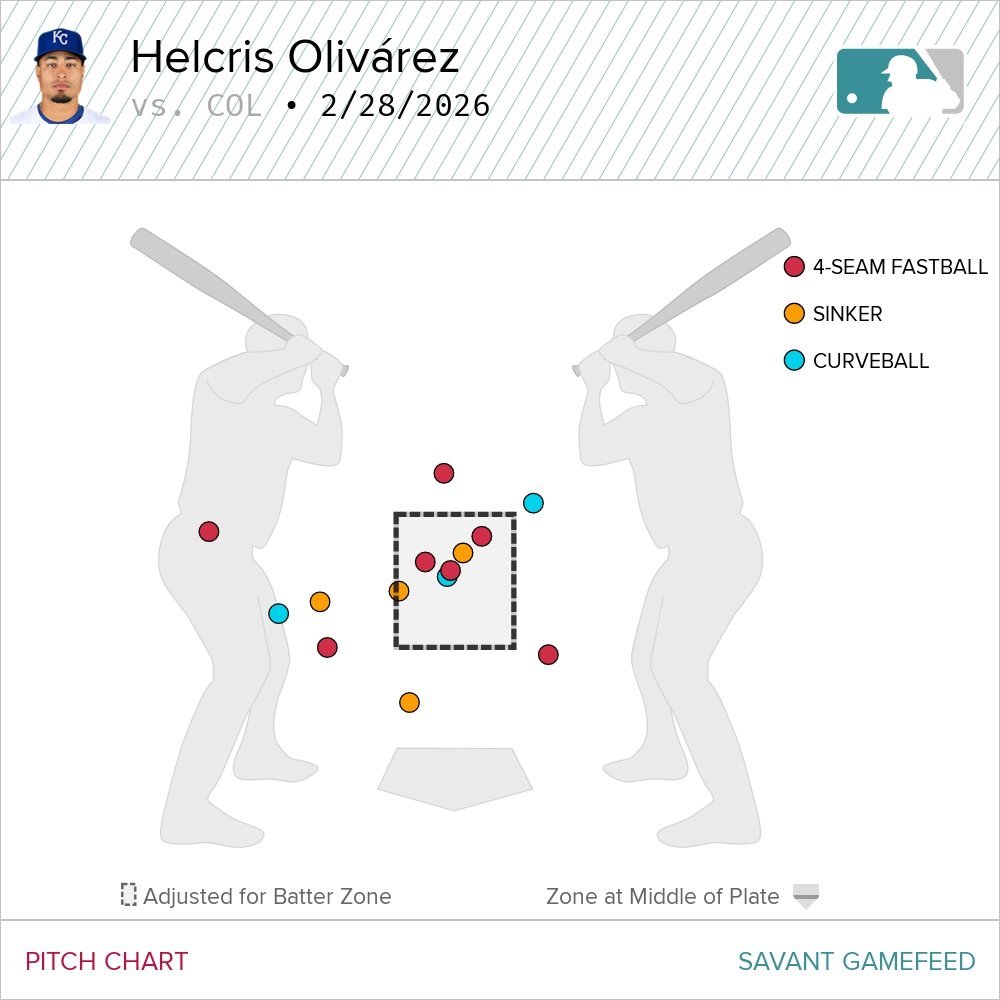
Once Olivarez is able to find the strike zone more this spring, the more effective his chase and whiff rates will be.
His most thrown pitch this spring has been his four-seamer, and it’s typically been a good pitch for him in terms of TJ Stuff+ and whiff profiles. Here’s a look at his TJ Stats summary from last year in Triple-A Sacramento, and take a look at the data on the four-seamer from a season ago.
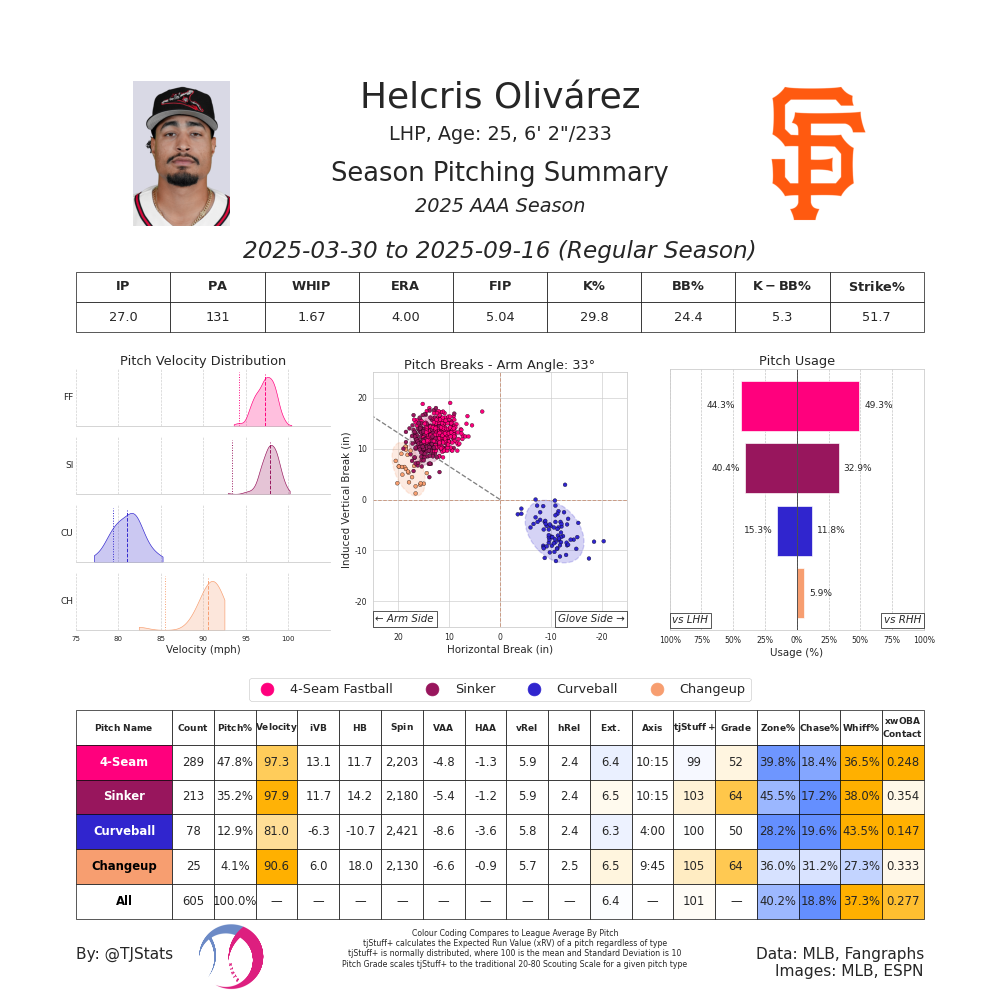
The four-seamer not only averaged 97.3 MPH, but it also had a 99 TJ Stuff+, 52 grade, 36.5% whiff rate, and .248 xwOBACON. So, what can we say about that data on the fastball from last season?

Yes, it is. Conversely, it had a 39.8% zone rate and 18.4% chase rate. Considering he threw the pitch 47.8% of the time, that erratic control of the four-seamer probably led to his 24.4% BB% in Sacramento.

What’s interesting about Olivarez’s four-seamer is that it doesn’t sport the characteristics of a normal four-seam fastball. It only had a 13.1 iVB and an 11.7 HB. Thus, it’s more of a horizontal moving pitch with more armside movement than typical for a four-seamer. One can see that in the pitch below from his time in Double-A Portland (when he was in the Red Sox organization), which hovers on the line being a sinker (though I don’t have the exact metrics of the pitch).
Despite that unique profile, Olivarez located it up, which one would do with the typical four-seamer. Based on the TJ Stats heatmap data, the approach worked for Olivarez in Sacramento last season.
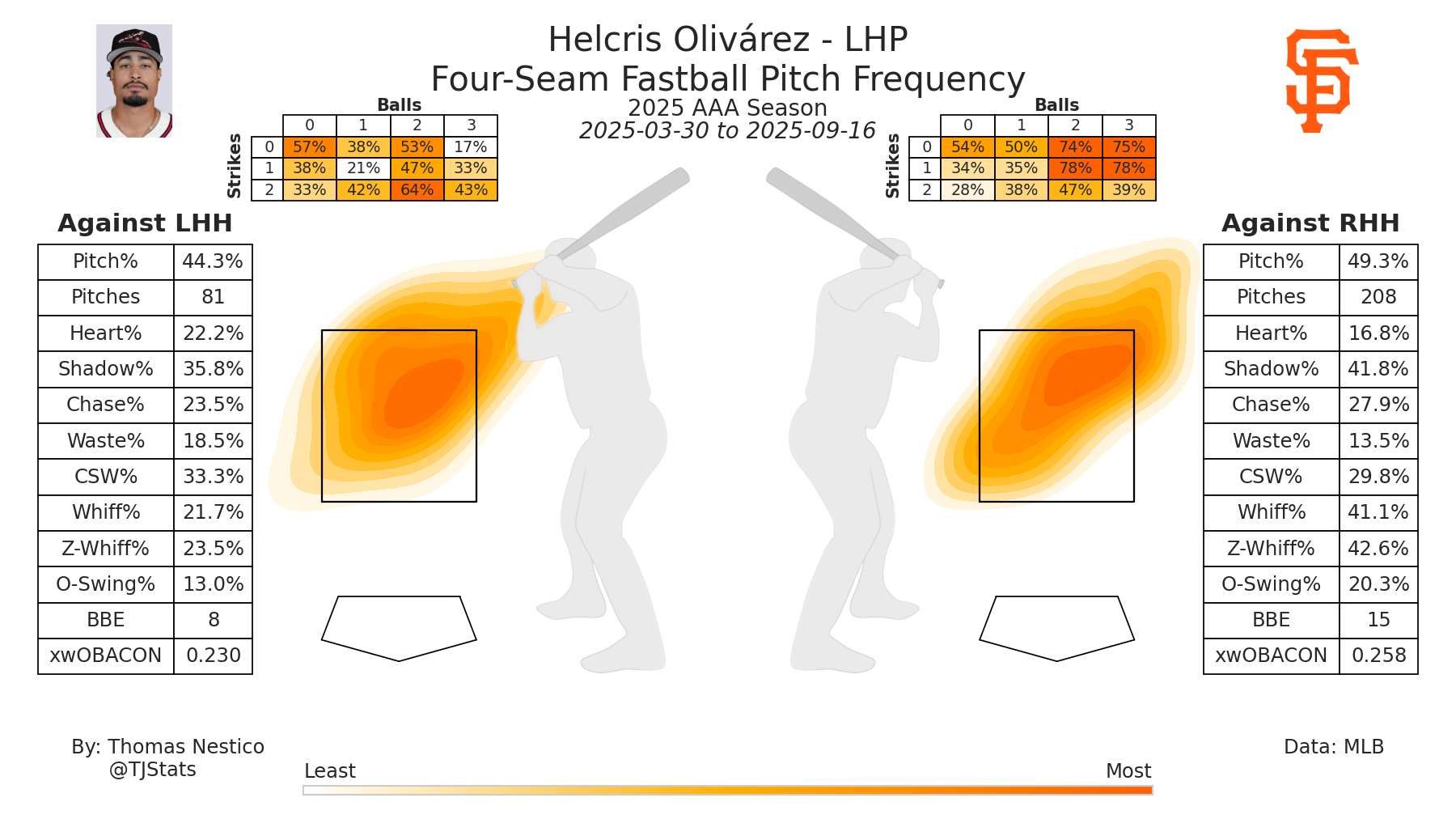
He produced a 33.3% CSW, 21.7% whiff rate, and .230 xwOBACON against lefties and a 29.8% CSW, 41.1% whiff rate, and .258 xwOBACON against righties. Thus, his four-seamer was a better strike-generating pitch against lefties but a better swing-and-miss pitch against righties last year in Triple-A.
Let’s see how that heatmap data looks so far this spring.
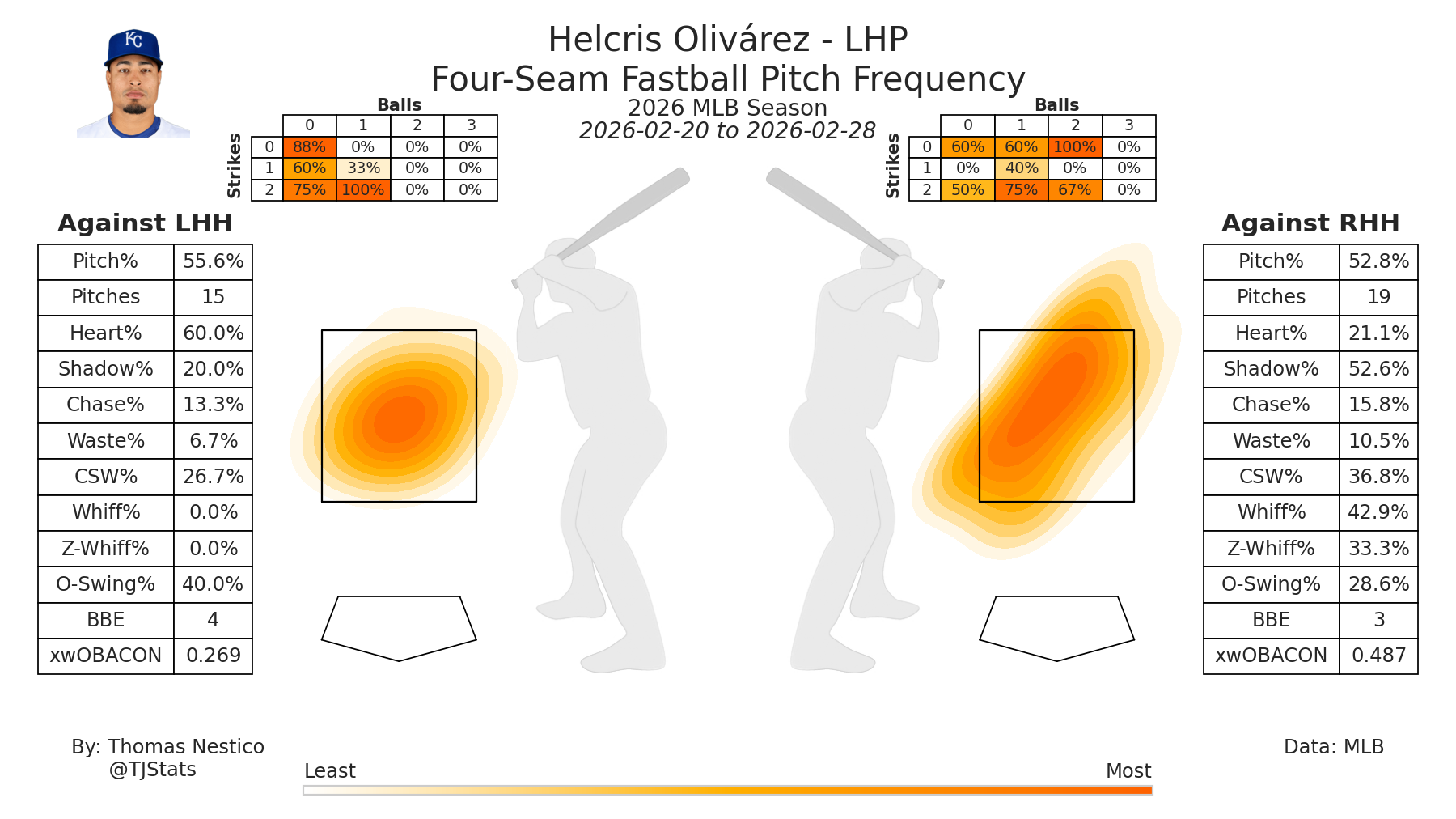
The location hasn’t been quite as sharp for Olivarez, based on his heatmap. His four-seamer has been located more in the middle of the plate than it was a season ago, when it was located up and armside against both lefties and righties. Against lefties, whom he has a 55.6% four-seamer usage against, it’s produced similar trends with a 26.7% CSW and 0.0% whiff, but .269 xwOBACON. Against righties, it’s been even better when it comes to generating strikes (36.8% CSW) and whiffs (42.9%), but it’s been hit a lot harder, as illustrated by a .487 xwOBACON.
The four-seamer will be key for Olivarez this spring because it can effectively set up his curve, which may be his best put-away pitch. Here’s a look at the TJ Stats heatmap data this spring on his primary breaking offering, especially against lefties.
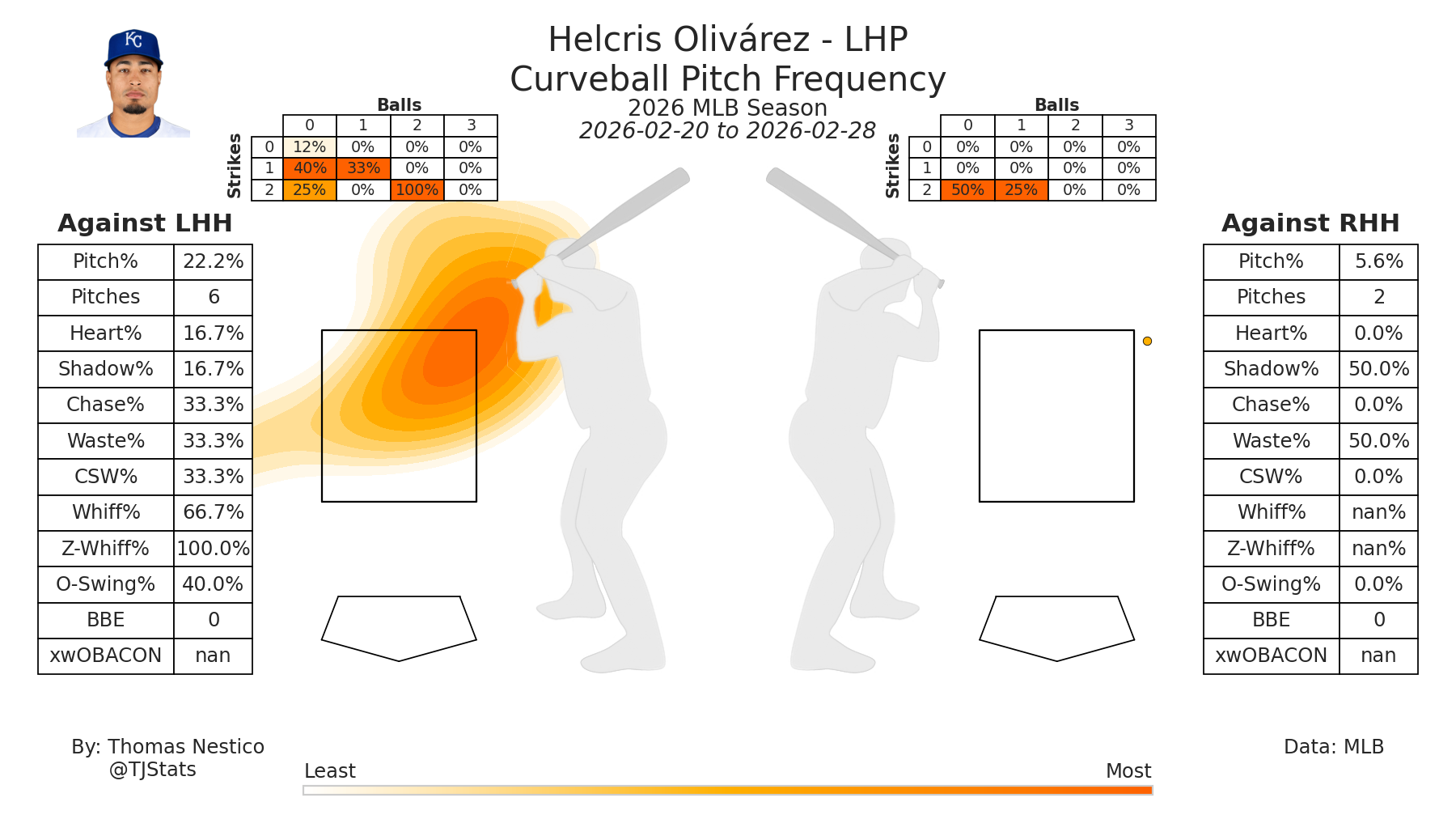
He’s only thrown it 22.2% of the time against lefties (and 5.6% against righties). However, against lefties, it’s been a stellar offering with a 33.3% CSW, 40% O-Swing (chase), and 66.7% whiff. He hasn’t located it all that well either, with the curve being located more up and in than typical. Here’s a look at his curveball heatmap data from 2025 with the Triple-A Rivercats.
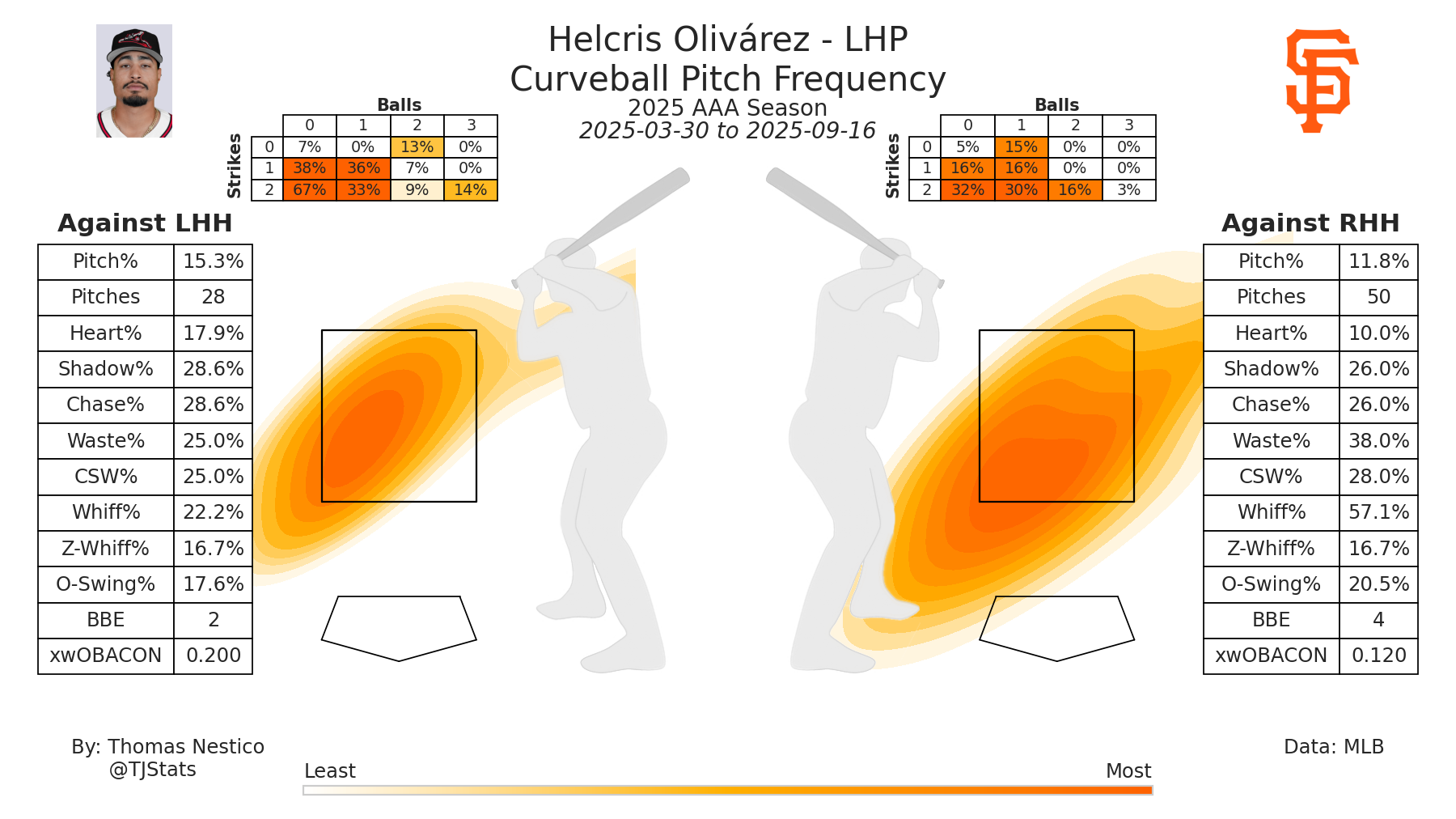
Olivarez located the curve primarily away and glove-side against lefties and righties last year. It was far more effective against righties with a 28% CSW, 57.1% whiff, and .120 xwOBACON. Command of the pitch is probably the reason for that difference, as his curve against righties was located more in the lower zone 7 portion of the strike zone, while against lefties, it was more up in zone 6. The curve breaking hard and in on hitters foot is always going to lead to more whiffs.
It would be nice to see Olivarez get to commanding that curveball back in that area of the strikezone this spring in Cactus League play, but he would likely need his four-seam command to improve first so he can get in more ideal counts to utilize his effective curveball.
What Kind of Role Can Olivarez Play in the Bullpen?
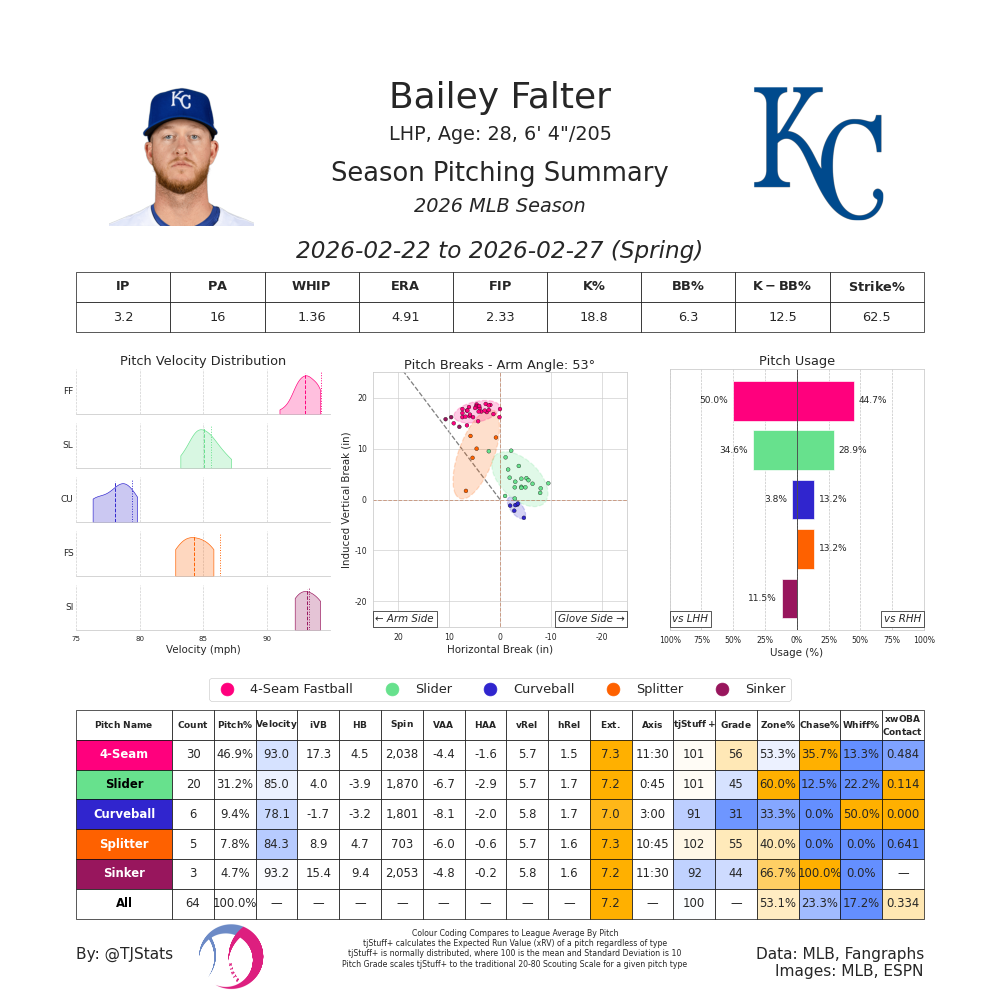
The Royals lack lefty depth on the 40-man roster. The only lefties who could pitch out of the bullpen are Strahm, Daniel Lynch IV, and Bailey Falter. That said, Falter is more of a starter and only moved to the bullpen after struggling initially with the Royals last season.
Lynch has looked solid this spring, with his stuff playing more up than it did a season ago, as illustrated by his TJ Stats summary in Cactus League play.
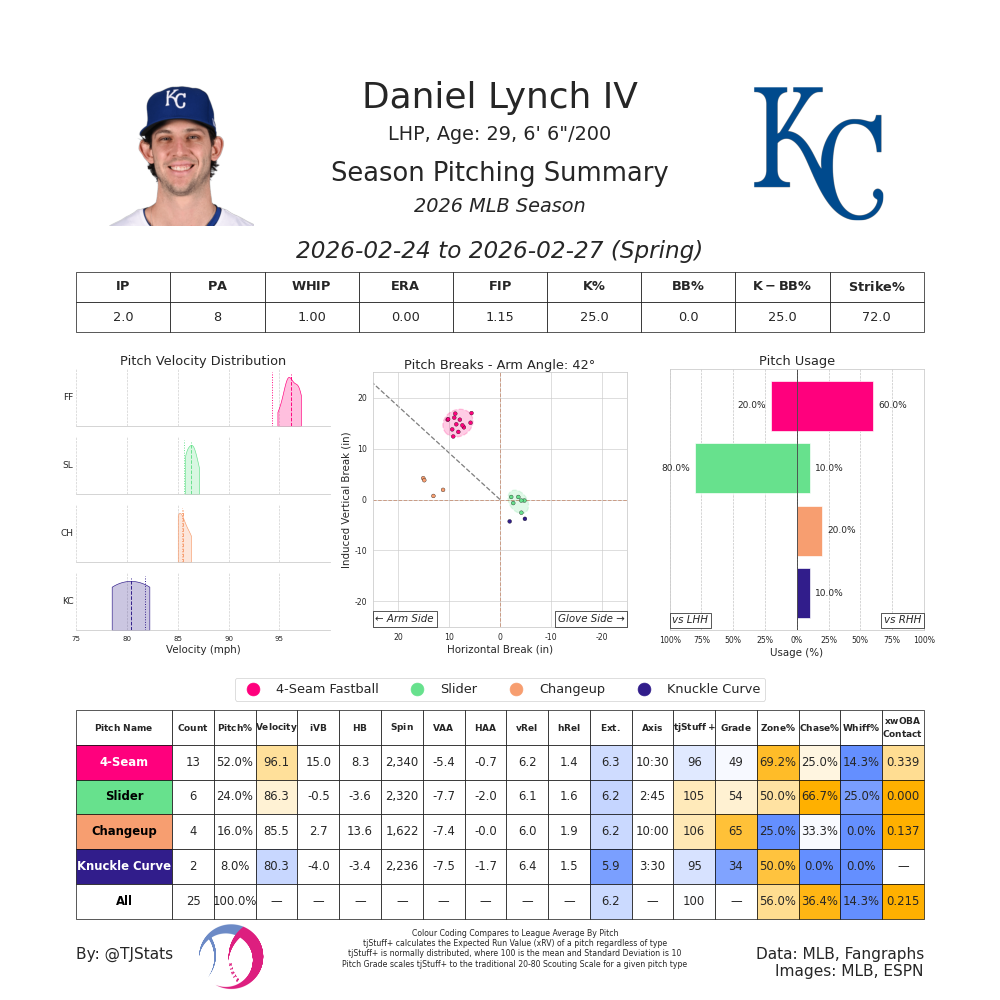
Thus, Strahm and Lynch could probably hold things down in the bullpen from a lefty perspective. However, as for Falter? I’m not quite as sure, though the TJ Stuff+, his pitch extension, and xwOBACON have been fine so far in Spring Training, as illustrated below.
It would be nice for the Royals to get one more lefty in the bullpen, especially with Angel Zerpa going to Milwaukee this offseason (in the Mears and Isaac Collins trade). Strahm is a workhorse, but he is another year older. Lynch IV has produced good numbers so far, but his 4.76 FIP was much higher than his 3.06 ERA last year. Thus, the former 34th overall pick of the 2018 MLB Draft could be due for regression in 2026.
Olivarez is far from dependable, considering his track record. That said, he’s a lefty with velocity and swing-and-miss stuff who could give the Royals the punch from the left side they desperately need in 2026, as long as he is able to harness the control a bit better.
What Are Some Similar Situations to Olivarez?
I don’t think Olivarez will make the Opening Day roster. However, he still has a Minor League option, and he’s still under-the-radar, so I don’t think there will be a tremendous market for him to opt out (he likely wouldn’t make another club’s Opening Day roster either). However, while he will start the year in Triple-A Omaha, he has a chance to be a Royals reliever who started the year in the Minors but later became a key contributor to the Royals bullpen.
Two examples of that archetype are Sam Long in 2024 and Taylor Clarke last year. Neither made the Royals’ Opening Day roster that season. However, they ended up being key relievers for Kansas City when they got called up.
Here’s a look at what Long did in 2024.
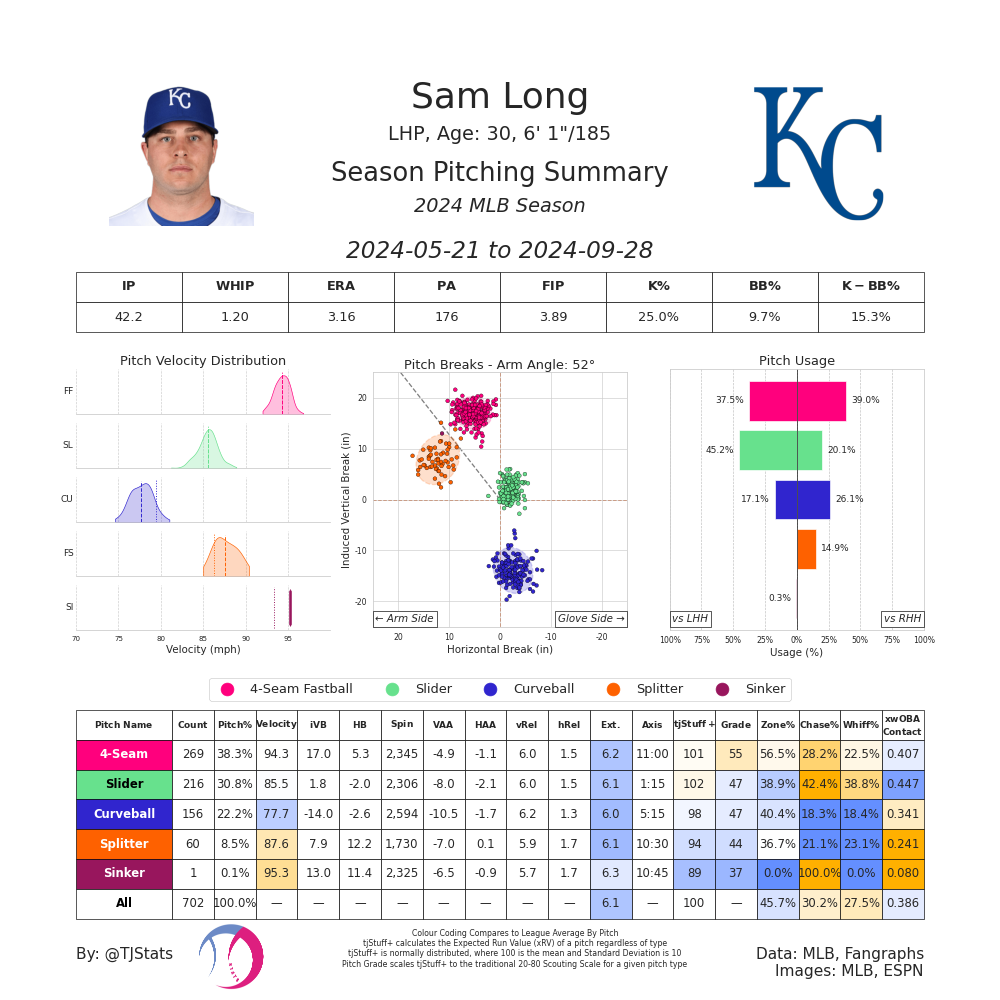
In 42.2 IP, Long posted a 3.16 ERA and 1.20 WHIP with a 15.3% K-BB%. He ended up being the Royals’ most dependable left-handed reliever that season, with some key innings in the postseason. Like Olivarez, Long has control issues, as evidenced by his 45.7% zone rate. However, he generated strong chase (30.2%) and whiff rates (27.5%), and his four-seamer was his most effective pitch with a 55 grade. Long fell apart a bit in 2025, but the Royals would take a similar campaign from Olivarez in 2026.
Now, let’s take a look at Clarke, who returned to the Royals after being traded away after the 2023 season.
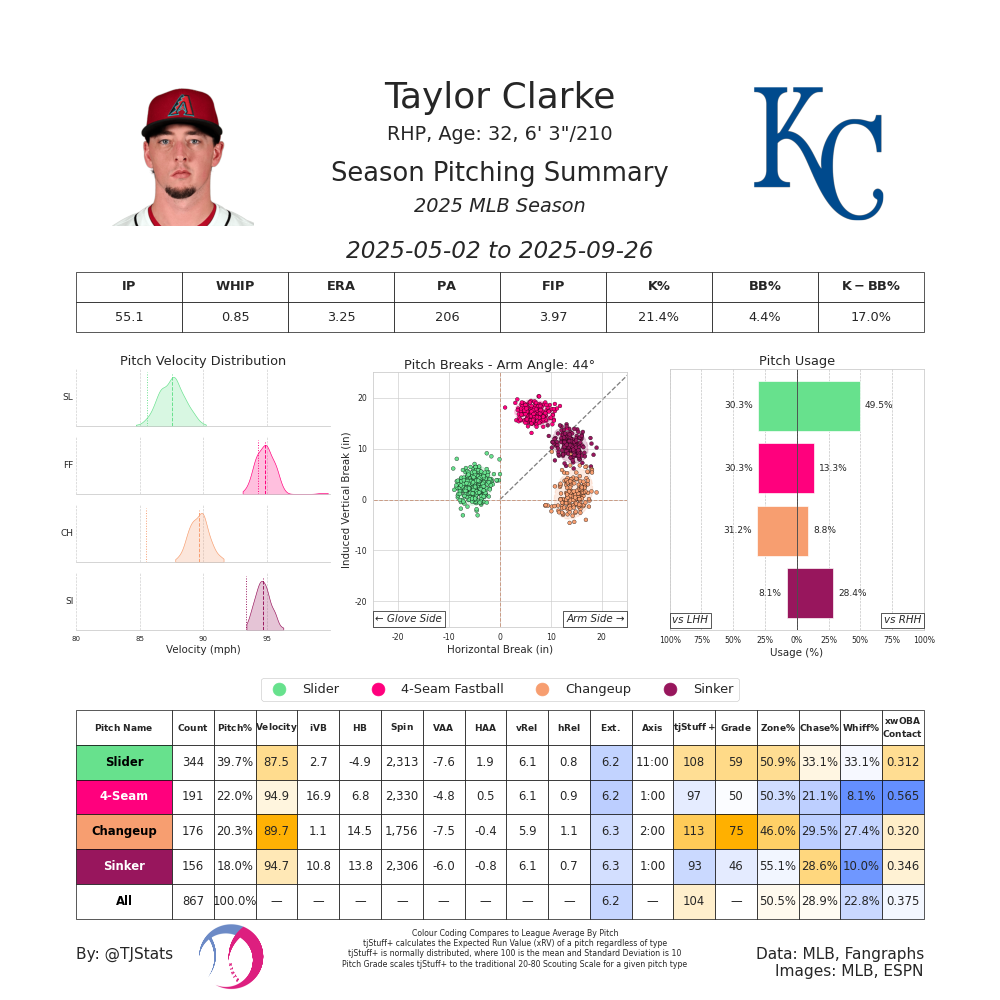
Clarke didn’t have a great four-seamer (97 TJ Stuff+ and 50 grade), but his slider was elite with a 108 TJ Stuff+ and 59 grade. The breaking offering that he threw 39.7% of the time also had a 50.9% zone rate, a 33.1% chase-and-whiff rate, and a .312 xwOBACON. As a result, in 55.1 IP, he posted a 3.25 ERA, 0.85 WHIP, 3.97 FIP, and 17% K-BB%.
It may be unfair to compare Olivarez to either Long or Clarke, mainly because Olivarez’s control issues are way worse than those of the two former Kansas City relievers. However, both are examples of pitchers who weren’t taken seriously by fans in the offseason, had good Spring Training campaigns, started in the Minors, and parlayed that success into strong Major League campaigns.
Success may look a little different for Olivarez in 2026. However, if the stuff continues and if he can continue to hone his command and control with each and every outing, both in Spring Training and in the Minor Leagues to begin the year, then it wouldn’t be surprising to see Olivarez turn into some kind of dark-horse impact reliever for the Royals by mid-season.
Hopefully, if that happens, he can have a longer, more successful tenure in Kansas City than Long or Clarke.