
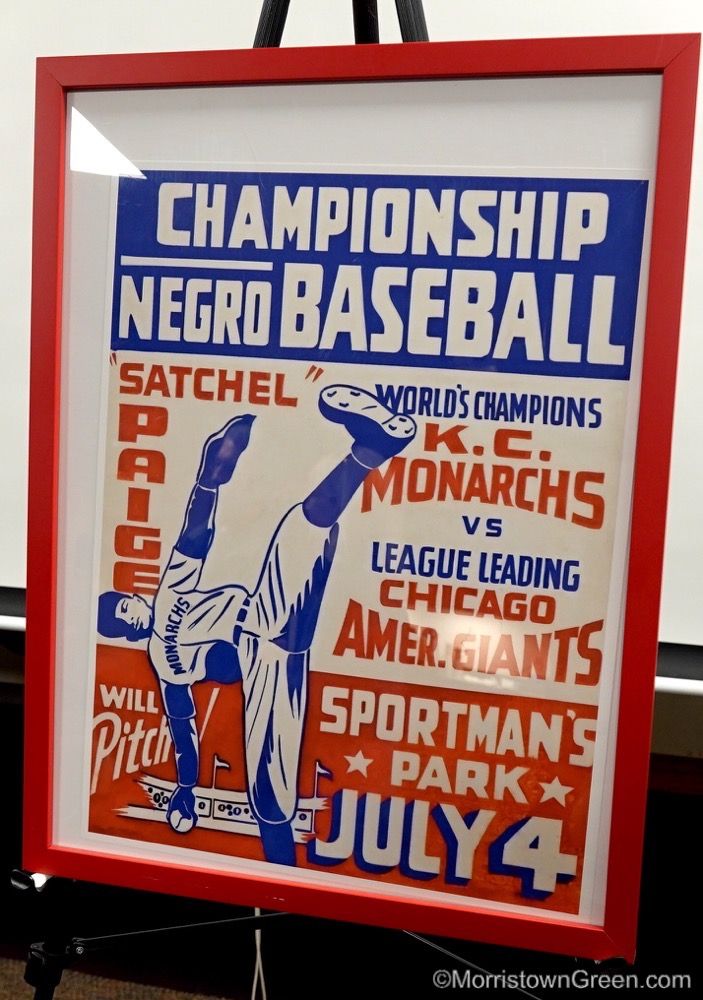
 Advertisement for Negro League All-Star Game in the 1930s, displayed at David Shuffler talk, Morristown & Township Library, Feb.27, 2026. Photo by Kevin Coughlin
Retired bank officer David Shuffler wasn’t talking about markets or interest rates last week at the Morristown & Morris Township Library. His focus was a different kind of capital — the talent, pride and economic power of Black baseball, much of it ignored or erased by organized baseball for nearly a century.
 David Shuffler discusses history of Black baseball, Morristown & Township Library, Feb.27, 2026. Photo by Kevin Coughlin
Shuffler has curated three anthologies on early Black ballplayers he calls Blackballers. The project grew from an unlikely starting point: His collection of authentic baseball caps.
“So he started doing some research on the players, and the ones that interested him were ‘Blackballers,’ pre-Negro Leagues,” explained his wife Karen.
That curiosity became a sweeping investigation into how Black players built their own game — and how baseball’s white power structure shut them out.
‘ECONOMIES WITHIN ECONOMIES’
Shuffler began with the community impact of Black baseball in the late 19th and early 20th centuries.
Black teams helped sustain what he called “unclaimed economies, economies within economies” in segregated neighborhoods. They provided travel, jobs, business opportunities and vital skills to Black Americans barred from the white mainstream.
Sunday games anchored that world. Every team saved its star pitcher for the Sabbath.
“Parishioners wore their dress-up clothes to church, and then on to the ballpark. The pastors were told unequivocally at the door: Keep your homily short,” Shuffler said.
 The first Negro League World Series, Oct. 11, 2024, in Kansas City, Mo. Photo by J.E. Miller.
Black players didn’t merely imitate white baseball. They reshaped it, he contends. What’s known as “small ball” today was tagged back then as “tricky baseball” — bunts, hit-and-run plays, stolen bases.
“Black baseball and its innovative gameplay transformed the way the game of baseball is played,” said the Basking Ridge resident.
A FORMAL BAN THAT LASTED UNTIL JACKIE
Despite the excellence on the field, organized baseball moved early to exclude Black players. Shuffler cited the National Association of Base Ball Players’ 1867 decision banning any club “which may be composed of one or more colored persons” from membership in the association.
In 1887, the International League followed suit. On the same day the Newark Little Giants faced Cap Anson’s Chicago White Stockings in an exhibition game — one in which Anson refused to take the field if Black stars George Stovey and Fleet Walker played — the league ratified a petition barring Black players.
 David Shuffler discusses history of Black baseball, Morristown & Township Library, Feb.27, 2026. Photo by Kevin Coughlin
“I have always asked myself, was this a coincidence, or was this a conspiracy? If I had to make a vote, I would vote conspiracy,” Shuffler said.
From the late 19th century until 1947, when Jackie Robinson debuted with the Brooklyn Dodgers, that rigid color line held.
The cost of Jim Crow in baseball, he asserted, was measured in lost legends.
‘THESE GUYS COULD PLAY’
Shuffler’s talk overflowed with names that should be as familiar as Ruth or DiMaggio. Fabled New York Giants manager John McGraw once raved about John Henry “Pop” Lloyd, known as the “Black Honus Wagner,” and called center fielder Oscar Charleston, “the best player he ever saw,” Shuffler said.
 Baseball cards of Negro League stars, displayed at David Shuffler talk, Morristown & Township Library, Feb. 27, 2026. Photo by Kevin Coughlin
Walter Johnson, legendary hurler for the old Washington Senators, was awed by Josh Gibson, slugging catcher of the Negro Leagues.
Gibson “could do anything. He hits the ball a mile; he catches so easy, he might as well do it in a rocking chair. And he throws like a rifle,” Shuffler quoted Johnson as saying. He added that Dizzy Dean sometimes chose Gibson to catch him in barnstorming games.
At his own induction ceremony in 1966, Ted Williams touted Gibson and Negro League pitching ace Satchel Paige for the Hall of Fame.
If Negro League first baseman Buck Leonard had played in the major leagues, Hall of Famer and Orange High School sports icon Monte Irvin reportedly mused, “people would have called Lou Gehrig ‘the white Leonard.’”
Shuffler also spotlighted dominant teams pre-dating the Negro Leagues. Among them were the St. Paul Colored Gophers and the 25th Infantry Regiment “Wreckers,” a Black Army team that was tough to beat circa World War I. A dozen Wreckers, including Wilber “Bullet” Rogan, would advance to the Negro Leagues,
“Competition was extraordinary,” Shuffler said. “These guys could play.”
FROM RUBE FOSTER TO JACKIE ROBINSON
Shuffler traced the formal organization of Black baseball to February 1920, when team owners met at a YMCA in Kansas City.
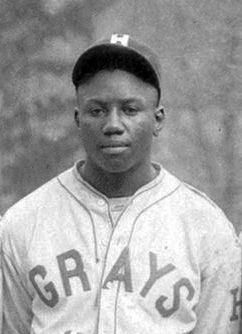 Josh Gibson, catcher with the Homestead Grays (Negro Leagues), circa 1931. Photo via Wikipedia
The 1930s became the “golden age of Black baseball,” with Negro League All-Star Games drawing big crowds and national media attention.
Yet the barrier held until Branch Rickey signed Jackie Robinson in 1945 and brought him to Brooklyn in 1947.
“If they [Negroes] can fight and die at Okinawa, Guadalcanal and in the South Pacific, they can play baseball in America,” Shuffler quoted Commissioner Happy Chandler as saying.
Even then, the pressure was crushing. Shuffler recounted pitcher Dan Bankhead’s fear.
“When he got to the major leagues, he was terrified that if he threw inside and hit somebody, it would cause a race riot. That’s the kind of pressure these guys were facing.”
‘TOO LITTLE, TOO LATE’
Shuffler’s anthologies are Segregation to Integration: A look back at Black Baseball in America, Selection Bias: A look back at the BBWAA Rules for Election to the National Baseball Hall of Fame, and 2025 Mock Hall of Fame Election: A Tribute to Legendary Iconic Negro and Pre-Negro Leaguers.
He spreads the gospel of Black baseball at libraries and anywhere else he can find an audience. Last year he addressed the annual Cooperstown Symposium on Baseball and American Culture, a joint venture of the State University of New York at Oneonta and the Hall of Fame.
 David Shuffler grew up in Watertown, NY — Yankees country — rooting for Ted Williams of the Red Sox. He’s pictured here visiting the Hall of Fame. Photo courtesy of the family.
Asked about Major League Baseball’s 2024 decision to incorporate statistics from seven Negro Leagues, spanning 1920-1948, into its official record books, Shuffler was blunt.
“I think it was good, but it’s a little bit too little too late, and could have been done a long time ago if they had the right mindset.”
On the Hall of Fame, he was sharper still, arguing that the election process “smacks of racism and racial discrimination of the highest order.”
He pointed to the Hall’s treatment of Buck O’Neil.
“Buck O’Neil was denied election in the Hall of Fame by one vote. And then 10 days later, was asked to be the inductee speaker in the Hall of Fame induction, which he did, with grace, with dignity… If ever there was an ambassador for Black baseball and baseball, it was Buck O’Neil.”
“For me,” Shuffler said, “that one incident summed up everything about Hall of Fame elections.”
‘THE DOORS OPENED UP TOO LATE’
To Shuffler, the story of Black baseball is both triumph and tragedy. Integration opened the Major Leagues but dismantled the Black baseball ecosystem that had sustained segregated communities.
Cool Papa Bell, inducted into the Hall of Fame in 1974, put it this way:
“He said, ‘No, I wasn’t born too early… The doors opened up too late.’”
That, Shuffler suggested, is the heart of the “Blackballers” story. The barrier was never ability.
“These guys could play,” he said. “Talent is talent.”
Morristown has a long history of people stepping forward in pivotal moments.
When you chip in to Morristown Green, you’re helping your neighbors stay informed, strengthening our civic backbone,
and carrying on the spirit that’s defined this town since its earliest days.
Rally for local news.