

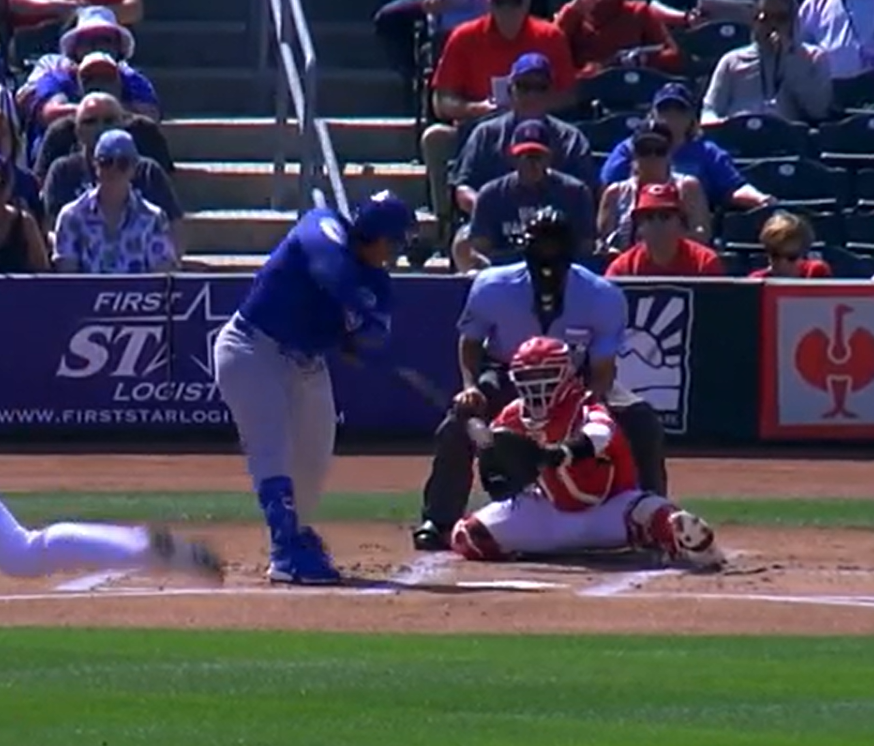
In his second game of the Cactus League season, Moisés Ballesteros collected two hits on hard-hit balls to left field. Admittedly, the first—a two-run first-inning double hit on a line toward flummoxed left fielder Will Benson—should have been caught, but even if it had been, one would have been compelled to remark on the impressive process of the swing. On a 2-2 slider bending toward his back foot, Ballesteros inside-outed the ball with real authority, at 95 miles per hour and with a 20° launch angle. It was very pretty hitting.
The next inning (this game was utter spring chaos), Ballesteros was up against the same pitcher (Reds starter Brady Singer) and got another 2-2 slider. This one, however, stayed up above the belt. Ballesteros found the center of it, hitting a 105-MPH screamer through the open left side of the infield, with a 7° launch angle. This one was an objectively worse pitch by Singer, but playing off the previous at-bat, it would have drawn a whiff or a mishit from many young hitters, because it looked so much like an offering from which it ended up being so disparate in location and required swing path. For Ballesteros, though, it was no problem.
There are hitters who take that second, hanging slider out of the park, even in a two-strike count, but almost all of them fail to do anything good on that first, better-executed one. There are hitters who turn on that first one and lace it into the right-field corner, thereby avoiding the need for a defender to get turned around in order to produce a double, but almost all of them foul off or freeze up on that second one. It takes an exceptionally adaptable swing (and a smart, balanced two-strike approach) to create both of the hits Ballesteros found Monday. That’s the unique value he adds to the Cubs offense.
Swing paths are all the rage in the analysis of hitters right now, within front offices and beyond them. The swing can now be quantified, in ways we were barely beginning to imagine even 10 years ago. Teams have metrics they don’t share with the public, of course, but even the ones that are available at Baseball Savant are now enough to describe a batter’s stroke in fine detail. The simplest measurement to which we now have access is bat speed, but there are other valuable ones, too—like swing tilt.
Every swing has to describe a path downward, then upward, swooshing and slashing from behind the hitter’s head or shoulder, through the strike zone and out around their front side. Every swing is a reaction to what the hitter sees, so the angles at which they swing change all the time—but it’s also a practiced and calculated motion, so each hitter also demonstrates an average swing path that defines how they address the ball. It’s reported at Savant as the angle between the barrel of the bat and an imaginary line parallel to the ground running through the handle, captured over the final 40 milliseconds before the intercept point (real or, on whiffs, hypothetical) between bat and ball.
The league’s average swing tilt is roughly 32°, but it ranges from under 25° to over 40°. More importantly, for our purposes today, players themselves use different swing paths, and we can use splits to gain more insight into their swings than the snapshot provided by a single number. On a four-seamer, for instance, most hitters will use a flatter swing—more on why in a moment. Almost universally, hitters use their steepest swings against curveballs. Though it’s far from a perfect gauge, one way to tell how adaptable a batter’s swing is is by looking at how much their swing path differs from one pitch type to another.
There are multiple reasons for different swings against different pitch types, of course. The first is timing. A four-seam fastball is coming at you quicker than a breaking ball is, but unless you knew that heater was coming and got started early, you have the same budgets of time and space to spend getting the barrel to the baseball. A flat swing is a more direct one, and while it’s often not technically as fast (as measured on Savant, which uses the rotational velocity of the barrel at the intercept point) as a steeper swing, it can still be quicker. What hitters want most is barrel accuracy, and the surest way to get the sweet spot on a fastball is usually to flatten out your swing a little bit.
To think about why curves engender steep swings, keep the above in mind, but further, consider the second reason why swing tilt differs by pitch type: location. A pitch up in the zone requires a flatter swing to produce contact than does one at the belt, and that pitch at the belt requires a flatter one than a pitch down at the knees. None of that is new, ground-breaking information. We’re just agreeing on foundational concepts.
Now, consider where most four-seamers are thrown: above the belt. Meanwhile, most curveballs (and sliders, for that matter; changeups and sinkers introduce another dynamic that we’ll mostly save for another day) are down in the zone, or below it. You need a steep swing to get to them. In fact, most hitters have pretty small differences in average swing tilt based on pitch type, and much larger ones based on pitch height.
I’ve told you all of that to tell you this: Ballesteros has perhaps the most plastic swing in the Cubs’ lineup, which will make him an invaluable part thereof this year. As proof (beyond those two lovely but ultimately unimportant hits on Monday in Goodyear, Ariz.), I offer this: No hitter on the Cubs last season had a greater difference between their swing tilt on four-seamers and their tilt on curveballs than did Ballesteros. Admittedly, his sample was small, but he averaged 27° of tilt against four-seam fastballs and 34° against curves. Expect that margin to shrink as he gets more playing time, but not so much that he won’t still stand out.
By pitch height. he’s just as remarkable. Only Nico Hoerner matched the 15° spread in tilt from Ballesteros, who had:
a 20° average tilt on high pitches;
a 29° tilt on middle-of-the-vertical zone pitches; and
a 35° tilt on low pitches.
Remember that slider from Singer he hit for a double? Here’s what he looked like at contact on that pitch:
Now, here’s another pitch he hit hard the opposite way—his first big-league homer, last summer.
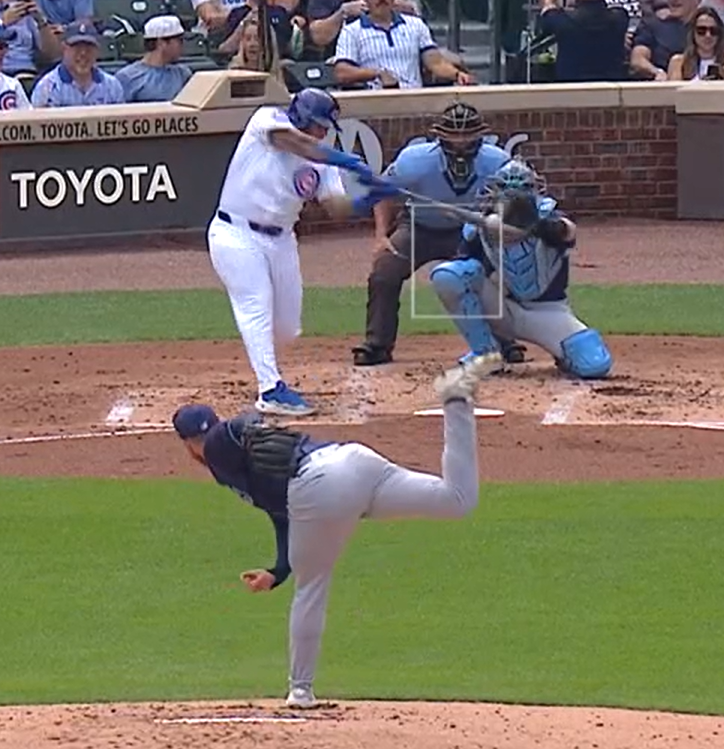
As the kids used to (but no longer) say, get you a man who can do both. Ballesteros is that kind of hitter, and they’re hard to find.
That doesn’t mean he’s perfect, of course. In fact, let’s talk a little more about the nature of swing tilt manipulation, including the tradeoffs involved. For these purposes, we’ll set aside pitch types and look only at pitch height. Remember, Ballesteros has about a 15° difference in tilt between his swings at high pitches and his swings at low ones. Looking beyond the Cubs, that’s still above average; the average split is about 12°. However, Ballesteros is not an outlier in baseball as a whole. Here are four hitters who excel at this kind of swing adjustment based on location:
With the possible exception of Chapman, these names won’t surprise you. They’re famous for their feel for contact, and specifically for getting more than you’d expect out of their swings, relative to their raw bat speed. Certainly, if Ballesteros can be anything like what Bellinger was at his best with the Cubs, the team will flourish.
Alas, it’s not this simple. There’s a specific penalty we need to account for: the high-pitch swing speed loss. We touched on this earlier. A pitch coming at you at the top of the zone (or above) is likely to be a fastball, which jams you up for time, but even if it isn’t, it forces you into a tough spot for space. Every hitter’s swing has to be able to punish mistakes in the middle of the plate, and the body can much more naturally adjust to a ball down—what you’ve always heard broadcasters call “dropping the head of the bat on it”. When most hitters flatten out their swings to attack a pitch up, though, they lose bat speed. It’s a shorter swing, and it can still work, but it’s just not as easy to forge a productive collaboration between gravity, your musculature and that very blunt tool in your hands on a flat, high swing as it is on steeper ones where the barrel can dip farther below the hands.
Different hitters pay different high-pitch bat speed penalties, but mostly, that’s a product of choices they make. The baseline for this is around 2 MPH of swing speed, but if you choose not to manipulate your swing tilt as much as other batters do, you can minimize that. Two former Cubs illustrate that option:
As you can see, neither player sacrifices bat speed to flatten their swing at the top of the zone. That means a much smaller variability in tilt than others have, which is why they’re more prone to mis-hitting the ball or whiffing, but with the right approach—good pitch selection, tailored to your swing and its most productive zones—holding onto your bat speed on high offerings can be worthwhile. Schwarber and Morel are a nice pair for illustrating just how important a great approach is to such hitters, though.
Though each of those two have below-average ranges of swing tilt, there are guys who are even more extreme in that regard—and who are, therefore, even more extreme in their discipline of only swinging at what they want. Seiya Suzuki and Juan Soto belong to a class of hitters who can’t manipulate their bat paths much and still do what they want to do at the plate, so they adopt an extremely selective approach, instead.
The more you adapt your swing path to the pitch, the more bat speed you generally give up at the top of the zone. Ballesteros is one example; a fellow left-handed hitter in the NL Central is another.
Moisés Ballesteros: HIGH: 20°, 69.4 MPH / MID: 29°, 73.2 MPH / LOW: 35°, 73.4 MPH
Brice Turang: 22°, 66.4 / 32°, 71.1 / 37°, 72.3
If you’re giving up four miles per hour of bat speed at the top of the zone, you’re probably being too aggressive with the adjustment of your swing path. Ballesteros’s case gives us a chance to talk about one more dynamic in play, though, which is the baseline tilt of one’s swing. How steeply you swing when the ball is exactly where you want it is a major factor in determining how much you need to adjust to handle offerings at the top of the zone—but that needn’t be a primary consideration when deciding what type of swing is best. In general, steeper swings are better swings. They handle the ball down and in the middle of the zone better, and they still have some loft left in them after the hitter adjusts at the top of the zone. There’s some tilt number—let’s say 24°, but you could pick anything from 22 to 25—at which you’re unavoidably giving up extra bat speed; it’s physics. Steep swingers can lose less speed at the top of the zone, because they don’t run into that sub-25° restriction.
Guys with slow, steep swings—think Michael Busch—can have big trouble handling the ball up and in, but if they have any semblance of a plan at the plate, they derive more benefit from that steep attack than damage from having a hole in their zone. In fact, you know who’s absolutely perfect in this regard, giving up virtually no bat speed at the top of the zone because they’re still swinging fairly steeply there but also getting to the ball consistently? It will not shock you.
Shohei Ohtani: HIGH: 29°, 74.6 MPH / MID: 37°, 76.5 MPH / LOW: 43°, 74.6 MPH
Ballesteros is no Ohtani. He’s not Busch, either. His swing is flatter, but it still has plenty of bendability. He shows a facility for seeing the ball and changing his bat path—what old-school scouts call “smart hands”—few players in the league can match.
The last step in his development at the plate could be more about selectivity than about manipulating the barrel. Maybe a perfect Ballesteros has a slightly steeper upper-zone swing, but look at that second hit from Monday, or the homer from last year: he derives real value from getting on top of the ball. No, his key will be to swing less often up there.
Some 369 hitters saw at least 100 pitches in the shadow of the top of the strike zone at Triple A last year. Ballesteros had the fifth-highest swing rate in that cohort. For a guy who stands 5-foot-8, in the age of the ABS system, that shouldn’t happen. Ballesteros can afford to be more picky, and to use his right to challenge pitches occasionally to thwart bad calls. The top of the zone (especially to short hitters) is where fans will feel the greatest difference between baseball before the ABS challenge system and baseball with it. For Ballesteros, the fact that few pitchers will be able to hit the top of his zone should be a huge advantage.
The plasticity of Ballesteros’s swing will make him a linchpin of the Cubs offense in 2026. If he also learns to let the ball along the top rail of the zone sail by a bit more often, he could turn a corner quickly and become a massive offensive weapon. Either way, though, the team has to be very pleased that he made it through a thorny entry process and landed on American soil in his hitting shoes.