
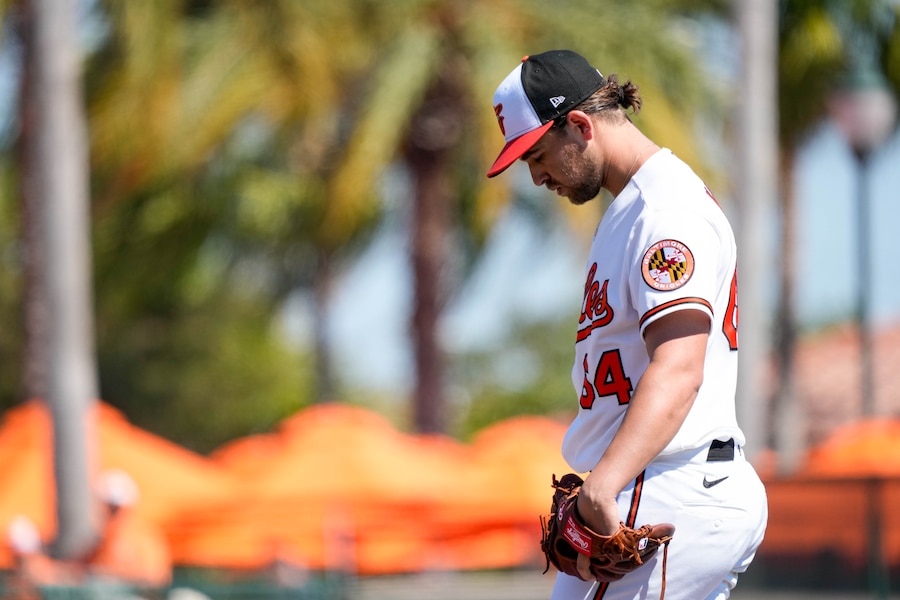
There wasn’t much to joke about last year as the calendar turned from April to May and the Orioles’ season circled the drain. Dean Kremer pitching seven shutout innings on the second day of May and magically leaving his chronic April struggles behind him was the notable exception.
For three years, Kremer’s issues in April have undermined so much. They’ve weighed down his season totals and made it hard for the good that followed to be fully appreciated. Last year, they were one of many reasons the Orioles season never got off the ground.
Once, maybe, was an anomaly. For him to need April to round into form three years running was a pattern worth breaking. So that’s what he and the Orioles are trying.
“This year was the first year that I didn’t really shut down — by choice,” Kremer told me. “It had nothing to do with the [World Baseball Classic]. It had nothing to do with any other decision. I feel like I’ve ended the year, every year, in a good spot, and then I shut down for a month, and then have to find it for a while. …
“Because I didn’t stop really throwing [off-speed pitches], the feel was much quicker to come back — or not leave. And I kind of stayed in the mental space of where I finished the season, instead of just forgetting about it for three months and then trying to find it again, and then seeing what I deal with and whatever comes out comes out, and then having to adjust throughout the course of the season.”
Although the workload and ramp-up for pitchers who need to be ready earlier in the spring for the WBC, where Kremer will lead Israel’s rotation, is a topic of conversation this time of year, that wasn’t why I asked Kremer about it. Instead, I asked about something we’d discussed previously: his lifting and cross-training routine during the winter. Kremer wasn’t sure there was a connection.
Whatever the reason, it’s been hard to ignore.
Kremer missed the start of 2022 with an oblique injury but started 2023, 2024 and 2025 below his typical standard. His ERA was 5.89 with a 1.39 WHIP in 94 2/3 innings before May 1. After May 1, it was a 3.70 ERA and a 1.22 WHIP.
Expected data, to the extent it can be split out in public platforms, suggests there’s luck involved both ways. His xFIP (expected fielding-independent pitching, which replicates ERA based on walks and strikeouts with a normalized home-run rate) was 4.61 before May 1 and 4.23 after May 1.
Pitching coach Drew French said: “We do have our eyes on some of those things that we feel are influential to who Dean is in the early parts of the year and who he becomes as the year goes on. I think the main benefit for him was just maintaining feel, and the ball coming out of your hands is something unique, where if you don’t know it, you don’t know it. But he felt like it was really advantageous for him, and we supported it.”
Kremer still lifted and built his body up for the long season ahead, but instead of going a month without picking up a baseball and then building up by playing catch with fastballs and restarting the process from scratch, he said, he “just de-loaded and made it like I was still in season.”
“I was still spinning stuff,” he said. “I was still throwing changeups. I was still tinkering with stuff, even in the beginning of the offseason.”
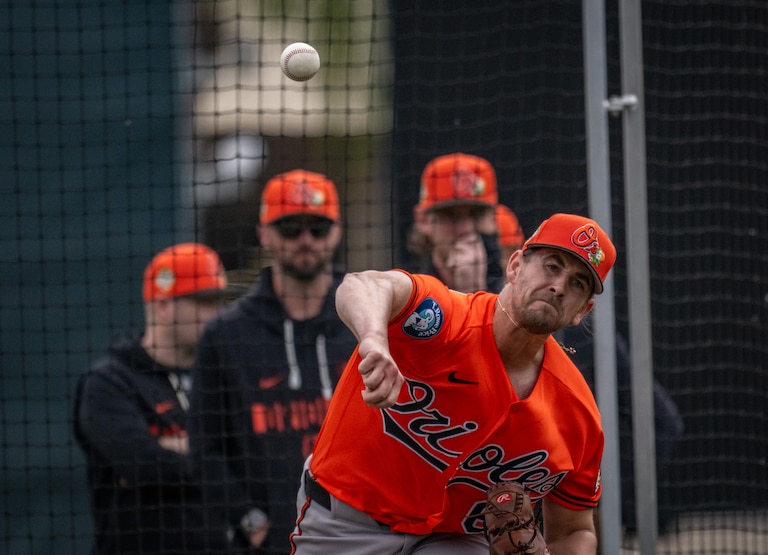 Kremer has started the last three seasons slowly before showing significant improvement. (Jerry Jackson/The Banner)
Keeping the feel for his pitches was a benefit he noticed right away, but so too was how his arm felt as the season preparation truly began.
“The body is interesting,” Kremer said. “Whether it’s strength, or in terms of arm, feel, everything — you lose it fairly quickly. But being able to kind of de-load, so give your body the break but not completely shut down, I think makes more sense for me. It’s funny that when you stop throwing your body goes back to what it’s supposed to. …
“Your skeleton kind of goes back to what quote-unquote normal looks like. Obviously, we beat it up over eight months — nine, 10 months, if you’re counting the throwing in the offseason. So, whether it’s your shoulders start slouching forward, or vice versa, they go [back]. Throwing overhand is not technically natural, so being able to go into [external rotation] and after not throwing for a while, your arm doesn’t want to go into external rotation as easily as it does during the season. And that’s one of the big reasons why I didn’t stop, to keep that fluidity.”
French said the team has researched, tested and compiled evidence on how pitchers use their offseasons, and it “found that [throwing] a couple of days a week, even lightly, can have a ton of benefits just in terms of what’s happening internally with the arm, the shoulder, and the elbow, and not putting yourself necessarily behind the eight ball in terms of the runway it’s going to take to get back.”
Even in 2023, the last year Kremer pitched in the WBC, that runway stretched into May for him to become the reliable presence in the Orioles’ rotation he expects to be. He’s getting an early look at how his pitches feel in spring training before the WBC, but when he flies north with the Orioles, he knows the goal — and knows it needs to start as soon as the season does.
“Hopefully, more consistency,” Kremer said. “But we’ll see. I don’t know. Hopefully, it goes like the five other months.”