
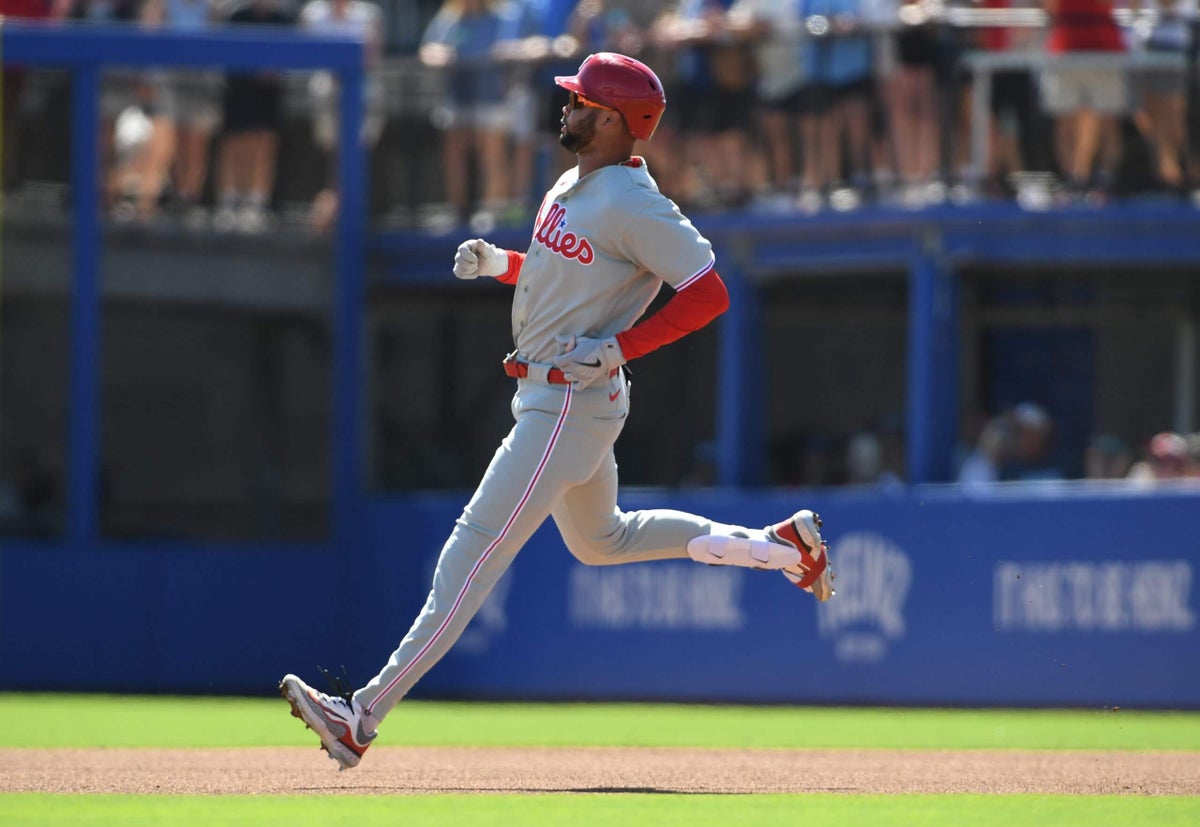
Justin Crawford entered the spring as a fringe top-100 prospect with little to no power, hardly the sort of player we would typically expect to emerge as a difference-maker in fantasy baseball. However, the 22-year-old Philadelphia center fielder happens to excel in at least two areas that matter a great deal in our game, if only minimally in reality.
Crawford slashed .334/.411/.452 with 46 steals last year across 506 plate appearances at Triple-A Lehigh Valley. It was the third straight minor league season in which he’d hit north of .310 while swiping 40 or more bags.
Batting average is basically a relic in the modern game — a curiosity, a party trick — but it remains one of the five standard hitting categories in fantasy, so we are required to continue to care about it. Base-stealing may not have a dramatic impact on game outcomes, either, but there’s never been a moment in fantasy history when a dude capable of producing 40 stolen bases wasn’t a player of interest.
Thus, we should all be focused on Crawford’s efforts to lock down an opening day starting role for the Phillies. Early results have been plenty encouraging. Crawford got the exhibition season rolling with an impressive piece of hitting against Eric Lauer, a well-established major league vet:
Wasting no time! Our first hit of the spring comes courtesy of Justin Crawford pic.twitter.com/EHLKCRl5kd
— Philadelphia Phillies (@Phillies) February 21, 2026
That’s a two-strike 104 mph rope to the wall against a credible left-hander. An ideal proof-of-concept at-bat, essentially. Crawford has delivered a few highlight plays defensively, too.
As of this writing, Crawford is 5-for-15 this spring with three doubles, one walk and one steal. He figures to open the regular season as a bottom-of-the-order hitter, but that’s not particularly worrisome given the team context. Crawford is likely to bat immediately ahead of Trea Turner, Kyle Schwarber and Bryce Harper, which gives him an obvious path to 85 or 90 runs scored.
As a prospect, Justin profiles similarly to his father Carl — a fantasy legend — but with greater on-base ability and perhaps less power (although Carl never hit double-digit homers until he was in the majors). If Justin’s elite contact rate (85.3%) translates to MLB, he has a clear chance to emerge as a three-category fantasy contributor and Rookie of the Year contender. He’s available now at a no-risk ADP, well outside the top-300 picks.
Jac Caglianone, destroyer of baseballs
Yeah, OK, Caglianone may have disappointed you last season when he was a heavily hyped prospect who struggled with his first exposure to major-league pitching. But you gotta get over it. Caglianone has showcased uncommon power in the early weeks of spring training.
This gentleman already has a 460-foot home run to his credit during exhibition play, and it’s somehow only the third hardest-hit ball he’s launched in terms of exit velocity. Caglianone launched a 120.2 mph double last week, which, of course, is absurd. It would have been the third-highest EV in the regular season in 2025.
Remember: Kansas City is moving in the fences at Kauffman Stadium this year while also lowering the outfield wall by 18 inches. We can reasonably expect Caglianone to be a better hitter in a much better environment.
Matt McLain added muscle, is now raking
On the one hand, McLain adding a dozen pounds of muscle in the offseason seems like an unambiguously positive development. He’s hit three bombs over his first five spring games, including this no-doubter:
MCBANG pic.twitter.com/BXN3NZXk2f
— Cincinnati Reds (@Reds) March 2, 2026
But on the other hand, maybe another 12 pounds of McLain just means there’s more of him that can be injured in 2026. Hard to say how this will play out. McLain’s career to this point has been defined by IL visits as much as his power/speed potential. Still, he’s a potential 20-HR/20-SB player at a premium position who no longer carries a premium draft price.
If we get 145 or more games from McLain in his age-26 season, he’s capable of a top-5 positional finish. He has five-category potential at a late-round ADP (208.45 at NFBC).
Ryan Weathers looks the part
Weathers struck out five batters over 3.2 innings in his spring opener for the Yankees, touching 99.8 mph with a 52% whiff rate. Given his recent injury history, I have decided to take a victory lap on him right now, today. I totally nailed this one. Great call by me. Weathers is a priority sleeper for the sophisticated Zero SP drafters among you. He has a deep and dangerous (and evolving) arsenal with significant K-potential and unusual control.
Again, the worry with Weathers is health, but that’s the nature of his position. You can’t entirely dodge injury risk with pitchers, but you can avoid it in the early rounds. Weathers is exactly the sort of end-game flier we should all be taking, regardless of our roster construction preferences.
We had a better subhead, but Braiden Ward stole it
Ward has been stealing everything in sight this spring. He swiped eight bases in nine attempts over his first 10 games. He’s stolen 208 bags over the past four minor league seasons, including 57 last year while splitting his time between Double A and Triple A.
Unfortunately, the 27-year-old has zero chance to crack Boston’s loaded outfield. There’s nothing he can do to nudge Jarren Duran, Roman Anthony, Wilyer Abreu or Ceddanne Rafaela out of the mix. Not happening.
But Ward has definitely drawn attention from manager Alex Cora, who recently referred to him as one of “the guys you need in September, you need in October.” If an injury hits Boston’s outfield at any point, we might see Ward’s upper-tier speed at Fenway ahead of schedule.