
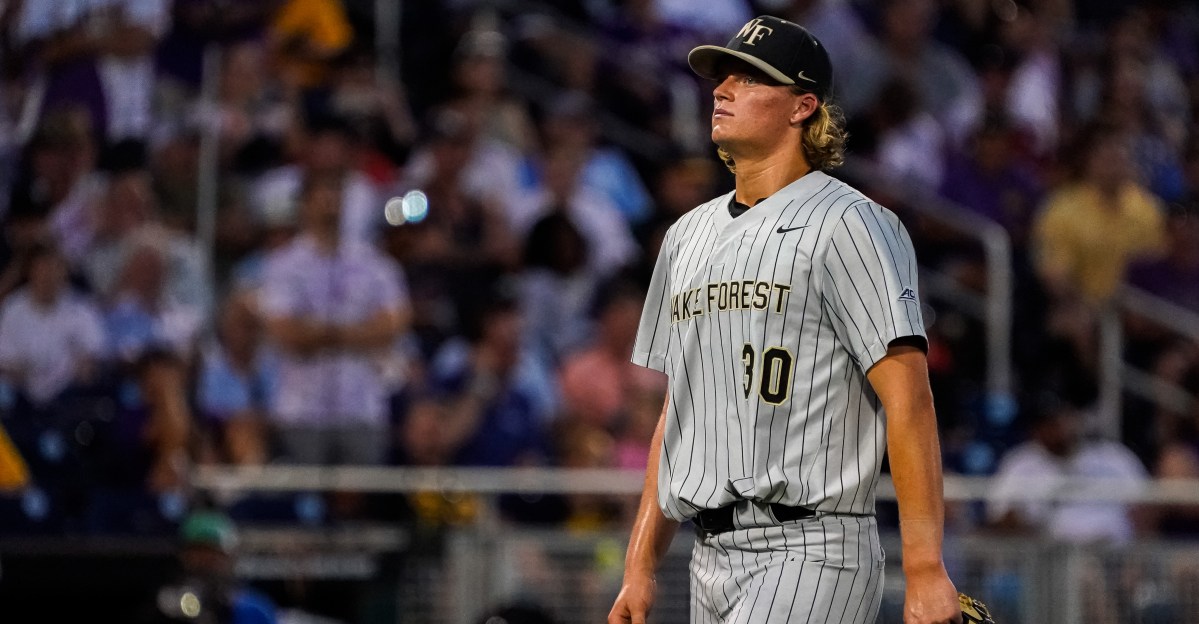
In our group of 40+ FV prospects, there are a quite a few young pitchers that we’re just in a holding pattern with. Like out 23rd ranked prospect, right-hander Michael Massey, it’s a talented group of young arms, but just about all of them have been sidelined with injury since joining the pro ranks. That’s not so uncommon, and we’re willing to wait a season and see if they can start making progress before we start dropping them further, but it does illustrate the high risk, high reward profile of the many pitchers the Tigers have accumulated in the farm ssytem under Scott Harris and Jeff Greenberg’s watch.
Massey doesn’t fit that profile so much as a college pitcher. He was drafted out of notable pitching factory Wake Forest in the 2024 draft. The Tigers spent some coin on him, inking the right-hander to a $522,500 bonus after selecting him with their fourth round pick. However, he too spent his first pro season on the injured list and so we haven’t seen him on the mound since his junior year of college.
Tulane was Massey’s first spot as a collegiate pitcher, but he transferred to Wake Forest after his freshman season, and spent his sophomore season as an ace reliver out of the Demon Deacons bullpen. His conversion to their rotation in his junior year wasn’t so smooth, as Massey walked a lot of hitters and was constantly pitching in traffic, but he still punched out 32.1 percent of the hitters he faced. After a hamstring injury, he finished out the year back in the pen. The high walk rate hurt his draft stock after some thought at the beginning of the season that he might sneak into the late first or CBA round with a strong campaign as a starter.
Moving from bullpen to rotation is a difficult challenge, so it’s not so surprising that the longer outings took some adaptation. There was still a lot of upside and it was hard to argue with him as a fourth round selection. He has the size and the stuff to start, but after his missed all of 2025 with a bad oblique strain, we’ll have to see how the Tigers view him going forward. There’s a pretty good argument that he still profiles best as a reliever.
Massey stands 6’5” and weighs 230 pounds, so he’s basically the size of Justin Verlander. He gets really good extension off the rubber, and has a pretty clean lower half mechanics, but the similarites to a young JV end there. Massey throws out of a high arm slot, requiring some upper body tilt to get over the top on target, and pitchers with those traits do tend to deal with oblique and rib injuries more than standard or low three-quarters types. There’s also an argument that such a move puts a limit on his potential command, making a permanent move to the bullpen more likely.
That high arm slot and the strong supinator tendencies that typically come with it play out in his stuff as well. By which I mean he’s not the type to be good at turning a twoseam/sinker or circle changeup. Massey was typically 93-94 mph in college, topping out at 96-97 mph, and his fourseamer has both ride and cutting action. At times he’s hit 20-21 inches of induced vertical break, with a little bit of late cutting action. That’s a pretty rare combination. The only real comp I can find in the major leagues is Kenley Jansen’s unicorn cut fastball.
He backs the heat up with a low 80’s sharp, late breaking slider and a spike curveball with good spin rate and plenty of depth. He threw a circle changeup occasionally in college, but that arm slot and tendency to supinate—simply visualized by holding your arm straight out and rotating your forearm thumb up as opposed to pronation, where you turn the thumb down—suggests he should work on a splitter instead. In a sense, Massey looks like a bigger, more extreme version of Troy Melton from his short arm stroke right down to the hair. He just doesn’t have that 97-100 mph gas Melton can produce yet, nor the consistency in his delivery.
Point being, the stuff is both very nasty and pretty uncommon. The range of outcomes, assuming he puts the shoulder injury behind him, is pretty wild in Massey’s case. If he ticks the fastball up to 96-97 mph in short outings and commands it, you might have one of the better relievers in the game. Or his stuff may not develop much, but if he learns to command what he’s got you could have a mid-rotation starter who has a few peak seasons in him. Or, he might always be a little too wild and slowly drive us crazy because the stuff is so intriguing.
The problem is command and now health. We’re talking about him based on his junior season in 2024, and that was nearly two years ago at this point. First we just need to see him work consistently and find out if the stuff has held up through the shoulder trouble. Massey has a lot to prove on both fronts, and we’ll have to see what the Tigers do with him this season to get a read on his trajectory.
Starting him may be the best way to help him refine his mechanics and learn to get outs with location as much as with max effort. His size, strength, and overall athleticism still suggests a starting pitcher. However, the arm slot, stuff, history of inconsistency, and soft tissue injuries may encourage the Tigers to not push their luck and simply fast track him as a reliever. He has the potential to be a dominant late innings, high leverage arm pretty quickly if he can command the fastball, but there’s a lot of risk in the profile.