
Another week, another Book Club. How else to get through February & March in MN besides baseball books and catching up on movies?! This time: Baseball in the Roaring Twenties by Thomas Wolf.
The title is actually a misnomer, as the book focuses specifically on the year 1926. Overall, I found it to be a great examination of the key events both on the diamond and off it. Without delving into as much detail as Wolf, I thought it would be fun to hit some of the key points of what MLB was like a literal century ago.

Baseball Magazine October 1926: “Is Fielding More Important Than Hitting?” I didn’t realize JohnFoley has been writing for so long :). (Photo by Transcendental Graphics/Getty Images) Getty Images
To set the scene, we’re talking about a league year in which…
No team resided west of St. LouisThe rosin bag was introducedThe sacrifice fly came into beingSatchel Paige made his debut for the still-developing Negro Leagues (they would draw between 3,000-5,000 fans for their World Series contests that year)
In the wider world of sports, Gertrude Ederle attempted the first-ever female English Channel swim (a feat immortalized in this under-the-radar but surprisingly effective film) while Jack Dempsey and Gene Tunney traded fisticuffs in the squared circle. Perhaps the biggest baseball fan to ever reside at 1600 Pennsylvania Ave was in office: not Calvin Coolidge—wife Grace.

“I venture to say that not one of you cares a hoot about baseball but to me it is my very life” (Grace Coolidge; far left) (Photo by Library of Congress/Corbis/VCG via Getty Images) Corbis/VCG via Getty Images
A game-fixing scandal involving star players Ty Cobb & Tris Speaker was an extremely sensitive topic for MLB officials in the wake of the 1919 World Series. Though neither player was convicted in a court of law—some conveniently-lost documents saw to that—they both received a harsh reprimand from Commisioner Kennesaw Mountain Landis and were ostensibly forced to leave their long-standing clubs to finish up their careers.

CLEVELAND, OH – DECEMBER, 28, 1926: Ty Cobb and Tris Speaker confer in the law offices of W. H. Boyd. Cobb and Speaker were accused of throwing a game by American League President Ban Johnson and met in Cleveland to prepare their defense. (Photo by Louis Van Oeyen/Western Reserve Historical Society/Getty Images). Getty Images
Between the white lines…
Heinie Manush (DET) led the league with a .378 BABabe Ruth (NYY) swept all the power categories: 1.253 OPS, 47 HR, 153 RBI, 139 RGeorge Uhle (CLE) was the wins (27) & IP (318.1) kingLefty Grove (PHA) presided over Ks (194) & ERA (2.51)
(Original Caption) Photograph is of George Uhle, veteran pitcher of the Cleveland Indians, who scored his eighteenth victory of the season and took the hurling lead in his league. The victory of the season for Uhle placed him ahead of Herb Pennock of the Yankees as the league’s leading pitcher. (Photo by George Rinhart/Corbis via Getty Images) Corbis via Getty Images
The respective league MVPs were quite interesting as well…
Somehow, 1B George Burns (CLE) ousted the AL’s Bambino with this line: 5.2 WAR, 216 H, 64 2B, 115 RBI, .358 BA, 130 OPS+In the NL, C Bob O’Farrell (STL) (3.9 WAR, 144 H, 30 2B, 9 3B, .293 BA, 112 OPS+) took home hardware in large part due to his handling of the Cardinals pitching staff
(Original Caption) The baseball career of George Burns started in Monmouth, Ill., in the Illinois-Missouri league, and his teammate was Gus Williams. A story told by an old friend of Burns, today, was that one time when a game was in progress in Monmouth, the smoke came over the diamond so dense from Maple City Pottery Company that the players could not be seen and Burns made a steal to second base. Burns was voted the most valuable player to his team in 1926 by a committee of eight baseball writers. His batting average for the season was .358, he scored 97 run himself and drove in 114, and established a major league record for two base hits, 64. When Burns and Williams split up, Williams went to the St. Louis Browns and Burns to the Cleveland Indians. George Burns, stellar first baseman for the Indians. (Photo by George Rinhart/Corbis via Getty Images) Corbis via Getty Images
When the dust settled, it was a Yankees (91-63) versus Cardinals (89-65) World Series.
Through six games, the Fall Classic had been a taut, thrilling affair. As usual, the Sultan of Swat presided. In Game 1, he ripped his pants sliding and the team tailor ran onto the field to sew them up, causing a 15 minute delay. Before Game 4, Ruth promised a critically-ill 11-year old boy—Johnny Sylvester—that he’d sock a home run for him. The Maharajah of Might mashed three dingers just to be safe.

UNITED STATES – OCTOBER 12: Daily News front page October 12, 1926, Headline: ‘DR.’ BABE RUTH AT BEDSIDE, “Gee, I’M Glad To See You, Babe!”… The small boy’s greatest dream was realized yesterday by Johnny Sylvester, Essex Fells, N.J. lad for whom Babe Ruth knocked those homers. Babe visited Johnny. Note lad’s overjoyed expression., (Photo by NY Daily News Archive via Getty Images) NY Daily News via Getty Images
The season’s most indelible moment would occur in Game 7. With the Cards up 3-2, the Yanks loaded the bases with two outs in the 7th inning. Despite pitching a complete game the day before, veteran Grover Cleveland Alexander was summoned from the pen. Ambling to the bump without so much as a stretch, Ol’ Pete tossed three spheres toward the dish and called his arm good.
Tony Lazzari—a rookie on the verge of stardom—dug in and sent an Alexander attempt deep, far, and…foul. Whether by inches or feet is known only to the 38,093 paid at the House That Ruth Built. Reprieve given, Grover got a third strike by Tony and STL escaped the jam.

BRONX, NY – OCTOBER 10: Tony Lazzeri of the New York Yankees strikes out swinging as catcher Bob O’Farrell of the St. Louis Cardinals and umpire George Hildebrand look on during Game 7 of the 1926 World Series on October 10, 1926 at Yankee Stadium in the Bronx, New York. (Photo by Bruce Bennett Studios via Getty Images Studios/Getty Images)
With the visitors still clinging to a one-run lead and riding Alexander to the finish, Ruth represented the last hope for the Bronx Bombers. On a 3-2 count, the STL ace did the smart thing and let the Babe trot to first base (instead of tie the game). What happened next is one of the most inexplicable plays in the history of the World Series.
With Bob Meusel (120 OPS+) & Lou Gehrig (153 OPS+) due up, the Big Fella—he of 11 SB & 9 CS in ’26—decamped for second base on the first pitch! O’Farrell threw a seed to Rogers Hornsby who slapped the tag down on Ruth. Game over. World Series over. Theeeeeee Yankees lose.

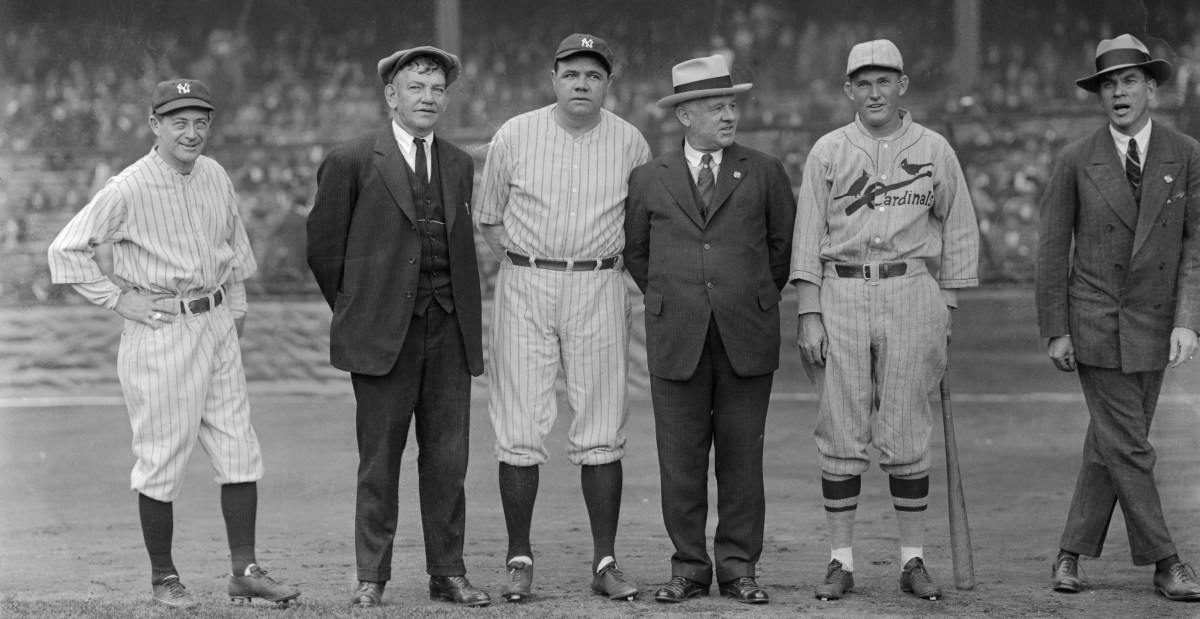
NEW YORK – OCTOBER 2, 1926. Babe Ruth of the New York Yankees and Rogers Hornsby of the St. Louis Cardinals shake hands in Yankee Stadium before the start of the World Series on October 2, 1926. (Photo by Mark Rucker/Transcendental Graphics, Getty Images) Getty Images
Imagine the second-guessing in today’s media landscape?! In that more innocent time: Ruth got up, shook the Rajah’s hand, and jogged off the field.
That was baseball in 1926.