
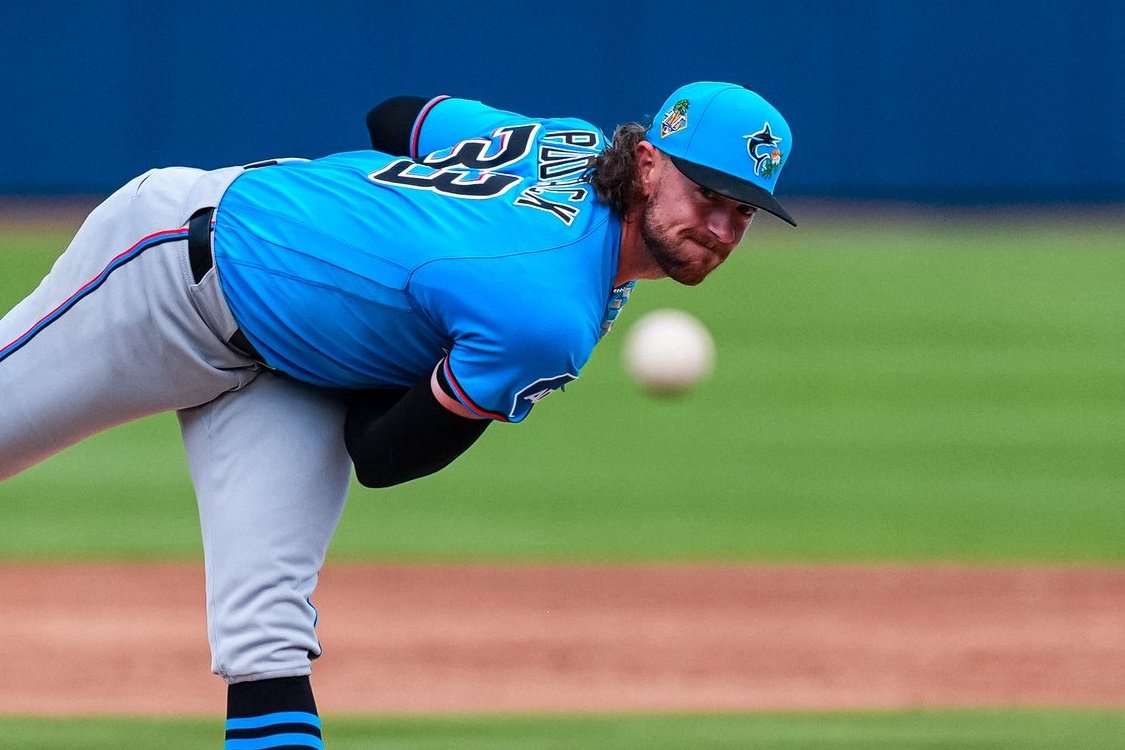
WEST PALM BEACH, Fla.—It’s hard to extrapolate spring training success to the regular season. But Chris Paddack is checking all the boxes.
Saturday was Paddack’s third start of the spring, and he continued to look as solid as one can be this early in the calendar.
The 30-year-old right-hander pitched three shutout innings, allowing just two hits and walking zero. For all of his struggles the last few years, he has consistently been one of the best in the league at limiting free passes, and he’s carried that control into Grapefruit League play this year with one walk over six innings pitched as a Miami Marlin.
“Thought he had a good heater today,” Marlins manager Clayton McCullough said. “He’s really playing well. Ability to get right up towards the top, and with the changeup that he has behind that.”
Paddack was originally drafted by the Marlins in 2015 and was traded to the San Diego Padres in 2016, making his MLB debut in 2019. After an impressive rookie season that saw him record a 3.33 ERA, he has struggled to find the same success, pitching to a 5.06 ERA in six seasons since. What will separate Paddack from his previous performances will be the effectiveness of his breaking pitches, each of which have had a negative run value from 2021-2025, according to Baseball Savant.
This spring, Paddack added a sweeper to his arsenal. He’s cautiously optimistic about its impact on his game.
“We still have some chipping away to do,” Paddack said “It’s not going to be that negative-18 (inches of horizontal break), negative-20 that you see some of these guys throw.”
Paddack throws with a naturally pronated wrist, meaning his wrist and forearm closes and internally rotates as the ball is released. This doesn’t benefit or detract from his production, but it does lend itself to making certain pitches easier or harder to throw. Four-seam fastballs and changeups, for example, are typically more effective this way. The opposite of pronation is supination, which makes it easier to throw sweepers and other pitches characterized by spin.
Paddack has been picking the brains of other pitchers that throw good spin pitches and breaking down film to look at his wrist position.
“We’re so close for it to catch,” Paddack said. “And it will be negative-12, negative-15 consistently. I would like it to be a little bit harder. It’s kind of mirroring the curveball right now.”
Last year, the Marlins deployed news training sessions for pitchers called “pitch design” where they throw a bullpen with real-time pitch data. It’s perfect for scenarios like this, where a pitcher wants to tinker with something new.
“I get feedback from guys that are on my side, not trying to take my lunch money,” Paddack said. “And if they do clip me, they’re able to walk me through, ‘Hey, this is what we saw,’ or, ‘That one was good—that one was better than the first one you threw.’”
Other notes
– The second round of cuts from Marlins big league camp consisted of right-hander Karson Milbrandt, first baseman Nathan Martorella and outfielders Dillon Lewis and Fenwick Trimble. Milbrandt, Lewis and Trimble are all Fish On First Top 30 prospects, but none have played above the Double-A level. There are now 61 players left in camp.
– Janson Junk (right ankle sprain) made his 2026 Grapefruit League debut on Saturday, striking out two and allowing zero runs in his one inning of work.
– Anthony Bender (right tibial stress reaction) and Andrew Nardi (left finger blister) are scheduled to make their first live game appearances of the spring on Tuesday.