
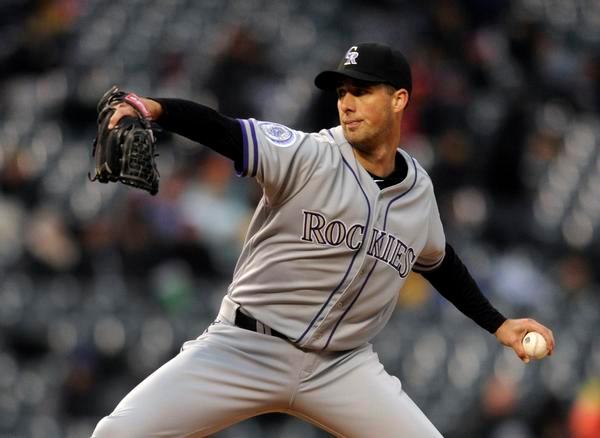
The next Rockies pitching experiment has begun.
Under Paul DePodesta, the new president of baseball operations, and with the tutelage of new pitching coach Alon Leichman, the team is adopting a different strategy.
“We want big arsenals,” Leichman said last month. “We think big arsenals will be harder to game-plan against. You know, if a guy has six, seven pitches, that’s harder to game-plan for than if a guy has two or three, right? So we think that’s an advantage.”
Why not give it a try? After all, the Rockies lost 119 games last season, and the starters posted a 6.65 ERA, the highest in baseball history since ERA became an official statistic in 1913.
It’s an intriguing idea. So intriguing, in fact, that I made a call to London, Ontario, to chat with former Rockies left-hander Jeff Francis to get his thoughts. He’s a smart, articulate guy and one of the better starters in franchise history. In eight seasons in Colorado, he was 64-62 with a 4.96 ERA. During the Rockies’ 2007 World Series season, he went 17-9 with a 4.22 ERA.
More from Mr. Francis in a moment, but first, a mini-history lesson.
The Rockies have tried all sorts of things to solve the Rubik’s Cube that is pitching at Coors Field:
• In 2002, the humidor was installed, and by all accounts, it has made baseball at altitude more manageable.
“Yes, of course, the humidor made a difference,” former Rockies pitcher Jason Jennings told me in 2022 on the 20th anniversary of the baseball storage unit that the club originally called “an environmental chamber.”
“It 100% made a difference,” Jennings continued. “For pitchers, it was about surviving.”
• In 2012, the club experimented with the so-called “piggyback pitching system.” The four-man pairing rotation — as the Rockies called it — paired starters with three “piggyback” relievers. The experiment failed.
• In 2014, Colorado wanted its pitchers to throw as many groundball-inducing sinkers as possible.
“As I always say, I’ve yet to see a groundball that can jump over the fence,” said George Frazier, the late Rockies’ TV analyst, who used a sinker as his primary pitch during a 10-year big-league career.
Now that the next chapter is upon us, what does Francis think?
“I was in Colorado last summer, and I got to watch Shohei Ohtani pitch,” Francis said of the Dodgers’ superstar two-way player. “I remember just being so blown away by how much different stuff he threw. And how hitters weren’t really seeing more than one pitch in an at-bat.
“I mean, how hard is that? Right? That’s very, very difficult. But it’s also very, very difficult to be Shohei Ohtani.”
Francis chuckled as he said that, then contemplated his own experience at Coors, where he was 34-92 with a 4.92 ERA over 97 games (91 starts).
“In my experience, it was tough for me to have three major league pitches,” said Francis, who threw a fastball, changeup and curveball before adding a slider when he became a reliever late in his career.
“So I can see both sides to the Rockies (new strategy),” he continued. “In the years when I was one of the older guys in Colorado, I saw that the young pitchers had trouble with just one pitch.
“It’s hard. And it’s hard to have seven pitches. It’s not easy. So, for me, it sounds a little bit overwhelming to have four, five, six, seven pitches, especially if you want them to be big-league level. But I completely understand the idea of wanting a lot of variety because you see it in some of the best pitchers in baseball.”
Francis also pointed out that the Rockies pitchers are not looking to throw a half-dozen “distinct” pitches, so much as they are throwing variations of their basic pitches.
“A pitcher might have different shapes for his slider, and now they have different names for that, like a sweeper or a cutter,” he said. “So one pitch becomes two or three pitches.”
But that takes time and experience.
“I’m thinking about my curveball toward the end of my career,” he recalled. “I was able to throw it in different places, at different speeds. That in itself became two or three pitches, even though I was getting a sign to throw a curveball. It was a matter of experience and feel and being able to repeat my delivery.”
Francis said that during his time in Colorado — 2004-10 and 2012-13 — he didn’t dwell on the altitude that much.
“It wasn’t a big elephant, though it was an element,” he said. “I don’t remember it being this big thing where we had to talk about it that much.”
But he thinks it might be different now, at least from the outside looking in.
“I still follow the Rockies, and it hurts me to see them struggle so much,” Francis said. “But now that I’m a fan, it seems like attitude has become a bigger elephant. But maybe just from a fan’s perspective.”
Francis, who graced the Oct 15, 2007, cover of Sports Illustrated with the headline “Out of Thin Air,” when the Rockies advanced to the World Series, is eager to see how that latest pitching exploration plays out.
“I’ll be watching, and I am curious,” he said.
Want more Rockies news? Sign up for the Rockies Insider to get all our MLB analysis.