
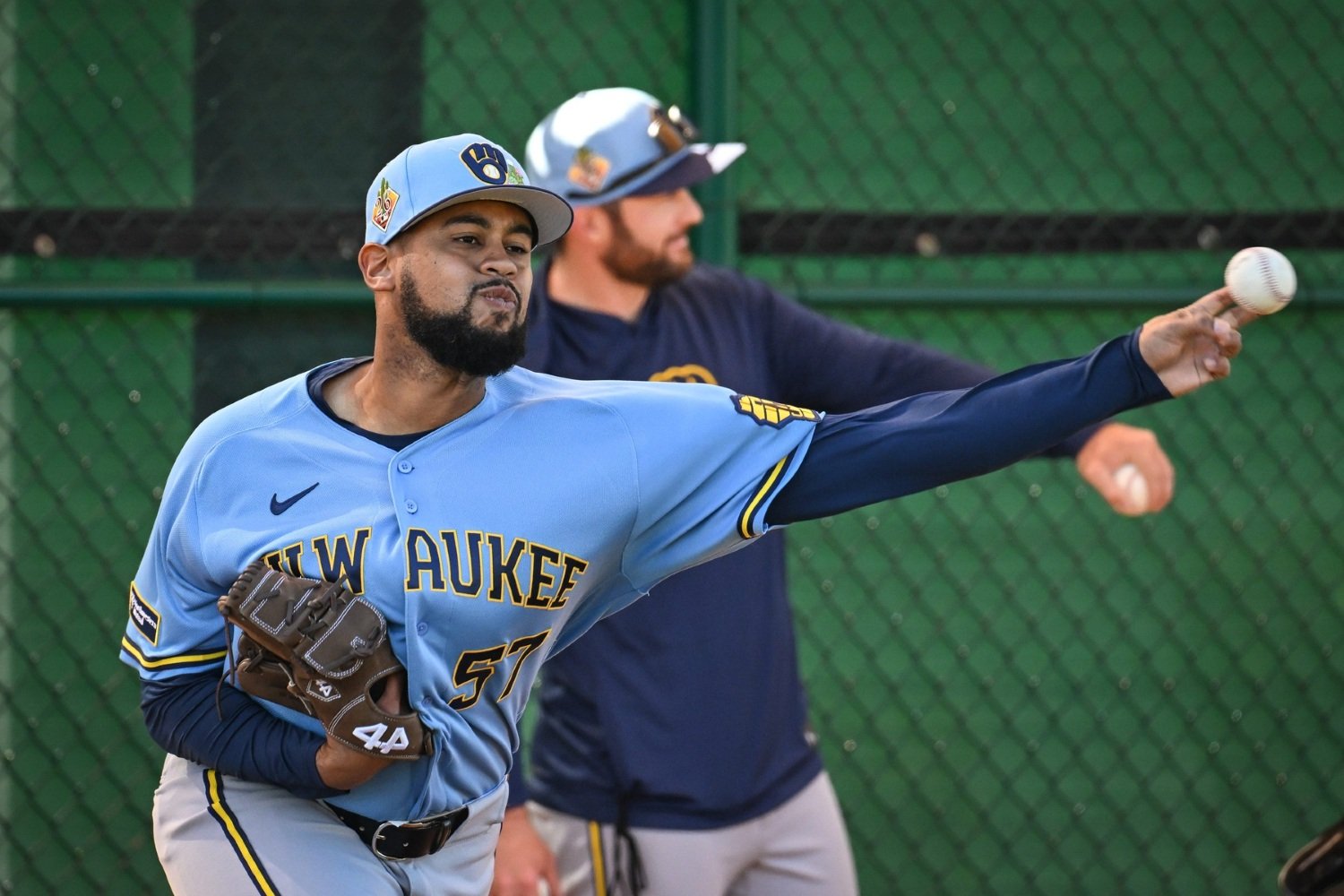
Jacob Waguespack doesn’t identify as a member of any extreme overhand pitching brotherhood, if such a thing exists. Sidearmers and submariners are famous for sticking together, but as Waguespack noted, that’s because most of them had to relearn to throw—as, for instance, Grant Anderson did during his transition to pitching, in college. By contrast, even guys who benefit from deception based on their very high arm slots usually achieve that semi-accidentally.
“There’s been a few guys in the past,” Waguespack said. “I’ve been compared to Chris Young, 1773265124 the GM of the Rangers. He was a tall guy, over the top. But it’s just something I’ve always done. It’s weird.
“I’ve just done that from a young age, man. I’ve got pictures of me in high school or even smaller, with me, you know, getting my head out of the way and my arm’s gotta come out [of that place above his torso].”
Waguespack said he’s received the feedback from multiple teams that pitching the way he does is useful, because it provides such a different look from what most pitchers in the modern game do. At 6-foot-7, he’s not quite as towering as Young was, but he does move and pitch quite a bit like Young—and even bears a passing facial resemblance to him. Because that motion came naturally to him from his youth, though, he’s never spent much time picking the brains of other pitchers like him. He focuses on using his plus-plus extension to help his fastball play up and on executing his stuff.
Over the winter, Waguespack made it his goal to improve his mobility and range of motion, especially in his hips and back. Knowing that his size works against him in his efforts to stay healthy and that he’s “lucky” to still be pitching the way he is at his age (32), he wanted to avoid using heavy weight in the gym and to maximize his flexibility. He consults with Cressey Sports Performance as a remote training guide, but his most important aides this winter were massage therapist Jay Manda and physical therapist Robbie Bolton, near his offseason home in Louisiana.
“Just more stretching, mobility, breathwork, things like that, to really open up a few more ticks of movement,” Waguespack said.
He spent time with the Rays and Phillies organizations in 2025, but injuries limited him to 25 appearances, all in the minors. To get back to the Show for the first time since 2024, he chose the Brewers—not because the path is unusually clear, but because he trusts his new team to shepherd him well and give him a fair shake when the chance arises. It’s not lost on him that the very locker he occupies this spring (in the least-trafficked corner of the clubhouse in Maryvale) belonged to Jared Koenig just two years ago. He called it “a blessing that the Brewers reached out,” and that stroke of luck made choosing his new team easier.
“When I got here, I came a week early and introduced myself to [manager Pat Murphy],” Waguespack said. “He just said they’re excited to have me, and if I can be a help to the team, then they’ll certainly use me. Wherever I may start—I’m not sure, probably start in Triple A—but I’ve got experience. It’s been a good feel. I think Murph’s a good leader. He’s been upfront and honest to us, and I like the vibe and feel of the team.”
Waguespack is the archetype of the recent Brewers reliever success story, in the vein of Anderson, Koenig, Bryan Hudson, Bryse Wilson and others. He doesn’t throw hard, but he offers unique traits and is a late bloomer, with an eagerness to succeed and a flexibility about the timeline of his contributions that the team prizes. Just across the room (though the two are hidden from one another by the large wall on which the massive TV is mounted) is another such winter pickup: lefty Sammy Peralta.
Unlike Waguespack, Peralta didn’t get to choose Milwaukee. They claimed him on waivers in late October, plucking him from the Angels organization and denying him what would have been a chance to become a minor-league free agent. Peralta, however, is not complaining.
“I got a call from [Carlos Villanueva] and a couple of the other guys here,” Peralta recalled, going back to when the team first picked him up. “They were telling me how much they were interested in me, and they’d really like to see me work on a cutter. So I pretty much worked on that all offseason, trying to develop a decent slider-slash-cutter.”
The Brewers like Peralta’s sweeper a lot, as a weapon against fellow lefties, but they emphasized to him that the cutter (or tighter slider) will be a difference-maker against right-handed batters. Peralta said the pitch immediately felt comfortable for him, and that “as long as you’re cognizant about how your body feels and how your arm feels,” the winter work involved in engineering a new or better offering is both safe and easy.
You can already see him doing it, too. Here’s what his pitch charts looked like in Triple-A Salt Lake, where he spent the bulk of 2025 for the Angels.
.png.a0904b94fd00395a8a3894ba6bb3ea26.png)
Compare that to the same data for this spring, in Brewers camp.
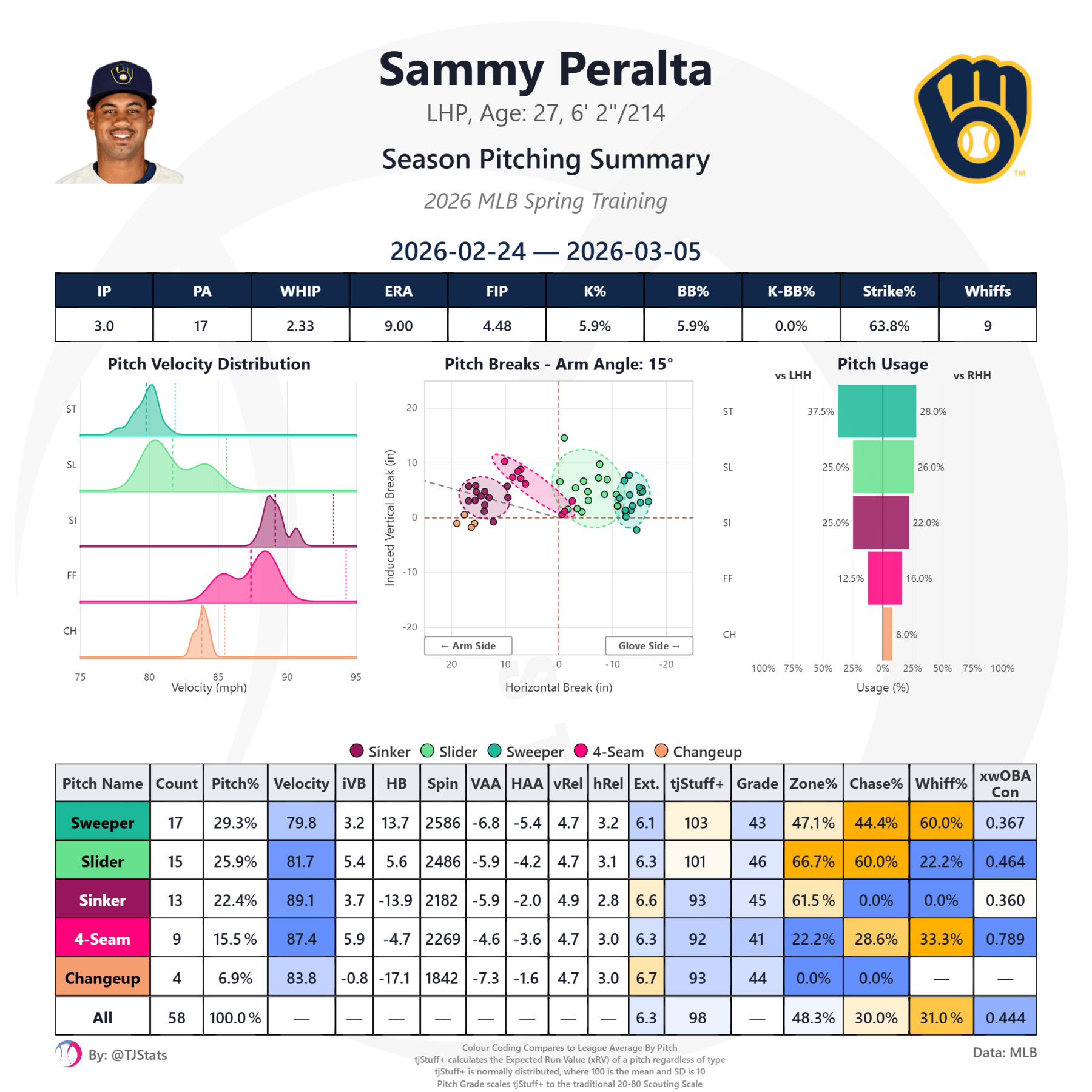
Statcast has some cleaning up and catching up to do, but in the velocity and movement distributions on his four-seamer and slider, you can see how he’s cultivated the cutter—that in-between pitch in both shape and speed that should help him neutralize right-handed batters. Righties have hammered Peralta (.302/.374/.448) during his time in the majors over the last three years, but the same was even more true of Anderson against lefties until he found his way to the Brewers last season. Peralta knows he’s in an excellent place to take a big step forward in his career, especially because his career arc is similar to what some of the other guys in the clubhouse have gone through to get this far.
Born in Queens, Peralta and his family moved to Florida when he was a child. He went to high school in Kissimee, but went undrafted after his senior year. He first attended Palm Beach State College, a junior college near home; then San Jacinto College, a community college in Houston. He ended up at the University of Tampa for one year, before being an 18th-round pick by the White Sox. The game did not let him in easily; he had to steadily knock the door down.
“It’s cool,” Peralta said of being in a place where several players’ résumés read like his. “I feel like it’s been a chip on my shoulder, and it also drives me to compete, and want to be the best version of myself I can be.
“I know a lot of these guys have been to a lot of places, and it makes me more comfortable knowing that I’m in a similar environment. Everybody here is striving to get better, and they want to be the best version of themselves, as well.”
Peralta, too, will start the season in the minors. Waguespack is in camp on a minor-league deal, but Peralta is on the 40-man roster and will have to survive some trimming as the team makes room for whoever might make the team but not be on the 40-man yet. He can still be optioned to the minors, though, so Milwaukee is unlikely to let him go for free.
Both Waguespack and Peralta are fringe arms whom other teams could have had without making major commitments this winter. Neither has even an outside chance of becoming a closer or a top-tier setup man. However, the Brewers get extra wins each year by having reliable, surprisingly effective middle relievers who seem to come out of nowhere, and these two players perfectly encapsulate the ‘how’ and the ‘why’ of that success. They might be names to file away for now, but it’s too early to forget about either. By September, one or both is likely to have come up big for the team at a moment that matters.