
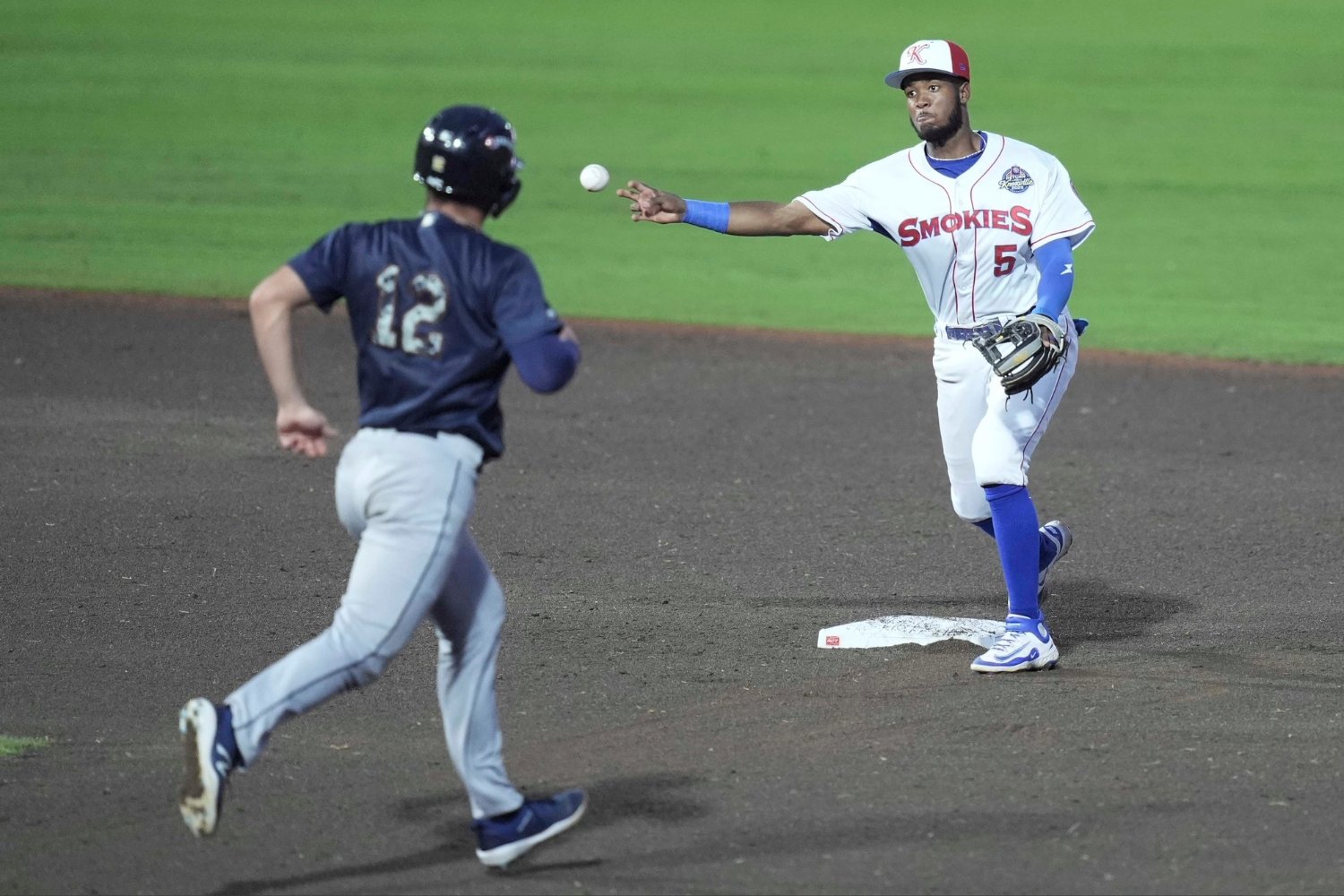
North Side Baseball’s top-20 Chicago Cubs prospects list for the 2026 season is nearing it’s conclusion. Today, we’ll be focusing on our bronze medalist, Jefferson Rojas.
Be sure to check out all of our previous installments in the series here:
#3 – Jefferson Rojas (Tennessee Smokies, Double-A)
Jefferson Rojas feels like he has always been on the precipice of a breakout without ever truly busting through the glass ceiling, and 2025 had a similar vibe. At first, it looked like perhaps we were seeing the coming out party we had all hoped for, as Rojas was an absolute monster at High-A South Bend. Over 299 plate appearances, the Cubs’ prospect slashed .278/.379/.492, which was 45% above average. This showed significant development for the 20-year-old, who somewhat struggled with an 88 wRC+ over his first 419 PA’s at the same level the year prior.
Things derailed when Rojas got to Tennessee however, which really limited the idea that he truly had broken through. Going homer-less in his first 172 plate appearances, Rojas looked a bit outmatched at Double-A. Much like his first go at High-A, these were productive struggles for a player who was younger than league average, but still, if you were hoping that the year was going to be all sunshine and rainbows, his first look at a higher level likely dampened that outlook.
What to like:
First off, Rojas has always been very young for his level of competition. Getting to High-A by age 19 and Double-A by age 20 puts him on a much quicker pace than most of his peers. Ethan Conrad, our sixth-ranked prospect, was playing at Wake Forrest at 20 years old, which is a step-below the level of competition in Double-A. Rojas has been cutting his teeth against some really quality opponents.
As a player, Rojas has shown a pretty solid ability to keep his strikeouts in check while keeping his walks up. Even struggling in Tennessee last year, the shortstop didn’t eclipse a 20% strikeout rate and maintained an 11.6% walk rate. Rojas has a pretty good approach at the plate that maximizes his contact ability without getting so aggressive that he still isn’t getting on base. So, despite his 58 wRC+ in Double-A, he maintained an OBP nearly .100 points above his batting average.
Rojas, outside of Tennessee, showed improved power last year. His 11 home runs in just under 300 PA’s was a career high at any level, and his .214 ISO was double that of his last go at High-A as well. This is great news for his future; hitting the ball with authority is never a bad thing. But it’s also good because it shows adaptability; yes, he struggled when he was 19 at High-A, but then he came back out and destroyed the level. If you’re worried about him heading into Double-A because of his poor first look, this gives you reason to believe he’ll overcome that small setback.
What to work on:
As much as I want to chalk up his struggles at Double-A to just the idea of productive struggles, a 58 wRC+ is never a good thing on it’s own. I’m willing to consider context, but for a prospect who defensively isn’t likely to stick at shortstop (which I’ll explore more later), he’s going to have to hit better than that in 2026.
Defensively, Rojas probably won’t stick long term at short. As Baseball America describes in his scouting report, Rojas has “average hands and footwork”. This probably will not be enough to allow him to stick at a premium position as he begins to fill out as an adult. While this isn’t an immediate disqualifier, it means that his bat will have to do more talking to ensure he can stick at a position like third base down the line.
The biggest knock on Rojas might be that there isn’t a standout tool in his bag. He has a good hit tool, shows the ability to hit double-digit home runs, and he’s probably going to be fine at either second or third, but there isn’t anything that wows you. Not every player needs a carrying tool, but it can be a concern that without one, he could just be a “jack-of-all-trades” type. It means that he can’t really have one aspect dip too far away from average, but so far, this hasn’t been an issue, thankfully.
What’s next:
Jefferson Rojas will go back to Double-A and look to improve on his first go at the level. There’s reason to be optimistic that last year will be of the “speed bump” variety in Tennessee. First, Rojas showed marked improvement from year one to year two at High-A and repeating that should shock no one.
More importantly, however, Rojas has been killing the baseball in spring training. While I’m not in the “spring statistics are meaningful” camp myself, I do think there’s reason to believe in this data; he’s changed his pre-pitch set up for the better. Compare below a home run he hit this spring to the video posted above. Notice that he is less upright and that his hands have more separation from his body before he launches into his swing. This seems to have loosened him up a bit and given him extra whip through the zone. He’s also made most of his hard contact against players who have sniffed MLB relevancy; for someone like Alex Bregman, that would be meaningless, but for someone who hasn’t yet seen Triple-A, we can’t ignore that fact.
A successful year for Rojas likely sees him rocket through Double-A like he did in South Bend last year and end up in Iowa. There’s little in the way of blocking him at that level on the infield, so he could continue to get reps at short even if he’s unlikely to be a solution for the big-league Cubs there. I also wouldn’t be surprised if the roller coaster experience continues; kill the level you repeat, struggle against the newest competition. Getting to Iowa by age 21`, regardless of his outcomes against Triple-A pitching, would put him on track to break through with the Cubs by his 22nd birthday, which is no small feat.
Longer term, he probably fits comfortably as a third baseman with 15 (or so) home runs in his bat while also making a good deal of contact. While not a 1:1 comparison, former Cub Zach McKinstry‘s 2025 campaign feels like a good outcome for Jefferson: a 3.2 fWAR season that was built with a 112 wRC+, 12 home runs, 9% walk rate, and a 21.7% strikeout rate.
What do you think of Jefferson Rojas? Are you optimistic about his mechanical changes? What do you think his upside is? Let us know in the comment section below!
Interested in learning more about the Chicago Cubs’ top prospects? Check out our comprehensive top prospects list that includes up-to-date stats, articles and videos about every prospect, scouting reports, and more!