
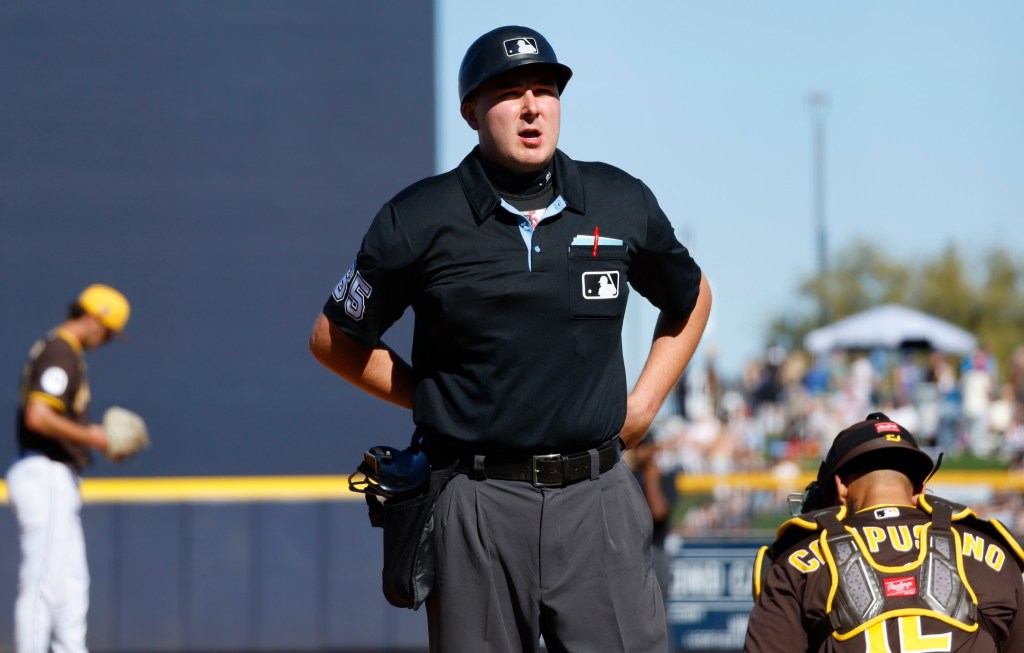
PEORIA, Ariz. — Major League Baseball first defined a strike zone in the late 1880s, when the game shifted away from a batters’ ability to call for a “high,” “low” or “fair” pitch at the start of a plate appearance. What qualified as a “fair” pitch — over the plate between the batter’s shoulders and at least one foot from the ground — morphed into over-the-plate pitches not lower than the knee and not higher than his shoulders as an official strike.
A rule-book zone has evolved from there, but anyone watching the game from anywhere on the field, dugout or even at home knew the strike zone depended on who was umpiring and sometimes even who was on the mound.
“I think the strike zone was pretty tight when you’re a rookie, and then as you got older, if you treated the umpires appropriately, they would give you a few calls here and there,” said Padres manager Craig Stammen. “ … Now they’re just judged on that box and the ABS and the strike zone, and the strike zone is much tighter than it used to be. We’ve seen videos back in the ‘90s and even videos when I first started playing. The strike zone was definitely a little bit bigger. It’s smaller now.”
That has been among the chief observations as pitchers, catchers and hitters wrap their heads around a new strike zone governed by the incoming Automated Ball-Strike System that will debut starting next week in the regular season. The dos and don’ts will be refined throughout the year, but the decision to challenge an umpire’s call begins with understanding what a strike is now.
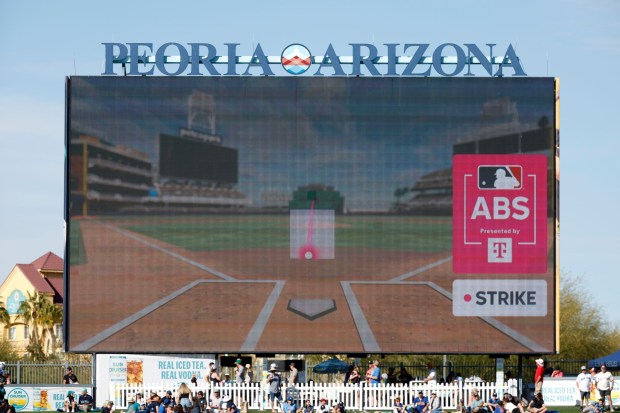 The scoreboard show the new ABS system during a protested call as the San Diego Padres played against the Seattle Mariners during a spring training game on Friday, Feb. 21, 2025. Major League Baseball is adopting the review system starting next season. (K.C. Alfred / The San Diego Union-Tribune)
The strike zone is just as wide — 17 inches — as home plate. The top-to-bottom measurement of the zone has shifted from midway between the shoulder and pants to the hollow of the kneecap to 53.5% of a batter’s measured height without cleats to 27% of a batter’s height. Determining a strike has also changed from a ball passing through any part of a 3D box over the plate to a 2D box at the middle of the plate.
“Knowing your zone is going to be crucial,” Padres second baseman Jake Cronenworth said. “I think it’s going to be even more crucial for the pitchers.”
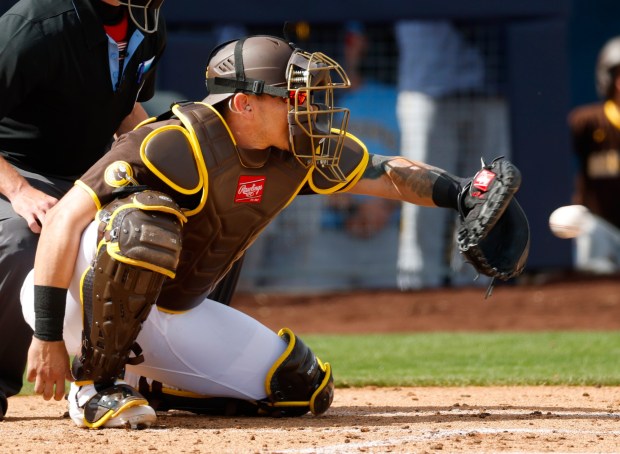 Peoria, AZ – February 23: Freddy Fermin #54 of the San Diego Padres catches a pitch during a spring training game against the Milwaukee Brewers on February 23, 2026 in Peoria, AZ. (K.C. Alfred / The San Diego Union-Tribune)
That’s why the Padres’ hitters have made a point of having their machines fire baseballs at the top and low points of their zones in the cages in Peoria. A catcher can’t possibly retain the specifics of that information for each hitter — on top of tendencies and such in scouting reports — so Freddy Fermin has developed a rule of thumb for setting targets for his pitchers.
“What I focus on,” Fermin said through interpreter Jorge Merlos, “is just where their hip is, kind of work from there, and see what the strike zone is afterwards.”
Teams can challenge ball-strike calls twice per game, though they retain the challenges if they’re correct.
The expectation is that hitters will only challenge egregious calls and in impactful situations late in games. Pitchers will likely be encouraged — if not flat out directed — to leave their decision to challenge up to the catchers sitting directly on top of the strike zone.
Michael King’s body language in his most recent start appeared to have some influence on catcher Rodolfo Duran winning two challenges on Friday.
One pitch nicked the top of the zone. The other landed easily in the upper right corner.
King agreed that the catcher is going to have the best view, especially because the top and bottom of the zone can fluctuate from, for example, the 5-foot-6 Jose Altuve to the 6-7 Aaron Judge.
“I feel more confident in and out because that hasn’t changed,” King said. “But top and bottom, when you’ve got Altuve up there and then Aaron Judge up there, it’s going to be totally different. I think it’s really hard to calibrate based on where it’s crossing for a hitter for my eyes to be able to challenge those pitches, because I’m usually throwing to the catcher and seeing where the catcher catches it.
“It’s going to be hard top to bottom, I think.”
Padres knuckleballer Matt Waldron said he hopes his specialty pitch will get more calls at the bottom of the zone when reviewed by ABS. It may be tougher for someone like Nick Pivetta to continue to get calls at the top of the zone. Pivetta gets about 20 inches of rise on his four-seam fastball.
“For me personally,” Pivetta said, “that one really kind of makes me a little more uneasy.”
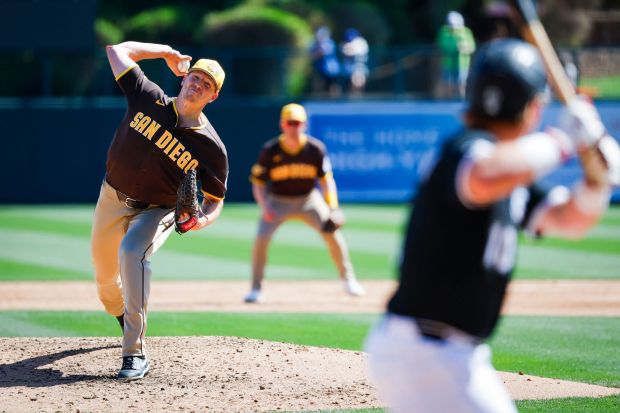 Nick Pivetta #27 of the San Diego Padres pitches against the White Sox during their spring training game at the Camelback Ranch on Tuesday, March 3, 2026 in Phoenix, Ariz. (Meg McLaughlin / The San Diego Union-Tribune)
Added pitching coach Ruben Niebla: “(Pivetta) still doesn’t understand and we don’t understand what that’s going to look like. At the end of the day, he gets a lot of great performance at the top of the zone and that’s not something we’re going to shy away from.”
The hope is that Pivetta’s four-seamer is too enticing for hitters to lay off, because there’s no more hoping that umpires can be coaxed into seeing things your way.
They either will or they won’t.
And then there’s no sweet-talking ABS.
“I was not a brown-noser, but I didn’t do anything to make (the umpire) mad,” Stammen said. “Put it that way. I just tried to treat them with respect. I felt that if I showed them respect, they gave me respect back. And my attitude, honestly, as a pitcher, was the umpire didn’t exist in my world. Whatever he called, that was the call. It was almost like ABS was back there.
“Whatever he called, that was a call, and it was my job to move on to the next pitch, and so hopefully that’s how a lot of our pitchers view it (now).”