
Want more ways to catch up on the latest in Bay Area sports? Sign up for the Section 415 email newsletter here and subscribe to the “Section 415″ podcast wherever you listen.
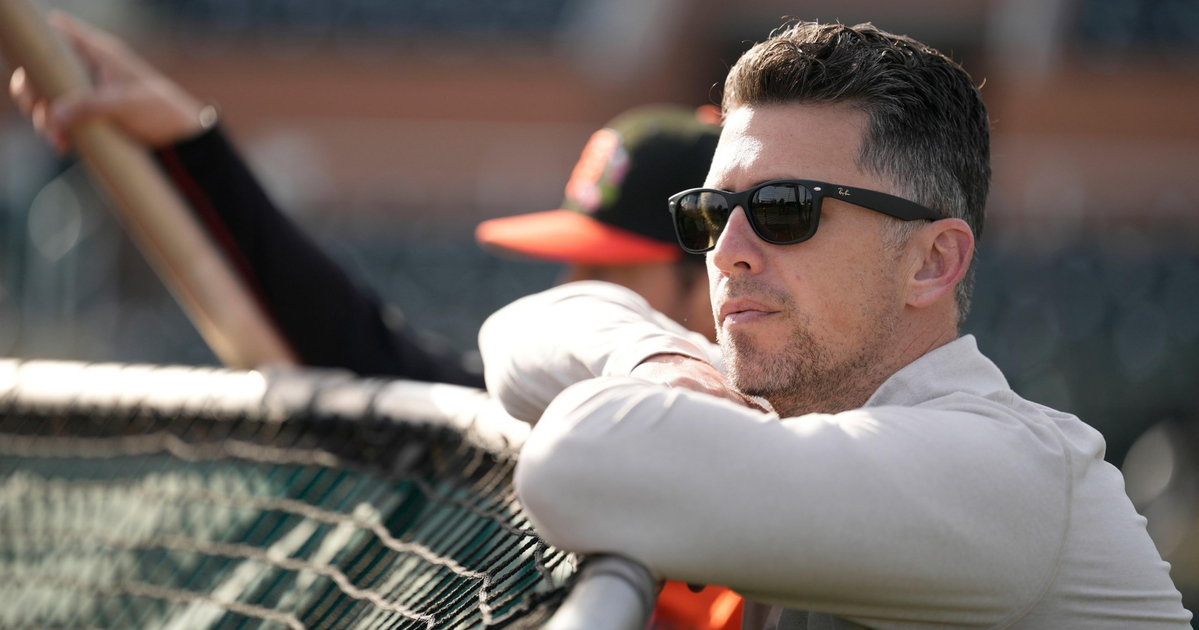
SCOTTSDALE, Ariz. — Five years after he pulled off his catcher’s gear for the final time, Buster Posey sat in the Giants’ dugout at Scottsdale Stadium and gave off a distinct vibe that he relishes his role as the president of baseball operations and the challenges and relationships that come with it.
This is where he wants to be. This is where he wants to flourish. He cares deeply about the franchise, its history, its future, and bringing it back to prominence.
So it was no surprise that one day in spring training, as he was walking across a back field at Scottsdale Stadium, he felt compelled to text his wife and express his feelings about how much he’s embracing his role as he approaches his second season at the helm.
“I told Kristen I feel really lucky to have this job because I really enjoy it,” Posey said in an interview with The Standard. “I’m excited to come to the park each day and have conversations with people that love baseball.”
Indeed, Posey, a common denominator to three World Series titles, has zero regrets about accepting the position after the 2024 season with the mission of, as he said at the time, “making more great memories for this fan base and community.”
At his introductory news conference, Posey not only stated the goal is to make the playoffs every year and compete for a championship, he also admitted he had much to learn about running an organization and still confesses he’s far from knowing it all. It’s why he relies so heavily on trusted assistants and advisers – an inner circle that has grown since last year with the additions of Bruce Bochy, Javier Lopez, and Curt Casali – and is open to input from everyone in the room before making decisions, big and small.
“One of the main things I was hopeful for, learning this role, is I wanted people to be very free flowing with their thoughts, knowing ultimately I have to make the final call,” Posey said. “That gives me the best chance to make the best decision possible.”
On that front, Posey’s progression on the job is noticeable. He’s not set in his ways. He’s open to personal growth. He’s not afraid to change his mind. That was never more evident than last summer when he exercised veteran manager Bob Melvin’s option for 2026, then pivoted three months later by firing him and eventually replacing him, stunningly, with Tony Vitello, fresh off the Tennessee campus.
To that, Posey gave a simple response: “Going through this, I’m trying to make the best decisions possible with the information that I have.”
That’s also true on the analytics side. As a player, Posey used plenty of information as a catcher to break down opposing lineups and as a hitter to study opposing pitchers. But the data back then was nothing like what his analytics team provides now.
“For me, the way it’s progressed, maybe I look a little bit more now at some of the subtleties of analytics that I didn’t look at before,” Posey said. “Something as simple as, prior to this role, I didn’t really look at a guy’s sprint speed, which we can measure. Or the really cool teaching tools that we can use that our sports science crew puts together that shows an overlay of a skeletal figure of a player you’re showing it to and another player.”
 Of the 10 MLB managers hired last offseason, Posey’s selection of Tony Vitello was the most unconventional. | Source: Ash Ponders for The Standard
Posey promoted the team’s analytics guru and devoted lieutenant, Paul Bien, to assistant general manager in December. Did the move signify how much he values analytics?
“I mean, I value analytics,” Posey said, “but I think as much as anything, it signifies how much we all value Paul.”
For example …
“I’m always asking Paul, ‘What’s actionable in the analytics?’” Posey said. “That’s what I want to push out there. Because it’s one thing to gather the information, but if you’re not doing anything with it, it really doesn’t serve a purpose. I think it leads to good discussion as well. With Paul, I’m comfortable enough with him that I can ask very direct questions and he’s not going to be offended by it.”
We asked Posey about his go-to stat, and he said, “I probably still lean a little bit more traditional as far as sum of the whole parts, the batting average, the on-base percentage, the slugging percentage. You love to see guys that do all three. Those are obviously your best players.
“Now I’m really going to sound like a front office guy: I do think that wRC+ is a pretty good tool as far as factoring in the ballpark and the conditions and giving you a little bit better picture of the type of player.”
1 day ago
5 days ago

Tuesday, Mar. 10

Weighted runs created plus measures a hitter’s total production adjusted for ballpark and era, especially relevant to the Giants considering offensive numbers at pitcher-friendly Oracle Park generally are below league average.
“But none of that stuff,” Posey added, “can measure this and this.”
He pointed to his head and heart.
Posey has built close relationships with many staffers to the point where he encourages all feedback even if it contradicts his own stance. It’s a reason he had a wall knocked out between two booths along broadcast row at Oracle Park, to form a bigger room so more execs could analyze games together.
Similarly, part of a wall was removed between two booths at Scottsdale Stadium, with only a sliding door in between, so Posey could create an all-encompassing atmosphere among staffers during spring training games.
At different times this month, Posey was in the extended quarters with general manager Zack Minasian, long-time executive Jeremy Shelley, farm directors Randy Winn and Kyle Haines, scouting chiefs Michael Holmes and Joe Salermo, and other officials.
Plus a laundry list of advisers, all of whom are specialized. Bobby Evans once ran baseball ops and has institutional knowledge. Jeff Berry is Posey’s old agent and understands contractual legalese. Lopez can chime in on the pitching side. Casali on the defensive side. John Barr has scouting expertise, previously in charge of the draft room, his very first pick being Posey. Ron Wotus has more coaching acumen than anyone in the organization, having worked under seven managers.
And, of course, Dusty Baker and Bochy, who can advise Posey and Vitello on pretty much anything as future Hall of Fame managers, the latter hired in November as special adviser to baseball operations.
“I’ve been sitting up in the box with Buster, and he’s competitive, he’s here to win, it’s who he is,” Bochy said. “He’s doing anything he can to get back to winning ways here. You’ve seen the moves he’s made already. They’re out of the box. He’s a risk taker, and you’d rather have somebody making major contributions rather than somebody who’s going to be cautious.”
From the Willy Adames contract to the Rafael Devers trade to the Melvin-to-Vitello transition, Posey has overseen significant transactions not seen around these parts since the Brian Sabean administration. This past offseason, he didn’t add any of the highest-priced free agents, but he signed accomplished veterans to fill holes, from starters Adrian Houser and Tyler Mahle to second baseman Luis Arráez and center fielder Harrison Bader.
Through it all, Posey did nothing unilaterally. Always with counsel.
“I don’t think with anything that I do, I’ll ever say all [the knowledge] is there,” Posey said. “Part of the reason I do have that many people up there is I like to hear them talk, I like to know the way they think about certain aspects of the game, the way they think about certain players. It’s all a little bit different. We all enjoy watching the game together. It’s not the type of thing where it’s my opinion so it’s greater than yours.”
Minasian said Posey strives for a front office that’s close and productive, similar to how he wants to see the players in the clubhouse.
“Buster is a natural leader,” Minasian said. “The position he played on the field, he was managing pitching staffs. There’s a lot of things that he did on the field and in the clubhouse that translates really well to running baseball operations. I think it’s been a pretty smooth progression for him.”