
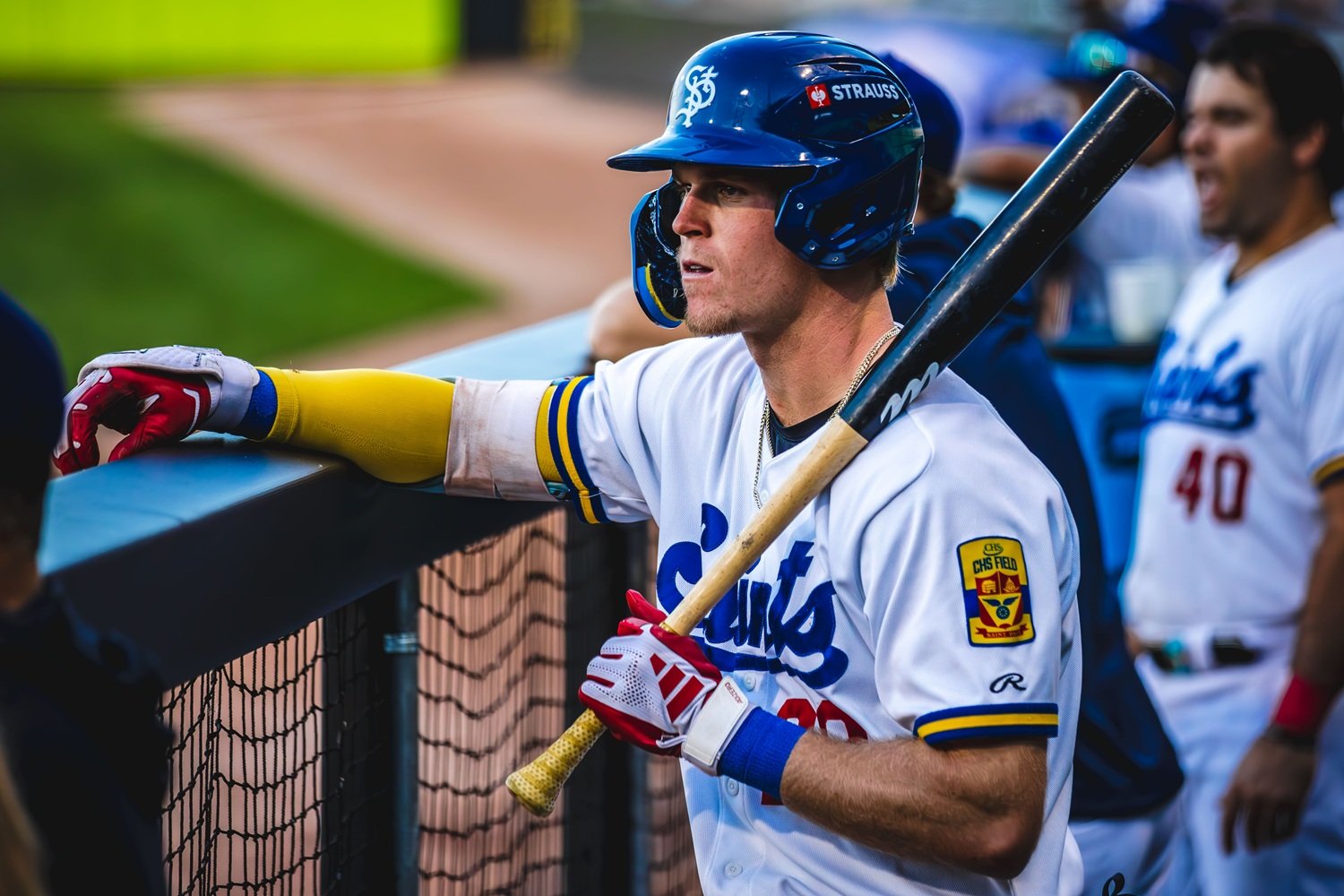
The Minnesota Twins have had plenty of highly-regarded prospects pass through their system in the last two decades. Few have carried the kind of expectations currently surrounding Walker Jenkins.
Across the industry, Jenkins is viewed as the top prospect in the Twins organization. In fact, many evaluators believe he may be the most talented prospect the team has developed since Byron Buxton was climbing the minor-league ladder as baseball’s next five-tool superstar. That’s lofty company, and it speaks to how impressive Jenkins has looked early in his professional career.
While most scouts agree on Jenkins’ overall offensive upside, one question continues to follow him as he develops: How much power will he actually hit for at the highest level? The answer depends on which evaluators you ask, and is the chief variable left in their assessments.
Understanding the Scouting Scale
Before digging into the debate, it helps to understand the grading system most prospect outlets use. Scouts typically evaluate tools using the 20-80 scouting scale. A grade of 50 represents major-league average. A 60 grade is considered plus, while a 70 or 80 grade reflects elite tools. On the other end of the spectrum, a 40 grade is below-average, and a 30 or lower suggests a major weakness.
In theory, each 10-point increment represents a standard deviation of movement. If 50 is average, 60 is one standard deviation better, so only about 17% of players should be better at a skill than a player with a 60 grade on a given tool. Fewer than 3% of players should be better than someone who scores a 70, and most scouts will only give one 80 grade in any tool over a given period of several years. By contrast, a 40 means that over 80% of regular big-league players are better than the player at that skill. Not every scout or organization interprets the scale quite that way, but that’s the gist. (This is also why you’ll often see players receive 45 or 55 grades, but rarely see them slapped with 25, 35, 65, or 75. The number of players who fall along the curve between 60 and 70 is small enough that, since these are highly uncertain, future-focused assessments, scouts are usually urged to choose one of the round numbers.)
These grades attempt to project how a player’s tools will look at their peak in the major leagues. With Jenkins, his hit tool receives virtually unanimous praise. The disagreement arises over how much power the bat will produce.
MLB Pipeline Sees Plus Power
MLB Pipeline recently updated its prospect rankings and gave Jenkins a 60 grade for power. That mark signals confidence that he could develop into a legitimate home run threat, even though Pipeline uses the scale a bit more generously than the description above, anyway. The outlet even went as far as naming Jenkins the top power prospect in the Twins system.
They wrote that Jenkins uses a smooth, repeatable left-handed swing that allows him to consistently find the barrel. His approach produces hard contact while also generating walks and limiting strikeouts. According to their evaluation, his power began to show more frequently during the 2025 season. Much of that power currently shows up to the pull side, though the report notes he can also drive the ball the other way for extra bases.
In that view, Jenkins profiles as the type of hitter who could combine a strong batting average with above-average home run production. If that projection holds true, it would give the Twins a middle-of-the-order cornerstone.
FanGraphs Takes a More Cautious View
The evaluators at FanGraphs are more conservative in their projections. Their scouting report assigns Jenkins a current raw power grade of 45, with a future projection of 55. When projecting how that power will translate into games, they are even more cautious. Jenkins receives a current game power grade of 40, with a future grade of 50.
In other words, FanGraphs sees Jenkins eventually reaching roughly average game power at the major-league level, rather than the clear plus power projected elsewhere. Their report notes that Jenkins is physically strong and well built, but lacks the overwhelming physical tools often associated with superstar-level power hitters. His bat speed is described as slightly above average, and the underlying power metrics from 2025 were more modest.
The report points to a maximum exit velocity of 110 mph, which is roughly the major-league average. More importantly, many of his balls in play fell far below that mark. His hard-hit rate, around 35%, suggests a solid but not overwhelming impact. From this perspective, Jenkins might be more of a high-contact hitter who occasionally runs into home runs, rather than a consistent 30-homer threat. Based on last year’s league-wide home run rate and isolated power, a version of Jenkins that hits .270 in the majors (a strong projection in a league that bats around .245) would slug about .430 and hit 19 home runs in a full season of playing time.
Why the Evaluations Differ
The disagreement between these outlets highlights the challenge of projecting power for young hitters. Jenkins’s swing naturally invites comparisons to another former Twins star, Joe Mauer. Like Mauer, Jenkins owns a smooth left-handed stroke built around barrel control and the use of the entire field. That style often produces plenty of doubles and strong on-base numbers.
Mauer occasionally flashed home run power during his career, but his game was built more around line drives and gap-to-gap contact, rather than towering pull-side home runs. Some scouts believe Jenkins could follow a similar offensive path.
However, there are also reasons to believe more power could develop. Jenkins is still physically maturing and has already shown an ability to drive the ball harder as he gains experience. Many young hitters also learn to selectively hunt pitches they can pull in the air as they climb the ladder. That developmental adjustment can significantly increase home run totals.
Furthermore, the league is forcing players to hunt power that way. A rising baseline for athleticism (especially in the corner outfield spots) and better outfield positioning have made it impossible to even rack up doubles the way Mauer did for so much of his career. Had Mauer come along when Jenkins did, he would have developed differently. If Jenkins turns out to be a comparably talented and intelligent hitter (admittedly, a big ‘if’), he’s likely to focus more on power and less on batting average.
Both the power and the hit tool are also difficult to evaluate, because hitting is such a reactive craft. Famously, former top Orioles catching prospect Matt Wieters was hailed as a switch-hitting “Mauer with Power,” but he never got near that level. He didn’t have Mauer’s preternatural combination of feel for contact and plate discipline, and while he did flash considerably more raw power, he was never a Mauer-caliber overall offensive force—let alone something more. Teams can much better evaluate players at similar stages now, using neuroscouting tools and bat-tracking data, but there’s still an alchemy involved that can only be experienced, rather than explained. Some hitters are more than the sum of their parts; some are less.
The Next Test at Triple-A
Ultimately, the debate about Jenkins’s power will be settled on the field. The next stage of his development could provide an important clue. Jenkins is scheduled to begin the season at Triple-A, in the hitter-friendly environments of the International League. That level often boosts offensive numbers and allows evaluators to see how a prospect’s raw tools translate against advanced pitching.
If Jenkins begins consistently lifting balls to his pull side and clearing the fence more often, the more optimistic power projections could start to look accurate. If his production leans more toward doubles and line drives, the comparison to Mauer’s offensive style might prove closer to the truth.
Regardless of which projection proves correct, Jenkins’s advanced hit tool already provides a strong foundation for his future. The lingering question is whether his power will settle at solid, average production or evolve into an asset anchoring the middle of the Twins lineup for years to come.
Whose evaluation do you agree with the most? Can Jenkins be an above-average power hitter? Leave a comment and start the discussion.
Interested in learning more about the Minnesota Twins’ top prospects? Check out our comprehensive top prospects list that includes up-to-date stats, articles and videos about every prospect, scouting reports, and more!