
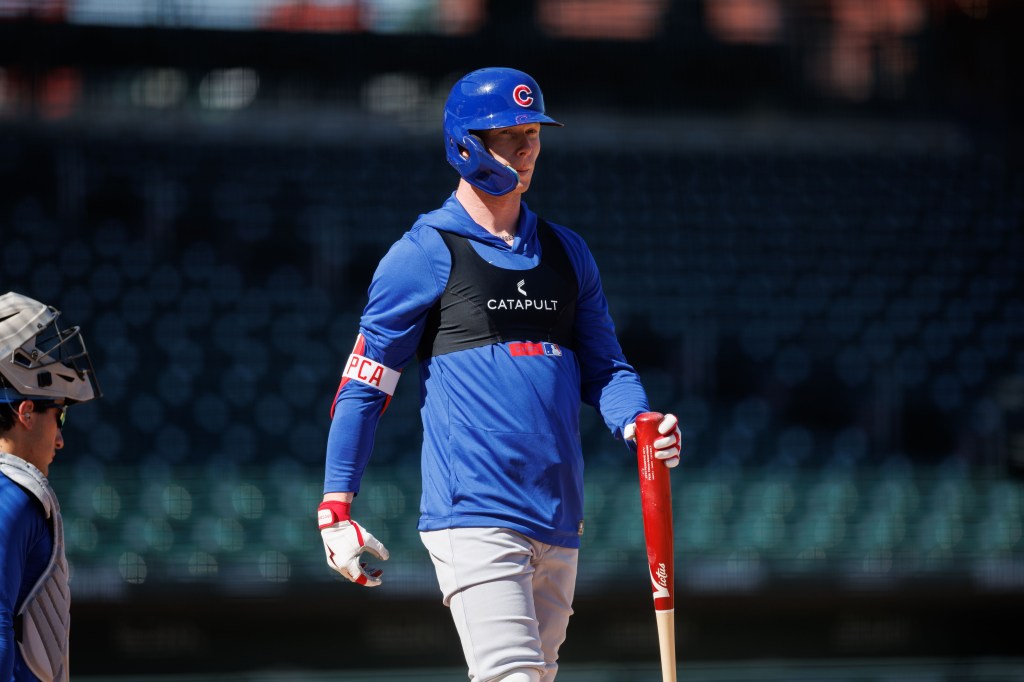
MESA, Ariz. — Jameson Taillon’s calf injury presented a problem.
For seven weeks last season Taillon rehabbed his calf. By the time he could return to the Chicago Cubs rotation, late August approached. Taillon had been limited by what he was able to do with his lower half because of his ailing calf, but he wanted to find a way to keep his right shoulder in shape and built up. Months earlier, during spring training, Taillon started wearing Catapult technology for the first time in his career.
Catapult tracks everything from the number and intensity of throws, trunk speed and input and output of effort. The device is inserted into a thin sports bra-like vest that can be worn over or under workout gear.
For Taillon, the Cubs were able to use the tech to build a workload program while he recovered from his calf injury centered on measuring the effort and intensity of his throws. Even though Taillon was throwing off one knee, his arm avoided becoming deconditioned because he could make 80 throws every day at a specific intensity level until his calf was healthy enough to allow him to resume pitching.
Taillon was at his best following the injury, finishing strong with a 1.57 ERA in a six-start stretch that carried into the postseason in which he took the ball in two pivotal elimination games with the Cubs winning both. He credits the biometric technology for helping him get back to that level.
“Obviously you don’t want to get hurt, but I really found a ton of value in keeping my workload up, that way I didn’t have to do a whole ramp-up again, I actually got to work on things and focus on things because I wasn’t just out there building back up,” Taillon told the Tribune. “I’m careful to give teams too much credit in this stuff, but my career has been helped tremendously. And it could just be a here thing, I have to be careful because we’re so good and our coaching staff is so good that I’ve found so much benefit.”
The evolution of biometric data and tools has evolved dramatically in the last three to five years. The advancements are wide-ranging: wearable tech (Catapult, Oura rings, Whoop bands), Edgertronic’s slow-motion cameras capturing pitchers’ grips, TrackMan that records pitch speed and movement, KinaTrax’s markerless motion capture measuring biomechanical movements and force plates that show how players generate and transfer power.
“Wearables were always taboo, it was always a lack of trust — how are we going to use the data?” president of baseball operations Jed Hoyer said. “I’m really happy as an organization we’ve overcome that, our number of guys doing it are great and I think it’s going to help guys peak at the right time. It’s going to help monitor fatigue, and I think it’s going to keep guys out there.
“The most important thing is building trust as an organization, that the players understand that you’re using this data to make them better and make them healthier, and I think we’ve gotten to that point.”
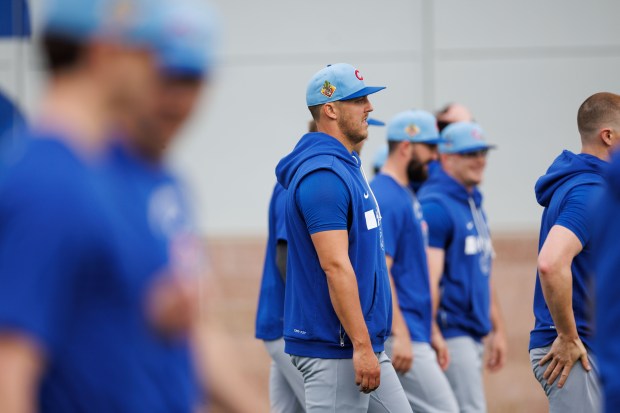 Jameson Taillon warms up with other Cubs pitchers during the first day of full-squad workout at spring training on Feb. 16, 2026, at Sloan Park in Mesa, Ariz. (Armando L. Sanchez/Chicago Tribune)
Most major-league organizations have access to all the biometric technology, but a willingness to invest in that area and, perhaps most importantly, understanding and properly interpreting what the data and information shows and how to apply it is quickly becoming a separator among teams.
Getting buy-in from players is the first step. The Cubs started utilizing Catapult in 2023 spring training, then saw heavy usage in 2024. By last spring, all but two of the 30 pitchers in big-league camp were wearing Catapult.
“You’re being judged all the time, which when you sign a contract you’re a little more comfortable being judged because it means they’re trying to help you, when you’re a young player, it’s a tricky thing,” Taillon said. “Do I wear the Oura ring and share my data with the team, or if I have a few beers, are they going to know? That sort of stuff. They’re gathering so much information, which is cool, but there was a time where even spring training results didn’t matter.
“I feel like I’ve gotten a lot of positive use out of it. And so when young players ask me, should I be giving my data? I’m like, if you think you can get helped by it.”
There are varying levels to how much players want to know and incorporate in their day-to-day routine.
Some, such as left-hander Shota Imanaga and right-hander Cade Horton, like having access to that information to supplement how they’re physically feeling. Imanaga didn’t have Catapult when he pitched in Japan but had other similar biometric tools. Part of the Imanaga and Cubs offseason process to get him back to the version pre-hamstring injury was using force plates in the mound to measure his lower-body strength.
Photos: What to eat at Chicago Cubs games this season at Wrigley Field
Pitching coach Tommy Hottovy has been intrigued by biomechanics for years, dating to when he pitched professionally. After he came back from Tommy John surgery in 2008, his velocity was down, prompting Hottovy to watch hours of video to try to figure out what was wrong. He dropped his arm slot and saw an uptick in his velocity. He didn’t know why at the time, but his body’s natural biomechanics helped him create more ground force and rotational speed by lowering his arm slot.
These advancements in technology now provide more real-time feedback that don’t require being in a pitch lab for the data collection.
“The biomech is a little bit more difficult because it’s definitely a lot more scientific,” Hottovy told the Tribune. “It takes a level of understanding with the biomechanics of how a body moves, how a body is naturally put together, how players are different and then how to find ways to impact or influence these movement patterns. We were all taught growing up data doesn’t lie, data either verifies what you have thought or disproves it.
“And I think that’s the fun part for me with data is it’s helped us understand, OK, here are the things and cues that might have worked in the past, and here’s the things that we know aren’t true anymore.”
On the pitching side in particular, Catapult has helped revolutionize health and recovery.
 Cubs pitching coach Tommy Hottovy, right, talks with catcher Reese McGuire and reliever Porter Hodge at the end of a team workout on Oct. 7, 2025, at Wrigley Field. (Chris Sweda/Chicago Tribune)
Hottovy remembers two years ago when Justin Steele suffered a hamstring injury and ultimately missed five weeks at the start of the season, the Cubs were able to build a throwing program based on the Catapult data that best mimicked Steele pitching. Steele’s hamstring didn’t bother him when throwing from 75 feet, so the Cubs treated heavy catch play days in the form of up-downs to simulate making a start. This allowed Steele to get the volume he needed to maintain arm strength.
“I was lucky to have great coaches coming up through my time in the minor leagues, but a lot of them would still say, I see this so we’re going to do this — you just had to trust them and sometimes they were right, but sometimes they were really wrong,” Hottovy said. “Now you a lot of that trust has come from the data being the data. There’s no argument. Like, you can say you felt something, but this is what you did. So I think players have gotten to the point where we’re all tech savvy.”
One of Catapult’s biggest myth-busters is that a player should maintain the same daily routine. However, biometric data shows that medium-intensity workout days are the worst kind for players because they’re not pushing output, which leads to gains, and their body also never fully recovers.
Taillon, for example, discovered last season that he often was throwing in the medium-intensity range between starts. This year he’s tweaking that approach, which Taillon acknowledged might feel challenging given how he has honed his routine over the last nine years. The Cubs are encouraging Taillon to really push his intensity level on his bullpen days but then hardly throw the following day, instead focusing on just moving around and being athletic.
Horton finds the biometric space to be very intriguing. When he first got into pro ball, he would play catch hard all the time because that’s what Horton thought guys did. Last year was the first time he really started using Catapult daily. Horton felt there was a noticeable difference in his recovery once he kept to light throwing days after starts while increasing his intensity on heavier workload days between starts.
Photos: Chicago Cubs on photo day at spring training
“Baseball for the longest time was like you’ve got to have a routine, the same thing every day,” Hottovy said. “Marathon runners don’t run marathons every day to train, sprinters don’t run sprints every day to train for the Olympics. You have to be able to regulate that workload, give your body the proper amount of rest, but also to continue to push maximum output.”
Although the biometric advancements started on the pitching side, there are tangible benefits for hitters too. The Cubs were one of the first major-league teams to get KinaTrax, so their research and development team has been at the forefront of processing the data and figuring out what is and is not important. Most MLB teams have KinaTrax at their home ballparks, allowing the Cubs to pull that data when they’re on the road. All of the Cubs minor-league affiliates also have KinaTrax at their stadiums.
“We’ve built this blueprint for all of our players over the past couple years, and every metric is different for each guy,” hitting coach Dustin Kelly told the Tribune. “It doesn’t mean because one metric is a little bit different than another player’s that it’s bad, but at least we have a reference of when they’re at their best, this is what some of the metrics and some of the angles look like. I can go back and look at guys from like 2019 and 2018, when they felt like their swing was their best, and match it up with what it looks like today and find some minor little differences.”
Over the course of the eight-month season, hitters naturally start to change what they’re doing without even realizing whether it’s timing, a small movement or even a full mechanical change to their swing or stance. Kelly and his assistant hitting coaches John Mallee and Juan Cabreja can better monitor those adjustments through technology such as KinaTrax.
The goal is to get ahead of a hitter’s struggles.
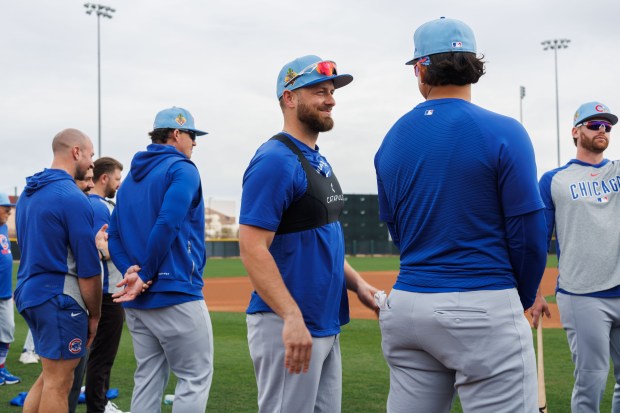 Michael Busch, left, smiles at Miguel Amaya before warming up during Cubs spring training at Sloan Park on Feb. 16, 2026, in Mesa, Ariz. (Armando L. Sanchez/Chicago Tribune)
“We’re just trying to catch maybe some of those dips a little bit earlier and put some information in front of them that might spark the brain a little bit like, yeah, I do feel that and it actually looks like that,” Kelly said. “We can see all the setup angles. We can see all of the joints, and a lot of it just comes out looking like a stick figure. And I can just match those stick figures up and see where the breakdown is happening before even starting the swing.”
Ian Happ, entering his 10th season with the Cubs, has seen the organization’s evolution in the biometric space firsthand. He finds KinaTrax to be a helpful checkpoint over the course of the season to make sure neither of his swings is horribly out of whack. The switch hitter still thinks it’s valuable to trust one’s eyes and feel and melding it all together.
Catapult has been helpful in understanding when might be the ideal time for an everyday player such as Happ to get his weightlifting in versus giving himself a day to largely stay off his feet.
“They all go together to form a bigger picture, so kind of zeroing in on what makes me good from the other side of the plate, and we’ve learned a lot about total volume for outfielders, just how much you’re on your feet, how much total distance you’re covering,” Happ explained. “Having an understanding of especially this time of year, it’s spring training, how to do some higher speeds and velocities when you’re not getting in the game, versus kind of total time on your feet.”
Nico Hoerner was first exposed to Catapult 10 years ago at Stanford, where multiple sports teams utilized it. Hoerner doesn’t want to be thinking about mechanical elements of his swing when he steps into the batter’s box, such as his stride length or distance from the plate even when he’s getting work in the cage. But having people on the Cubs staff whom he trusts to communicate when those things start to change unknown to the naked eye plays a big role in being consistent over a 162-game season.
“There’s often some overthinking and paralysis that comes out of trying to be perfect in every single way,” Hoerner told the Tribune. “That’s where the staff is incredibly important, whether it’s a nutritionist or a strength coach or a hitting coach, people that can look at large amounts of information and pick out a couple things that are really important to you.
“Those tools are often only as valuable as the way that you process them. … There is no perfect way to train to be a major-leaguer.”
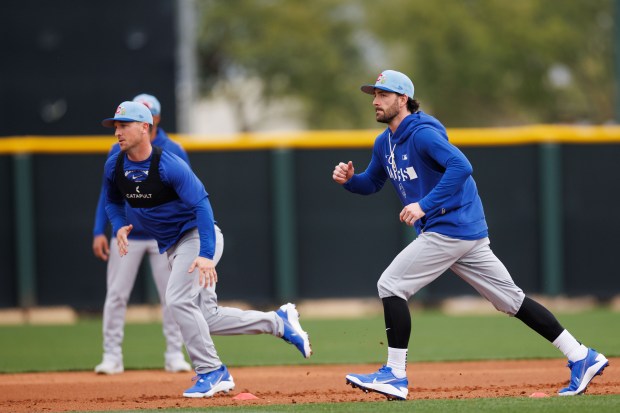 Alex Bregman, left, and Dansby Swanson run drills during a Cubs spring training workout at Sloan Park on Feb. 16, 2026, in Mesa, Ariz. (Armando L. Sanchez/Chicago Tribune)
As much as wearable tech can help players, some take a more cautious approach to giving teams access to their biometric data. Veteran shortstop Dansby Swanson has never worn the Catapult vests, one of only a few Cubs who don’t, and he doesn’t envision ever using it. Swanson takes pride in being available to play every day, no matter how he feels. He’s wary of how the biometric information might be used.
“I never want to give the team a reason to ever say my workload is so high and I shouldn’t play a game, it shouldn’t matter whether I’m tired, it doesn’t matter, that’s life,” Swanson told the Tribune. “I just have never been a huge believer in anyone having personal health data. I base everything off of my own feel and decisions that I make for myself. There’s more conviction in what I do when I go off of what it is that I feel that I need to be doing, not what something may or may not be telling me to do.
“But it obviously works for some guys too. Some guys are able to monitor all the different things they’re doing and how to better help serve them so they can play. … It’s interesting, I came up in the time where if they ever ask you for anything, don’t give it to them.”
Multiple players told the Tribune that if they were in another organization they might feel more uncertain by how the team was using the biometric information and less inclined to use wearable tech. Trust is an important part of this, and the Cubs seemingly have created a level of comfort for players to opt into sharing biometric data.
“I’m trying to use this to my advantage already, and then couple it with the Cubs, they want to use it to my advantage and it’s a really nice combination,” Taillon said. “I do think in the past, like, if I were fighting to make this roster, I would probably view it a little differently.”
Teams are always looking for that next edge, so what could be the next evolution in biometric technology?
Hottovy and Kelly both believe the baseball industry hasn’t fully dug into is eye-tracking and brain-processing, making that the next frontier.
“It’s really hard to do, it’s hard to get it in game, like, how are we really figuring out what these guys’ eyes and brain are doing and processing pitch data and location?” Kelly said. “It’s really hard to get that information.”
With how players have embraced their physical biometric data, Hoyer envisions tremendous leaps in this space in the coming years.
“Because now there’s that buy-in, people want their data, it’s something they seek,” Hoyer said. “You see it in the winter when you’re doing zooms with prospective agents and stuff, players are so eager to talk about how you can help them. And that is a real shift in the last five years.”
One of the biggest battles in a player’s career is fighting the aging curve. A better understanding of one’s biometrics and how to make better tweaks to stay healthy and effective could lead to more longevity, potentially another edge for any organizations able to harness that to prolong careers.
“For someone my age, if you’re not monitoring your workload and your intensity and your force plate jumps in the weight room, you’re just going to fall behind,” Taillon, 34, said. “I can’t get a job if I’m throwing 86 miles an hour because I’ve had a good back of the baseball card before.
You need to keep pushing every day, and I think all the technology helps, even little things.”