
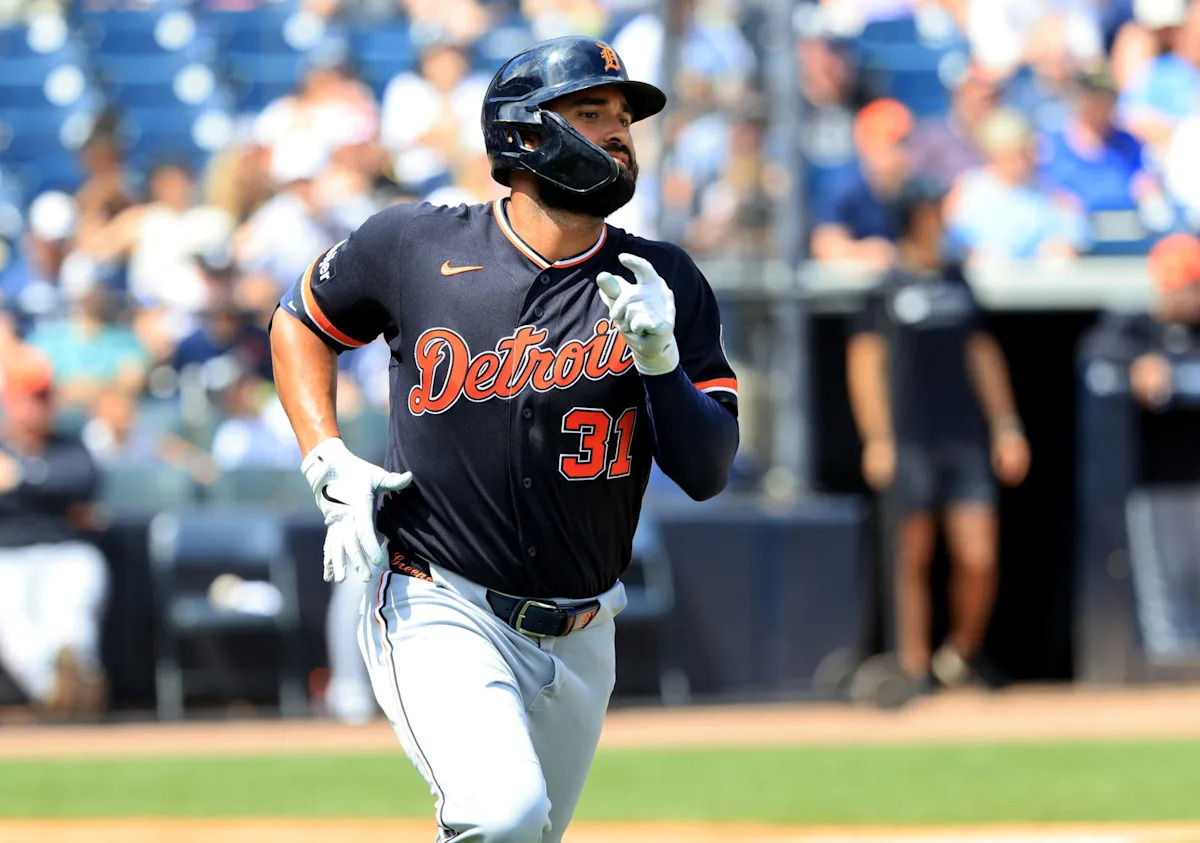
The Tigers enter 2026 with World Series aspirations and one burning question that has dominated every corner of spring training: does Kevin McGonigle break camp with the big club? After three weeks of Grapefruit League games, it shapes to be the case.
So, if you look at the final Grapefruit League stats over the last two weeks, (.174/.387 .435/ OPS of .822, Kevin McGonigle, the 21-year-old shortstop ranked No. 2 on MLB Pipeline’s overall prospect list, still has an impressive OPS, with 8 walks to 4 strikeouts with two home runs including a 460-foot blast off Luis Severino, and a highlight reel of defensive gems, the kid from Drexel Hill, Pennsylvania, has left the Tigers with no reasonable argument to send him down. A.J. Hinch said in the spring training finale on Saturday that his abilities to make adjustments quickly and to play up to three positions gives him that much more appeal outside of his appoarch at the plate.
Advertisement
He wasn’t assigned to the Spring Breakout roster on March 18, which every beat writer interpreted as the clearest signal yet. The only real debate is whether the Tigers hold him back 15 days for service-time manipulation, but with Tarik Skubal potentially walking after this season, the urgency to win now should override that math.
McGonigle’s presence triggers a domino effect. Javier Báez shifts to center field and a lot has been made of Parker Meadow’s stat line, but as I have indicated before, his defensive value carries a lot of weight. But he was 7-for-23 (.304/.385/.391) over the last two weeks so after a slow start, along with Matt Vierling’s strong spring, the Tigers outfield depth is solid.
Catchers (2): Dillon Dingler, Jake Rogers. Dingler is the clear starter after taking over behind the plate in 2025. Rogers took a scary hit in the cage that put him in concussion protocol, but he caught a bullpen session March 21 and should be cleared by Thursday
Dingler looks to build on a solid first full season as the team’s catcher. Dan Petry on the broadcast last week said that after he spoke to Lance Parrish, the Tigers’s catcher who wore the number 13, like Dingler, thinks Dingler can hit for more power this season and put up better offensive numbers.
Advertisement
Infield (6): Spencer Torkelson (1B), Gleyber Torres (2B), Kevin McGonigle (SS), Colt Keith(3B), Javier Báez (UTIL), Zach McKinstry (UTIL). Keith has earned the shot for third base, but McGonigle, McKinstry, and even Vierling’s ability to play third, the pressure does not seem as intense.
Outfield/DH (5): Riley Greene (LF), Matt Vierling (RF), Kerry Carpenter (DH), Parker Meadows (OF), Jahmai Jones (OF). Jones is the lefty slayer but hit righties for average but defensively, he is limited, which helps having Vierling back, who can also spell Carpenter in right.
Starting rotation (5): Tarik Skubal, Framber Valdez, Jack Flaherty, Justin Verlander, Casey Mize. A.J. Hinch locked in the order on March 20. Skubal chases an unprecedented third consecutive Cy Young. Valdez has been dominant in camp (0.75 ERA, 12 K in 12 innings) and immediately slots as a co-ace. Verlander’s homecoming adds postseason pedigree and a massive clubhouse presence. The concern is Mize, whose spring struggles are real, but with Reese Olson done for the year after labrum surgery and Troy Melton on the 60-day IL with elbow inflammation, there’s no better internal option right now.
Advertisement
Toledo’s rotation will be headlined by the likes of Ty Madden and Keider Montero, who will probably see sometime in Detroit. Every team will need to go 9 or even 10 deep this season and it will be up to the Tigers pitching depth to answer the bell. Could another arm rise up from the minors this season like Melton? Could be lefty Andrew Sears, who was hidden away in the backfields in Lakeland but had a strond debut in Erie last season.
Bullpen (8): Kenley Jansen, Kyle Finnegan, Will Vest, Tyler Holton, Drew Anderson, Brant Hurter, Brenan Hanifee, Enmanuel De Jesus.This is a historically deep relief corps. Jansen, Finnegan, and Vest each recorded 20-plus saves in 2025, the first time since saves became official in 1969 that one team has rostered three such pitchers. Hinch hasn’t named a closer, and frankly, with this trio he doesn’t need to. De Jesus forced his way onto the 40-man roster with a filthy five-inning, eight-strikeout World Baseball Classic outing for Venezuela and provides crucial lefty swingman depth while Melton recovers.
Riley Greene and Spencer Torkelson all took a step forward last season. This reporter believes Greene can have a top 3 MVP in the AL season. Does that sound crazy? Yes, but, here is my logic.
Advertisement
Riley Greene has the makings of a legitimate AL MVP candidate in 2026, though the case comes with an important asterisk. His exit velocity, hard-hit rate, and raw power are all plus tools, and at just 25 he’s squarely in the window where elite hitters typically take their biggest leap. The discipline and contact ,concerns, namely last year’s strikeout rate ,are real and will fuel the skeptics, and fairly so.
But here’s where the ABS argument gets interesting: the strike zone top is now locked at 53.5% of each player’s height enforced with Hawk-Eye precision rather than an umpire’s inconsistent eye. Historically, the top of the zone has been baseball’s most poorly and inconsistently called region, high fastballs that legitimately caught the upper edge were swallowed as balls constantly, and hitters who chase up in the zone got punished for it.
If Greene’s strikeout issues are at least partially tied to expanding at the top, chasing pitches that were borderline and getting rung up, the ABS creates a strategic reset. Pitchers can no longer rely on that fuzzy upper boundary, and Greene, armed with elite bat speed, can potentially be more selective without sacrificing aggression. It’s a bet on upside and circumstance more than a sure thing, but the tools are real and the timing of ABS may be no coincidence.
Beyond Riley Greene, the broader story of this Tigers team may be the most compelling organizational narrative in baseball heading into 2026. Health and another year of development for this homegrown core could be the final ingredient. Detroit has a legitimate shot at fielding a lineup of nine players all drafted and developed within the organization, something that has never been done in the modern era since the MLB Draft began in 1965.
Advertisement
The closest historical parallel is the 1968 World Series champion Tigers, a club famously built around players who came up through Detroit’s farm system together, though that predated the draft entirely, meaning those players were scouted and signed freely rather than selected through a structured process. What this current group is chasing is something without true precedent. If the health holds and the young core takes the next step, this Tigers team won’t just be competing for a pennant they’ll be making history simply by taking the field together.
Follow me on “X” @rogcastbaseball