
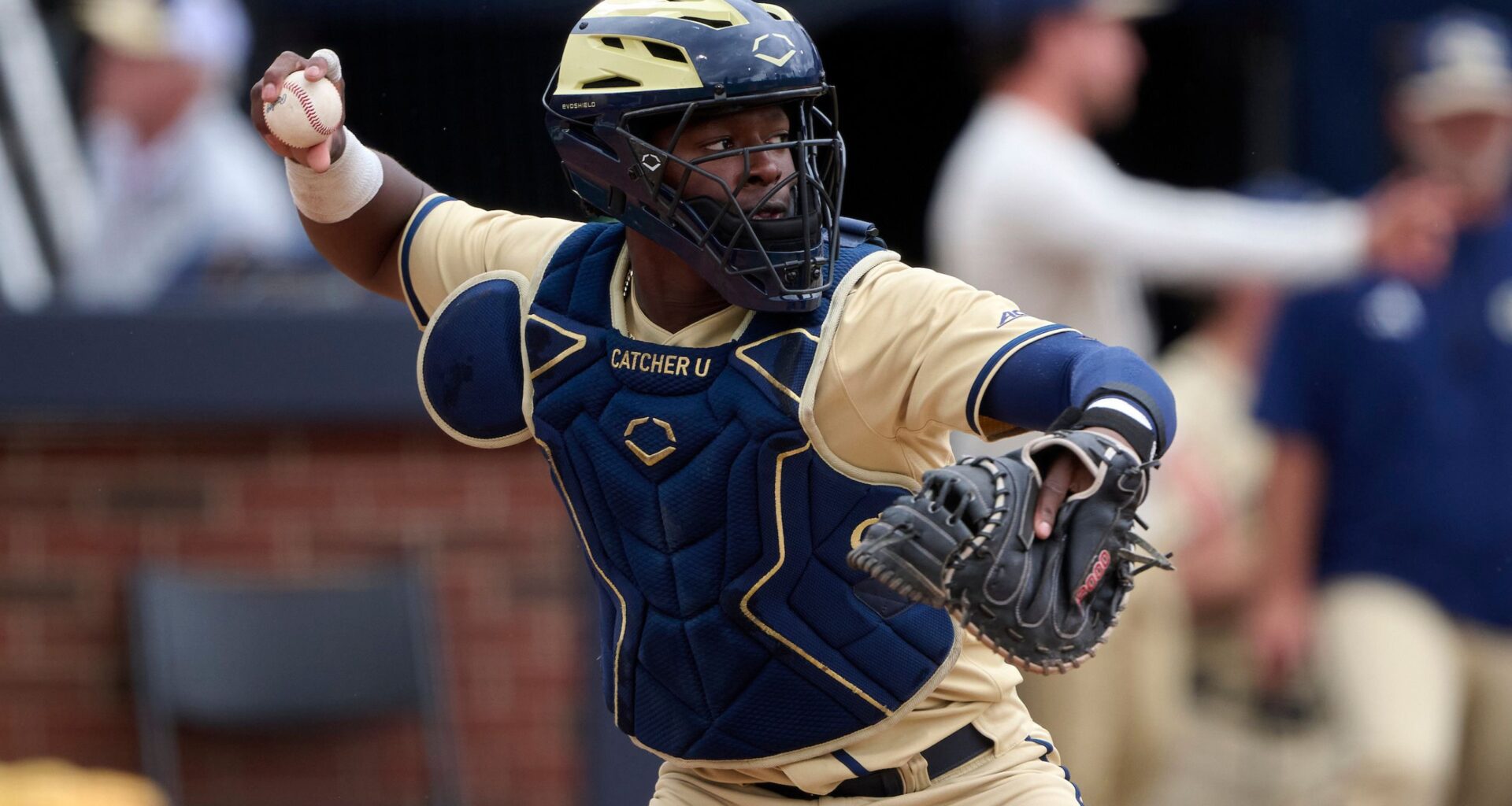
Welcome back to our Scouting 101 series for the 2026 draft class. In this series, we’ll examine some of the top players in the class by getting into the weeds with video, data and reporting as we prepare for the 2026 draft. You can find all of our previous Scouting 101 installments here. Today, we’re checking out Georgia Tech catcher Vahn Lackey, the latest in the program’s long history of prominent catching prospects and a significant first-round riser.
Lackey was an unheralded high school recruit coming out of Collins Hill High in Suwanee, Ga., but after two solid years at Georgia Tech, he put himself into first-round territory to begin his 2026 junior season. His reputation entering the year was as an excellent athlete and glove-first catcher who had strong contact skills to build on, but power and impact questions that had him sitting on the first-round fringe.
Six weeks into the season, Lackey has answered those questions emphatically, and perhaps no other first-round hopeful has as much helium as he does. He is hitting .425/.545/.851 with nine home runs in 24 games (already a single-season best) and looks like a lock to join a Georgia Tech catching club that already features four top 15 draft picks.
Body & Swing
Like most top-ranked collegiate catchers, Lackey has a strong and powerful frame. He was a huskier player in his early days but has done a nice job leaning out and adding strength to his frame throughout his college years. He’s now listed at 6-foot-2, 215 pounds with long legs and broad shoulders.
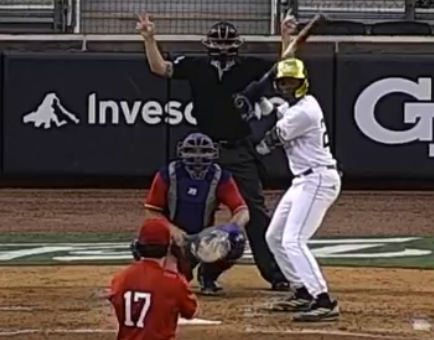
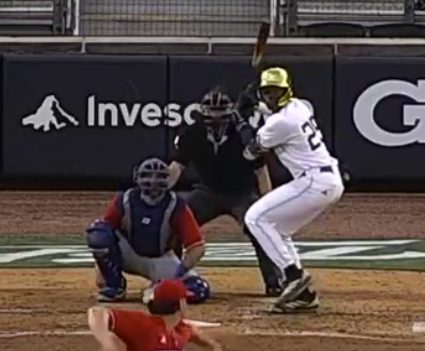
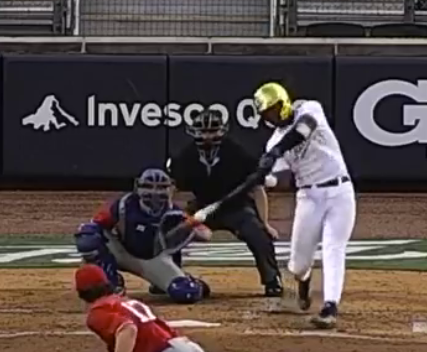
In the righthanded batter’s box, Lackey employs a slightly crouched and even stance. He’s relaxed with solid rhythm and has a soft bat waggle with his hands at chin height in his pre-pitch setup before taking a standard hand load to get going. His lower half is fairly simple with a small leg kick and standard stride.
The movement and rhythm in Lackey’s swing so far in the 2026 season are different from what he showed previously. This spring, there’s more life in his hands. Last summer and during the 2025 season, Lackey was much more still in his batting stance. He kept his barrel rested on his shoulder and employed a slight barrel tip in his load before firing his hands, and the direction of his leg kick was a bit different, as well.
Pre-pitch:
Point of deepest leg lift:
Point of contact:
Approach & Contact
Contact skills were the defining trait of Lackey’s offensive profile prior to the 2026 season.
After hitting .214 in 33 games as a freshman in 2024, Lackey led Georgia Tech with 77 hits and hit .347 in a breakout 2025 sophomore campaign. In his college career, he has managed an 84% overall contact rate, a 91% in-zone contact rate, a 90% contact rate vs. fastballs and a 77% contact rate vs. secondaries.
Those career contact rates are similar to what he’s managed so far in the 2026 season, even with some of the power gains he’s shown (which we’ll get to shortly).
Lackey has never struck out at a high clip. The 17.5% strikeout rate he posted as a freshman is the worst of his career, and he’s steadily brought that mark down year-over-year.
He amplifies his bat-to-ball skills with impressive patience and a solid batting eye that makes him difficult to strike out and leads to solid on-base value. Lackey has swung the bat less than 40% of the time throughout his college career, and he’s been even more patient so far in 2026, with a 34% overall swing rate. That patience can border on passivity at times, and letting too many balls go by in the heart of the zone is something that could continue to be a point of emphasis for him.
Power
The singular reason for Lackey’s up-arrow trajectory this spring is because of his power. It was the No. 1 to-do list item for him entering the spring and the lone significant question mark of his profile.
There were hints of what was coming during his sophomore season. He lowered his groundball rate significantly—from 56.9% in 2024 to 46% in 2025— and his 90th percentile exit velocity was also 3 mph better. While that led to many more extra-base hits, Lackey still hit just six home runs in 60 games last year.
He flew through that mark in 2026 with nine home runs in his first 19 games. His current .851 slugging percentage would shatter his previous single-season best (.500) if he can maintain it throughout conference play and into the postseason.
𝐕𝐀𝐇𝐍!!!!!!! HIS 7TH HOMER OF THE SEASON!
He’s a single shy of the cycle and has played six different positions in the field!
389 ft / 107 EV / 20 degrees
📺 ACCNX#StingEm🐝 x #WreckHavoc pic.twitter.com/5b5lZ48zZ1
— Georgia Tech Baseball (@GTBaseball) March 10, 2026
Lackey doesn’t have exceptional bat speed, but he is strong and can homer to all fields with a batted-ball profile that continues to improve. A majority of his home runs have gone to center field and the pull side in left, but he has shot a pair of homers to the opposite field in right, too.
Below is a table that shows the progression of Lackey’s batted-ball data throughout his college career.
YEARAVG EV90TH EVMAX EVBARREL%HH LAAIRPULL%202487.1102.7107.321.4%17.830.8%202589.4105.2112.717.4%8.936.4%202692.3106.5110.930.0%17.344.4%
Lackey is hitting the ball harder than he ever has before, and his hardest-hit balls are also more frequently being put into the air and towards the pull side. He’s done all of that without losing any of the excellent contact quality that made him a solid pure hitter in previous seasons.
Put it all together, and you’re looking at a career year.
Speed
For many positions, speed is the tool seen as least valuable. And for catchers, it can be almost disregarded entirely. The range component of catching is essentially being able to block well laterally. And unless you’re named JT Realmuto (or 2025 Cal Raleigh), stealing bases could be as much of a detriment as a benefit for catchers given the grind their bodies are already going through behind the plate.
Lackey is unique in this capacity, because he’s an excellent runner for a catcher and someone who can turn in above-average or even plus run times while underway. He takes a few steps to get going, and his running form isn’t the most smooth, but he moves shockingly well for his size.
Teams tend to project down on catchers’ run tools because of the toll the position puts on their legs, but if Lackey didn’t catch and became a legitimate 55-grade runner, that wouldn’t be shocking—though a 50-grade or 45-grade run tool in the long run might be more likely.
He’s been an excellent baserunner in his college career. He stole 18 bags as a sophomore and so far has gone 26-for-29 (89.7%) across all three seasons.
Fielding & Arm
Lackey’s offensive exploits might be getting most of the headlines, but his best tools are, without question, his defensive ones behind the plate. Many scouts view him as the best defensive catcher in this class, and many teams believe he’s one of the best defensive players available overall.
He’s a tremendous athlete with excellent hands, actions and a plus arm strength. He’s the sort of receiver who should be able to steal plenty of strikes in all areas around the zone. His hands are quick, snappy and confident.
Like nearly all catchers these days, Lackey works from a one-knee-down setup, and he does a tremendous job moving from that position with an enviable ability to get side-to-side and block. In addition to moving well and getting in front of the baseball in the dirt, Lackey also does a nice job smothering and centering his blocks, which allows him to get into throwing position quickly when necessary.
He simply looks like the sort of catcher that pitchers dream of having behind the plate.
Lackey’s plus arm strength ties together his defensive tools nicely, though his 25.6% career caught stealing rate (22-for-86) perhaps sells this tool short. He has solid power and accuracy with his throws and routinely turns in pop times in the 1.85-1.95 second range. He also does a lot of the finer details at a high level. His exchange is quick, he does a nice job with his footwork to get in good positions to throw and he also showcases unusually strong slot versatility for a catcher.
On top of all the physical tools, scouts see a catcher who has the work ethic and desire to play the position with the energy and want-to that separates the good from the great.
If catching doesn’t work out—and that would be surprising—Lackey is the sort of athlete who could play a number of other positions. Georgia Tech coach James Ramsey came into the season intending to play Lackey at all non-pitching positions in a single game to showcase his defensive versatility and did just that on March 10.
In Summary
Now that Lackey’s power is starting to show up with more frequency, it’s hard to find a real knock on his profile.
Because of that, he’s vaulting up draft boards. Teams picking in the teens, who perhaps entered the season with his name circled, are starting to wonder whether they’ll even have a chance to consider him with their top pick.
He’s an outlier athlete with proven contact skills, emerging power and a swing that looks more connected, synced up and loose than it has in previous years. Add that to a defensive package that could allow him to stick at—and excel at—the most difficult position on the diamond, and no one will be surprised if he goes within the first five picks on draft day.
Back in 1994, Jason Varitek was drafted 14th overall out of Georgia Tech. In 2007, it was Matt Wieters at fifth overall. In 2018, Joey Bart went second overall. A few years later in 2022, Kevin Parada went 11th overall.
Georgia Tech claims “Catcher U” for a reason. Lackey looks to be the latest example of why that’s so.